Short answer
To offer gambling to players in Romania you need an ONJN Class 1 license (10 years) and an annual operating authorization. The applicant must be a Romanian company or an EU/EEA/Swiss entity with a Romanian permanent establishment. Online, the fixed cost is €1,280,000 a year, and with the guarantee year 1 commits €3,294,000 (betting/poker/bingo) or €6,294,000 (online casino). ONJN decides within 30 days of a complete file; plan 6–9 months to go-live.
Who needs a Romania Class 1 license?
Anyone offering games of chance to players located in Romania, wherever the group is headquartered:
| Vertical | License | Notes |
|---|---|---|
| Online casino (slots, RNG tables, live casino) | Class 1 + authorization | €5,000,000 guarantee |
| Online sports betting (fixed-odds, pool) | Class 1 + authorization | €2,000,000 guarantee |
| Online poker and bingo | Class 1 + authorization | €2,000,000 guarantee |
| Land-based casinos, betting shops, slot halls, bingo and poker clubs | Class 1 + per-venue authorizations | Land-based fee schedule; on-site inspection before approval |
| Lottery | Class 3 — state monopoly | Not available to private operators |
Suppliers do not need Class 1. Studios, platforms, PSPs, hosting, test labs and affiliates need a Class 2 (B2B) license at €20,000 a year — and you may only contract Class 2-licensed suppliers.
Romania Class 1 fees and costs (2026)
Every category, from land-based betting, casinos and slot machines to guarantees and local authorization, is compared in our analysis of gambling taxes in Romania in 2026. To compare Romania across all 23 jurisdictions we cover, see starting an online casino in 2027. Sector turnover, tax receipts and 2027 scenarios are in our Romania gambling market in 2026 analysis. What the €500,000 responsible-gambling contribution pays for, and what it does not: Romania's responsible gambling rules.
| Charge | Amount | When | Set by |
|---|---|---|---|
| File-analysis fee | €3,500 | On submission, non-refundable | Annex (OUG 82/2023) |
| License issuance fee | €10,500 | On grant | Annex (OUG 82/2023) |
| Annual license fee | €300,000 | Yearly, 10-year term | Law 141/2025 |
| Authorization fee | 30% GGR, min €480,000 | Yearly | Law 141/2025 (was 21% / €400,000) |
| Responsible-gambling contribution | €500,000 | Yearly (85% state budget / 15% ONJN) | art. 10(5¹) |
| Advertising contribution | 5% | Of advertising contract value | OUG 77/2009 |
| Fixed annual floor | €1,280,000 | Due even with zero GGR | |
| Year-1 cash outlay | €1,294,000 | Floor + one-off fees, before the guarantee | |
Then budget the non-statutory side: laboratory certification, mirror/safety server hosting and the ONJN data feed, AML and KYC tooling, a Romanian director and reporting. We quote those per project.
What the 30% really costs you
Slide to your expected annual GGR from Romanian players. Statutory charges only.
Excludes 16% corporate income tax, VAT, winnings withholding (borne by players), suppliers and the guarantee.
Financial guarantee and share capital
Setting up the licensee: Romania company formation for a Class 1 license.
- Guarantee — online casino
- €5,000,000 (art. 29)
- Guarantee — other online
- €2,000,000 — betting, poker, bingo
- Form
- Bank guarantee or EU/EEA/Swiss insurance policy
- Timing
- In place before filing; kept for the license term
- Share capital — remote gambling
- RON 1,000,000, cumulative per activity
Until end-2024 the guarantee was tiered by revenue; the fixed amounts apply from 2025. Full per-activity capital schedule: Romania overview.
The 12-step route to a live Class 1 operation
Steps 1–6 build the Romanian footprint and compliance stack, 7–10 secure the license, 11–12 secure the authorization and go live.
- Before filing
Confirm eligibility and structure the entity
Romanian SRL/SA, or an EU/EEA/Swiss entity that will register a Romanian permanent establishment. Clear every shareholder, UBO and director through fit-and-proper screening first — a refusal stays on the record.
- Weeks 1–3
Register the permanent establishment
An EU/EEA/Swiss applicant tax-registers its Romanian permanent establishment (art. 8 Fiscal Code), with its own fiscal code; a Romanian SRL/SA incorporates and capitalizes instead. This is the pivot of the OUG 82/2023 reform.
- Weeks 2–6
Contract Class 2-licensed suppliers
Platform, payments, management services and every game studio must hold an ONJN Class 2 license. Check each supplier on the ONJN register before signing — pending supplier licenses delay your file.
- Weeks 3–8
Certify games and platform
An ONJN Class 2-licensed conformity body accredited to ISO 17025 or 17020 certifies the RNG, games and platform; each game shows at least 85% payout on its certificate.
- Weeks 3–8
Stand up the mirror and safety servers
Game, mirror and safety servers interact in real time; the mirror and safety servers sit at ONJN premises or a location ONJN names (HG 111/2016). Scope this in week 1, not week 10.
- Weeks 4–8
Build AML and RG frameworks
AML/CDD/KYC under Law 129/2019 and ONJN Order 370/2021, a designated reporting person, responsible-gambling and minor-protection measures, and self-exclusion handling under Order 79/2025.
- Before filing
Post the financial guarantee
€5,000,000 online casino or €2,000,000 other online gambling, as a bank guarantee or EU/EEA/Swiss insurance guarantee (art. 29).
- Weeks 6–8
Assemble the dossier, pay the analysis fee
Corporate, fit-and-proper, financial, technical and compliance files (HG 111/2016 Annex 6a), in Romanian or certified translation. €3,500 file-analysis fee on submission.
- Week 8–9
File the Class 1 application
Standard-form request in Romanian signed by the legal representative. The Supervisory Committee decides within 30 days of a complete file; ONJN may ask for documents beyond the list.
- ~Week 12
Obtain the license, pay license charges
€10,500 issuance fee and €300,000 annual license fee. Valid 10 years — but it does not yet let you operate.
- Weeks 12–16
Obtain the operating authorization
File the operation dossier and settle the authorization fee (30% of GGR, minimum €480,000) and the €500,000 RG contribution.
- Ongoing
Go live and run compliance
Withhold winnings tax at source, keep advertising within the rules, report to ONJN and ONPCSB, keep records five years, pay 16% CIT, renew the authorization every year.
Class 1 dossier checklist
Romanian or certified translation, apostilled where required, dated within 90 days where the document type allows. ONJN may request more.
1. Corporate establishment
- Trade-registry certificate and certificat constatator of the Romanian SRL/SA, or registration of the EU/EEA/Swiss entity’s Romanian permanent establishment
- Articles of association (current), shareholder and director registers
- Full ownership chain to the UBO, including nominees, trusts or foundations; group structure chart
- Evidence of paid-up share capital — RON 1,000,000 for remote gambling, cumulative with other activities
- Board/shareholder resolution approving the Class 1 application
2. Fit and proper (HG 111/2016 Annex 6a)
- Certified ID for administrators, legal representatives and every holder of 5% or more
- Police clearance and criminal-record certificates from each jurisdiction of residence
- Tax-clearance (fiscal record) certificates
- Self-declarations on beneficial owners (Law 656/2002 as replaced by Law 129/2019), incompatibility and bankruptcy history
- CVs showing sector experience
3. Financial
- Financial guarantee instrument — €2,000,000 or €5,000,000
- Financial statements or opening balance; group accounts where available
- Business plan with projections reconciled to source of funds
- Romanian bank account for player funds; ONJN-licensed payment processor
- Proof of payment of the €3,500 file-analysis fee
4. Technical
- Full system certification by an ONJN-licensed, ISO 17025/17020 accredited body (RNG, games, platform)
- Game list with a certificate reference per title (min. 85% payout)
- Mirror and safety server configuration with the ONJN data connection
- Supplier list with each supplier’s Class 2 license number
- ORDA registration for proprietary software; domain list
5. Compliance and player protection
- AML/CFT program under Law 129/2019 and Order 370/2021, designated person named
- KYC: identity verified within 30 days of registration; max. €200 deposits before verification; no withdrawals until verified (HG 111/2016 art. 129)
- Responsible-gambling policy, minor blocking (18+), self-exclusion handling per Order 79/2025
- Advertising compliance position, player T&Cs, complaints procedure
Technical requirements
- Games and platform certified by an ONJN Class 2-licensed body accredited to ISO 17025 or 17020; minimum 85% payout per game.
- Game server, mirror server and safety server interacting in real time; mirror and safety servers at ONJN premises or a location it names (HG 111/2016).
- Only Class 2-licensed suppliers for platform, payment and management services.
- Control and accounting records and game rules kept five years and produced on demand; ONJN may order technical or financial audits at any time.
Operator taxes and player-winnings withholding
- Authorization fee
- 30% GGR, min €480,000
- License fee
- €300,000 / year
- RG contribution
- €500,000 / year
- Corporate income tax
- 16%, on top
- Advertising
- 5% of contract value
| Band | Tax |
|---|---|
| Up to RON 10,000 | 4% of the amount |
| RON 10,000 – 66,750 | RON 400 + 20% of the part over RON 10,000 |
| Over RON 66,750 | RON 11,750 + 40% of the part over RON 66,750 |
The operator withholds at each transfer from the game account to a bank account; players do not self-report. Sports-betting winnings are taxed from the first leu; casino, poker, slot and scratch-card winnings are non-taxable up to RON 66,750 per payout (Fiscal Code art. 110).
Advertising restrictions
- No unsolicited electronic marketing (art. 1²) and no advertising to self-excluded persons.
- No outdoor panels or materials over 35 m².
- No TV or radio gambling ads 06:00–23:00, except betting spots during live sport; no public, sporting or cultural figures or influencers (CNA Decision 573/2025 art. 109).
- Every ad shows 18+, the license series and number and the ONJN logo (HG 111/2016 art. 6(1)); no bonus or jackpot values outside gambling venues (art. 7(4)).
- Google Ads and X accept Romanian gambling ads only from holders of the ONJN license and authorization.
AML, KYC and responsible gambling
- Online operators are reporting entities under Law 129/2019; ONJN has been the sole gambling AML supervisor since May 2025.
- Suspicious transactions go to ONPCSB without delay; cash transactions of €10,000 or more within three working days (Order 370/2021).
- Players must be 18+. Identity verified within 30 days of registration; up to €200 may be deposited before that and withdrawals wait for verification (HG 111/2016 art. 129).
- Self-exclusion follows art. 15¹ OUG 77/2009 and Order 79/2025; check the scope that applies to your online stack with us before go-live.

Written and reviewed by Alex Szilaghi
Founder of Szilaghi Consulting. More than twenty years in gambling licensing and corporate structuring across EU, UK, Canadian and offshore jurisdictions, based in Romania and working before ONJN on Class 1 and Class 2 files. We act as Romanian representative and local director for foreign ONJN licensees and file their monthly regulatory reports, so these guides reflect how the rules are applied in practice, not only how they read.
Last legal review . Current to OUG 77/2009 as amended through Law 141/2025 and Law 239/2025. General information, not legal advice.
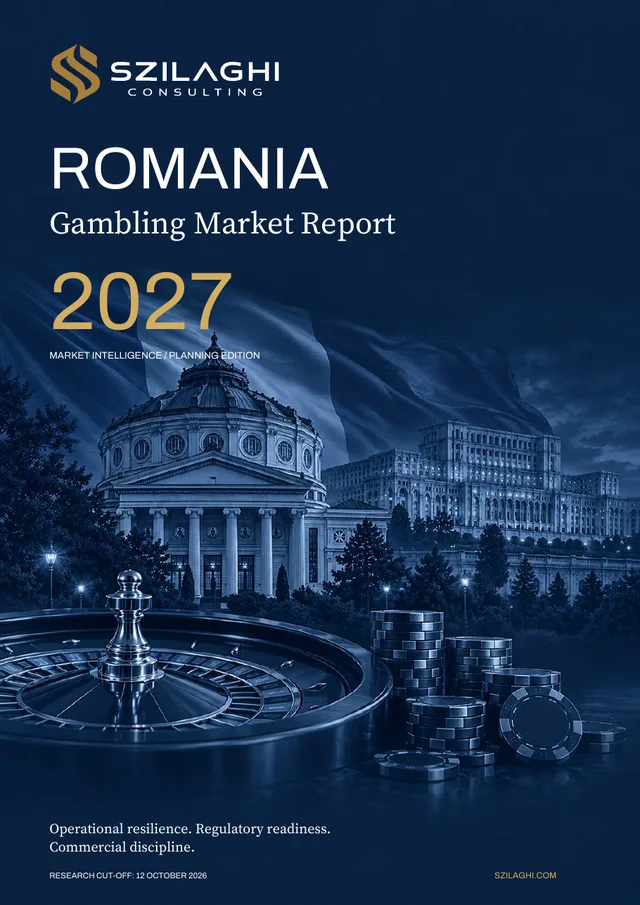
New: Romania Gambling Market Report 2027
Free 27-page planning report: 2027 revenue scenarios (base case RON 19.7 billion GGR), licensing economics, Class II operations, AML readiness and the operating agenda.
Download the 2027 reportInsights
Class 1 analysis and updates
Romania Class 1 (B2C) license — FAQs
How much does a Class 1 gambling license cost in Romania?
€3,500 file analysis and €10,500 issuance once; then €300,000 license fee, €500,000 responsible-gambling contribution and 30% of GGR (minimum €480,000) every year. The fixed floor is €1,280,000 a year. With the guarantee, year 1 commits €3,294,000 for betting, poker or bingo and €6,294,000 for online casino.
How long does it take to get an ONJN Class 1 license?
ONJN decides within 30 days of a complete file (art. 1(4) OUG 77/2009), and the decision usually lands around week 12 of a well-run project. Go-live takes 6–9 months because the laboratory certification, the mirror and safety servers and the guarantee instrument have their own lead times.
Do I need a separate authorization as well as the license?
Yes. The license (licența de organizare, 10 years) admits you as an operator; the operating authorization (autorizația de exploatare, 1 year) is the right to actually take bets and carries the 30% GGR fee. You cannot go live on the license alone.
Can an offshore company apply for a Romanian B2C license?
No. Since OUG 82/2023 the applicant must be a Romanian SRL/SA or an EU/EEA/Swiss entity with a registered Romanian permanent establishment. A Curaçao or Anjouan company cannot hold the license directly.
What guarantee do I need for an online casino license in Romania?
€5,000,000 for online casino and €2,000,000 for other online gambling (betting, poker, bingo), posted before filing as a bank guarantee or an insurance guarantee from an EU/EEA/Swiss insurer (art. 29 OUG 77/2009) and kept for the life of the license.
How are player winnings taxed in Romania?
The operator withholds tax at source on each withdrawal: 4% up to RON 10,000; RON 400 + 20% between RON 10,000 and 66,750; RON 11,750 + 40% above RON 66,750 (Fiscal Code art. 110, as amended by Law 141/2025). Sports-betting winnings are taxed from the first leu.
Can I use unlicensed suppliers or game studios?
No. A Class 1 operator may contract only ONJN Class 2-licensed suppliers for platform, games, payments and management services. Missing supplier licenses are the most common gap in first submissions — see the Class 2 guide.
What are the gambling advertising rules in Romania?
No unsolicited electronic marketing; nothing to self-excluded players; no outdoor panels over 35 m²; no TV or radio gambling ads 06:00–23:00 except betting spots in live sport; no public figures or influencers (CNA Decision 573/2025 art. 109); every ad shows 18+, the license series and number and the ONJN logo (HG 111/2016 art. 6(1)). A 5% contribution applies to the value of advertising contracts.
Is the Romanian B2C license worth it in 2026?
If Romania is a core market and you can clear €1,600,000 GGR, yes: real enforcement (2,881 blacklisted domains), a mature supplier ecosystem and an EU regulator on your file. Below that, the €480,000 minimum makes your effective rate higher than 30% — validate offshore first.
Sources
Every statutory figure on this page was checked against the instrument that sets it on 8 October 2026. The consolidated text of OUG 77/2009 on the Romanian Legislative Portal is informative, not official, so each figure is also cited to the act that currently sets it. Statutory fees and thresholds change — confirm before you commit capital.
- OUG 77/2009 — consolidated, Romanian Legislative Portal
- Amendment chain for OUG 77/2009 — Chamber of Deputies
- OUG 82/2023 — Monitorul Oficial Part I no. 905/2023
- Law 107/2024 — Monitorul Oficial Part I no. 370/2024
- Law 141/2025 — Monitorul Oficial Part I no. 699/2025
- HG 111/2016 — methodological norms
- Law 129/2019 — AML/CFT
- ONJN Order 79/2025 — self-exclusion procedure
- ONJN — Class I licensees register
- ONJN — Class II licensees register
- ONJN — blacklist of unauthorized domains
- ONJN — license and authorization forms
Model the 30% before you commit
We pre-screen your ownership chain, size the guarantee and share capital for your activity set, and run the authorization-fee break-even against your margins — before a single euro of the €1,280,000 floor is at risk.
Request a Class 1 feasibility review