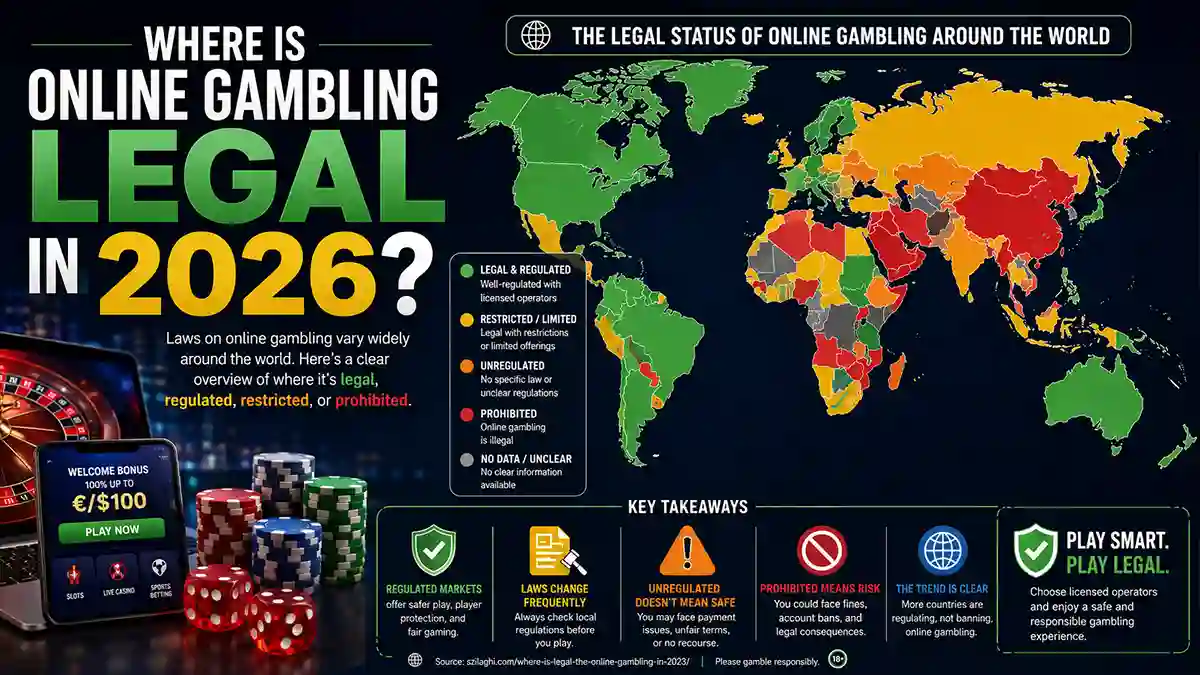
The map most operators are still using to decide where to launch is wrong. Not slightly dated — wrong. Brazil, the market half the industry spent 2023 treating as a “we’ll deal with it later” grey zone, licensed roughly 80 operators, ring-fenced them behind a mandatory .bet.br domain, and started blocking everyone else at the payment rail. The country flipped from tolerated to enforced in a single January.
If you run an iGaming business, you already feel this. The old game was simple: find a jurisdiction that didn’t actively block you, license somewhere cheap, and point traffic wherever the money was. That game is closing. Every year, another few countries stop looking the other way, and the “offshore-friendly” gaps you built a business plan around quietly seal shut. The market is worth roughly USD 88 billion in 2025 and pushing toward USD 98 billion in 2026, and governments have noticed exactly how much tax they were leaving on the table.
Get the jurisdiction call right and you build on ground that won’t move under you — predictable tax, bankable licensing, payment providers who’ll actually work with you. Get it wrong and you’re rebuilding your entire stack eighteen months in, mid-enforcement, while a regulator you underestimated freezes your settlements. This piece is the corrected map: which countries sit in which regulatory tier as of 2026, which ones just changed, and how to read the direction of travel before it costs you.
What You Will Learn
- The four regulatory tiers every market falls into — and why the lines between them are blurring fast.
- The three jurisdictions that flipped hardest since 2023 (Brazil, Curaçao, Finland) and what each one signals.
- Why the “license offshore, operate anywhere” model is running out of road — and what’s replacing it.
- A practical filter for choosing a jurisdiction that won’t strand you when the rules tighten.
The picture in 2026, minus the hype
Start with the number, because the number drives everything else. The global online gambling market sat at about USD 88 billion in 2025 and is on track for roughly USD 98 billion in 2026, growing at around 11% a year. Europe still takes the largest slice, close to half the global total, and mobile now accounts for the clear majority of play.
That growth is the whole story behind the regulatory shift. When a market gets that big, governments stop treating it as a vice to tolerate and start treating it as a revenue base to tax. The 2022 version of this article talked up VR headsets and virtual casinos as “the next revolution.” They weren’t. Three years on, nobody’s putting on a headset to play blackjack. The actual revolution was boring and enormous: smartphones, instant payments, and — above all — regulation catching up to reality. That’s the trend that reshaped the map, not the gimmick everyone was writing about.
So here’s the framework, kept from the original because it still works, but with the placements corrected and one warning attached: these tiers are converging. Countries are steadily migrating from the loose end toward the regulated end. A jurisdiction that tolerates offshore play today may license and enforce tomorrow. Treat the categories as a snapshot, not a constitution.
Tier 1 — Offshore operators aren’t blocked (but “not blocked” isn’t “legal”)
These are markets where local authorities don’t apply their licensing regime to offshore sites. An operator licensed elsewhere can usually reach these players without a local permit, either because enforcement is weak or because the state hasn’t built the machinery to stop it.
| Continent | Representative countries |
| Africa | Eritrea, Nigeria |
| Asia | Azerbaijan, Brunei, Hong Kong, Japan, Kyrgyzstan, Laos, Malaysia, Qatar, Singapore, Uzbekistan |
| Europe | Bosnia & Herzegovina, Iceland, Luxembourg, Serbia, Slovakia |
| North America | Cayman Islands, Mexico |
| Oceania | American Samoa, Guam, New Zealand |
The trap here is reading tolerance as permission. Play in these markets is frequently not legal in any positive sense — it’s simply not policed at the offshore level yet. That “yet” is doing heavy lifting. Note what’s missing from this list compared to three years ago: Brazil. It graduated. Which brings us to the single most important change on the whole map.
Case study: Brazil, the market that stopped being grey
Through 2023 and into 2024, Brazil was the textbook Tier 1 market — a vast, betting-mad population served almost entirely by offshore sites the government couldn’t quite bring itself to shut down. Then Law 14,790/2023 landed, and on 1 January 2025 the regulated market went live under the Secretariat of Prizes and Bets (SPA).
The transformation was fast and total. Fourteen operators launched on day one; by late 2025 more than 80 held federal authorization. Licensed sites must run on a .bet.br domain — anything else gets blocked at the telecom and banking level. Players complete facial-recognition KYC and route money through Central Bank-authorized accounts. Operators pay 12% on gross gaming revenue, and foreign companies can’t hold a license directly — they need a local entity with 20% Brazilian ownership. Roughly 25 million Brazilians bet on licensed platforms in the first year.
The lesson isn’t “Brazil is now regulated.” It’s the speed. A market can go from open borders to hard enforcement in the time it takes to run a single marketing campaign. If your 2026 plan assumes a grey market will stay grey, Brazil is your warning.
Tier 2 — Local license required, no exceptions
These are the mature regulated markets. Wherever you’re based, if you want to serve these players legally you obtain a local license, meet the conditions, and pay local tax. Operate without one and you’re blocked, fined, or both.
| Continent | Representative countries |
| Europe | Austria, Belgium, Bulgaria, Croatia, Denmark, Estonia, France, Germany, Italy, Netherlands, Poland, Romania, Spain, Sweden, UK |
| Americas | Brazil, several US states, Panama, Antigua & Barbuda |
| Asia | Georgia, Sri Lanka |
This is the tier everyone is drifting toward. It’s more expensive and slower to enter, and that’s precisely the point — the compliance cost is the moat. Germany’s Joint Gambling Authority (GGL) now runs a unified regime across the states. The Netherlands operates under KOA. Sweden has been licensed since 2019, and Brazil now belongs here, not in Tier 1. The barrier to entry is real, but so is the stability: you’re building on rules that won’t be rewritten out from under you every budget cycle.
Tier 3 — Locals need a license, offshore is tolerated
A hybrid. Domestic operators must be licensed and taxed, but the state doesn’t extend that requirement to offshore sites — either by choice or by capacity. This is the classic monopoly-plus-leakage setup, and it’s the least stable of the four tiers because it’s usually a transition state, not a destination.
| Continent | Representative countries |
| Europe | Greece, Hungary, Ireland, Latvia, Lithuania, Moldova, Monaco, Montenegro, Norway, Portugal, San Marino, Slovenia, Switzerland |
| Africa | Gambia, Mauritius, Rwanda, Seychelles |
| Americas | Canada (federal), Curaçao, Dominican Republic, Belize |
Finland is the market to watch here, and it’s leaving this tier as you read. After decades of the Veikkaus monopoly bleeding roughly half its online spend to offshore sites, Finland’s parliament approved a new Gambling Act in December 2025. B2C license applications opened on 1 March 2026, and the competitive market goes live around 1 July 2027, supervised by a new national authority with a 22% GGR tax. Veikkaus keeps lotteries and land-based; everything else opens up. Finland is doing exactly what Denmark and Sweden did before it — converting leakage into licensed, taxed revenue. Ireland is on a parallel track, having stood up its new regulator, the GRAI, under the Gambling Regulation Act 2024.
When a Tier 3 market gets serious about channelization, it becomes Tier 2. Build your entry strategy around where it’s heading, not where it sits today.
Szilaghi Consulting offers licenses for legal operation in various markets and assists clients in obtaining gambling licenses from Curacao, Malta, the Isle of Man, Kahnawake, Gibraltar, and Estonia.
Tier 4 — No meaningful restrictions
The largest group by headcount: countries with no functioning licensing framework and no coordinated blocking. Much of Africa, chunks of Latin America, and many small island states fall here.
| Continent | Representative countries |
| Africa | Angola, Botswana, Cameroon, Egypt, Ghana, Kenya, Morocco, Mozambique, Senegal, Tanzania, Tunisia, Uganda, Zambia |
| Americas | Argentina (federal level), Bolivia, Chile, Ecuador, Guatemala, Honduras, Jamaica, Nicaragua, Peru |
| Europe | Albania, Andorra, Belarus, Kosovo, Liechtenstein |
| Oceania | Papua New Guinea, Samoa, Solomon Islands, Tonga |
Two cautions. First, “unregulated” and “safe to operate in” are not the same sentence — no framework also means no legal protection, unpredictable enforcement if politics shift, and banking that can vanish overnight. Second, several of these are on the launch pad. Argentina regulates province by province and is tightening steadily; Peru and Chile have both moved on formal frameworks. Tier 4 is where tomorrow’s Tier 2 markets are incubating.
The licensing side just changed too: what happened to Curaçao
For twenty-odd years, Curaçao was the answer to “where do I license cheaply?” Four private master-license holders sold thousands of sub-licenses with almost no oversight. That era is over.
The National Ordinance on Games of Chance — the LOK — came into force on 24 December 2024. Legacy sub-licenses expired in early 2025, and every operator now applies directly to the new Curaçao Gaming Authority (CGA) for a B2C or B2B license. Full UBO disclosure is mandatory. Annual fees run near €47,000 for B2C and €24,000 for B2B, with AML rules and dispute-resolution mechanisms now baked in, and local-presence requirements phasing in toward the end of the decade. Some operators transitioned, some migrated to Malta, Estonia, Anjouan, or Vanuatu, and some drifted into a grey zone the CGA is actively pursuing.
Curaçao is still viable and still cost-effective relative to Malta or the Isle of Man. But the “rubber-stamp in a fortnight” pitch is dead. If a service provider is still selling you the old version, they haven’t read the law — and that tells you something about them.
How to actually choose
Strip away the noise and a jurisdiction decision comes down to four questions, asked in this order:
Where are your players, legally? Not where the traffic is cheap — where you can serve them without an enforcement risk that ends the business. A regulated market you can enter beats a grey one you’ll get evicted from.
What’s the direction of travel? A Tier 3 or Tier 4 market tightening toward regulation is a different bet than one sitting still. You want to arrive as the door opens, licensed and ready, not scrambling once it’s shut.
Can you bank it? Payment access quietly kills more operators than regulators do. A license that no serious PSP or bank recognizes is a certificate, not a business.
Does the substance requirement fit you? Local ownership rules (Brazil), local presence (Curaçao’s phase-in, most Tier 2 markets), real staff on the ground — these are now standard, not exotic. Price them in before you commit, not after.
Conclusion
The single most valuable thing to internalize about the 2026 map is that it’s moving in one direction only. Countries go from loose to regulated — almost never the reverse. Brazil did it in a year. Finland is mid-transition. Curaçao rewrote its entire licensing model. The grey-market gaps that a lot of business plans still quietly depend on are closing one jurisdiction at a time, and the ones that remain open are open temporarily.
So stop optimizing for where you can slip through today. Build for where the enforcement line will sit in three years, because that’s the horizon your license, your banking, and your compliance stack actually operate on. The operators who’ll still be standing in 2029 are the ones treating regulation as the moat rather than the obstacle — entering markets early, licensing properly, and pricing in substance from day one. The cheap, frictionless jurisdiction is a short-term rental. The regulated one is the address you can actually build on. Pick accordingly, and verify current status before you sign anything — on this map, “last year” might as well be a different continent.
How can Szilaghi Consulting help you start your online gambling business?
Choosing a gambling licensing jurisdiction is quite difficult, to begin with. Given the sheer number of factors that need to be considered by gambling operators, the choice can be overwhelming.
Szilaghi Consulting has been providing services to the online and offline gambling industry for over 22 years. We have helped our clients to make the right choices, to realize their visions, to overcome obstacles, and, above all, to succeed. We offer transparency and efficiency and we are committed to always acting only in your interest.
Our experience in obtaining online and offline gambling licenses differentiates us from the competition. We cover all your needs, from the incorporation of the gambling company, the creation of fiscal and compliance structures, to obtaining the gambling license.
We invite you to schedule a consultation with us. We like to communicate with our customers, troubleshoot their problems, and offer solutions. We invite you to contact us today to discuss this with one of our agents. Let us help you take your business to the next level.