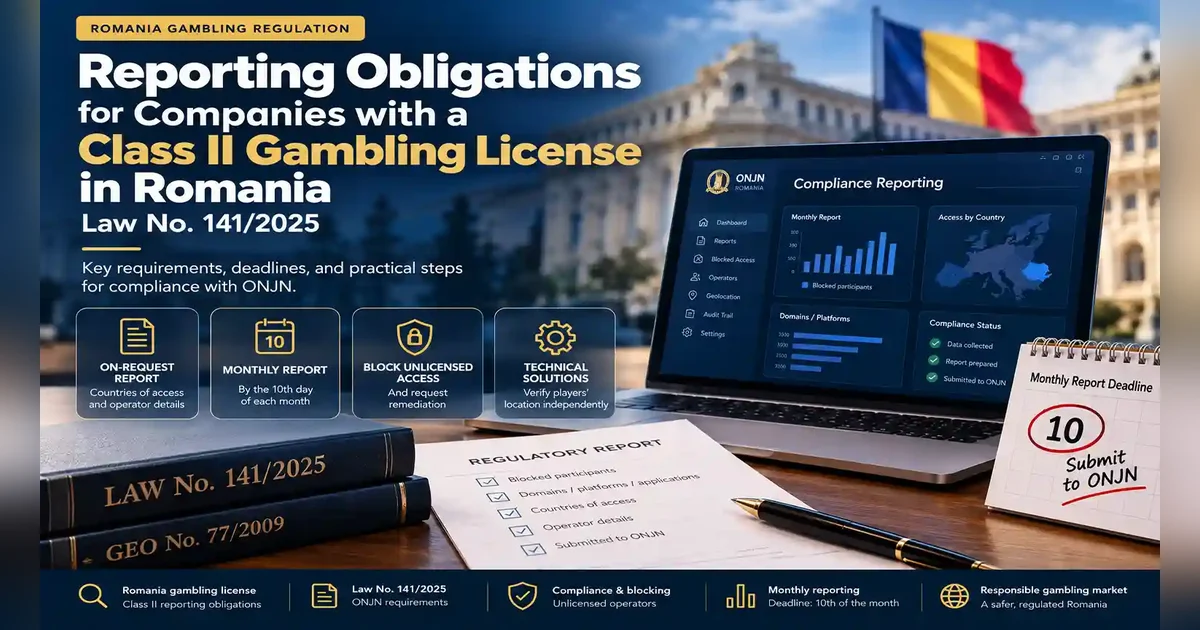
Since 28 July 2025, Romanian Class II licensees that build gambling software, host or manage gambling platforms, or process payments must report to ONJN on how players reach their systems. Law 141/2025 added these duties to OUG 77/2009 through article LXII and tied them to one goal: cutting off Romanian players’ access to operators without a Class I license.
The law creates two different reports. One must be ready whenever ONJN asks for it. The other is filed every month by the 10th. They have different contents and purposes, and neither is the operator’s gaming-revenue declaration or a general duty to disclose individual players. This guide reflects the legislation as amended up to 10 October 2026.
Which Class II licensees must report
The duties in art. 1(5⁶) and art. 1(5⁸) apply to the categories listed in art. 1(5⁵):
- production and distribution of specialized gambling software;
- management and hosting facilities on gambling platforms;
- payment processing.
They do not apply to every Class II licensee simply because it holds a Class 2 (B2B) license. Start by mapping the license categories you actually hold against these provisions. Labels such as “technology provider” or “gambling supplier” are too vague for this exercise. If your company holds several Class II licenses, assess each licensed activity separately rather than assuming your main business decides the whole question.
The report available on request
Art. 1(5⁶) requires the supplier to keep a report available for ONJN. It must contain:
- the countries from which players access the supplier’s own IT system; and
- the identifying details of the entities that, under the gambling contract, give gambling access to participants located in Romania and/or to Romanian citizens who are not tax-resident in another state.
Three practical points follow from the wording.
The country list is not limited to Romania. Your reporting design should capture geographic access across the whole system concerned, not just a yes-or-no flag for Romanian traffic.
The report identifies operators, not players. The paragraph asks for the entities giving gambling access, not a list of individual players. Distinguish the legal entity running the gambling service from its brands, websites and contractual intermediaries.
“On request” does not mean “assemble it after an inspection starts”. The law sets no monthly date for this report, but you should hold the underlying records in a form that lets you answer ONJN quickly and reliably.
The monthly report: deadline and contents
Under art. 1(5⁸), the supplier submits a consolidated report (situație centralizată) to ONJN by the 10th day of each month, inclusive, covering the previous month. It contains:
- the number of participants whose access was blocked under art. 1(5⁷); and
- the internet domains, gambling platforms and applications through which those participants accessed the supplier’s IT system.
This is narrower than a report of every access restriction. The reference to art. 1(5⁷) links it to one blocking duty, the one concerning unlicensed operators. It does not turn the report into a list of every account closure, fraud block or responsible-gambling intervention.
Keep those categories apart in your systems. A single “blocked accounts” figure can be accurate as an internal security metric and still be wrong for this regulatory purpose.
The law also counts participants, not rejected requests or blocked sessions. Document how you treat repeated attempts, multiple accounts and access through different interfaces. Where your data cannot produce an exact count, escalate the limitation internally and disclose it; do not hide it behind an unexplained aggregate.
Blocking, remediation and the December 2025 amendment
The monthly report records conduct the supplier must already have taken. Under art. 1(5⁷), whenever a covered supplier identifies an entity without a Class I license that allows gambling access from Romania, it must:
- block the participants’ access to its IT system; and
- immediately ask the unlicensed entity to remedy the situation.
Reporting does not replace intervention. The underlying rule, in force since April 2024, is that Class II suppliers may not serve operators without a Romanian Class I license.
The wording has changed once. Law 141/2025 originally extended the blocking provision to Romanian citizens not tax-resident elsewhere. Article XXXV of Law 239/2025 amended it with effect from 18 December 2025, so the blocking trigger now focuses on access from Romanian territory. The broader citizenship and tax-residence wording remains in the on-request report under art. 1(5⁶).
Do not assume the two reports have the same scope. Your procedures should separate the current blocking trigger from the information the on-request provision asks for. Where you are unsure how to obtain or classify citizenship and tax-residence data, settle it expressly with counsel and ONJN rather than through an undocumented assumption.
What if there are no reportable blocks?
Art. 1(5⁸) sets a recurring duty and contains no exemption for a month without reportable blocks. The prudent course is to file a nil report unless ONJN confirms that none is needed. This is a conservative reading, not a nil-return procedure written into the paragraph.
File a nil report only after a completed review. Internally, keep three outcomes distinct:
- monitoring ran and found no reportable events;
- the information was unavailable;
- the review was not performed.
Treating them as the same undermines the whole reporting process.
Building a reporting process that survives scrutiny
The law also requires covered suppliers (art. 1(5⁵)) to run technical solutions that determine players’ actual location within their own IT systems, independently of the location data the gambling platform passes through the integration. That independent geolocation is the foundation for both the blocking and the reporting duties.
An effective setup connects technical detection, contract data and regulatory reporting. The compliance team should be able to answer, for any event: which legal entity sits behind this interface, what evidence supports the location finding, whether a reportable block occurred, and how it entered the monthly report.
For each reportable incident, we recommend recording:
| Record | Why it matters |
|---|---|
| Detection date | Places the event in the right reporting month |
| Domain, platform or application | Required content of the monthly report |
| Operator concerned | Feeds the on-request report and remediation request |
| Evidence for the licensing assessment | Shows why the operator was treated as unlicensed |
| Blocking action taken | Proves the art. 1(5⁷) duty was met |
| Remediation request sent | Proves the “immediately request” step |
These are recommended audit-trail elements, not fields the monthly return expressly prescribes.
Review your contracts. Where an aggregator, platform operator or other intermediary controls information you need, add information-sharing, escalation and suspension clauses. A customer’s promise to comply with Romanian law does not replace your own assessment.
Assign ownership. Name who prepares, reviews and submits each report. Set an internal deadline before the 10th, keep evidence of submission, and have a correction procedure for errors found after filing. The full monthly calendar is in the deadlines and taxes that keep your license alive.
Significant-change notifications remain separate
Law 141/2025 did not replace the existing duty to notify significant changes. Under art. 12(2) OUG 77/2009, you notify ONJN within 48 hours when filing online, or within five working days from registration of the change when filing by post or at ONJN’s registry.
ONJN Order 33 of 18 March 2025 (in force 21 March 2025) lists the significant changes. They include changes to:
- beneficial-owner identification details;
- administrators, authorized representatives or shareholders and their identifying details;
- the registered office or permanent establishment;
- the company name;
- specified criminal-record information;
- share capital;
- contracts with ancillary-service providers;
- gambling equipment;
- withdrawal or revocation of police approvals held by directors, shareholders or the authorized representative.
Check which items apply to your business and license. Mentioning a corporate change in the next monthly blocking report does not satisfy this separate, much shorter deadline. Run notifications as their own workflow.
Sanctions: match the breach to the rule
Describe the consequences precisely, because they differ by obligation.
- Late significant-change notification. Art. 22(1) fines a breach of art. 12(2) at RON 20,000–40,000. Art. 22(1) does not list art. 1(5⁸), so do not apply that fine by analogy to a missed monthly report. Art. 22 and art. 25 were amended by Law 141/2025 and Law 239/2025; check the current consolidated text for the sanction specific to the art. 1 reports.
- False, refused or obstructed information. Art. 25 makes it a criminal offense to give false information to the authorities, refuse requested information, obstruct supervision, or give incomplete information in order to conceal the real facts. The general penalty is six months to two years’ imprisonment or a criminal fine.
- Supplying unlicensed operators. Art. 25 also covers prohibited supply to unlicensed gambling businesses, and art. 25(3) provides for revocation of the Class II license for the offense in art. 25(1)(m).
A late filing, a knowingly misleading report and continued prohibited supply are different legal situations with different consequences. Accurate reporting and a documented response to detected access are still your best protection against the far larger risk of a supply-ban breach and losing the license. The Romania gambling license guide sets out how the Class II regime fits with Class I and ONJN supervision as a whole.
Three workflows, three owners
For Class II suppliers covered by Law 141/2025, compliance is more than a monthly upload. It needs a process that detects relevant access, takes the required action, keeps reliable evidence and reports through the right channel.
Run three separate workflows, each with its own scope, owner, records and deadline:
- the report available on request (art. 1(5⁶));
- the monthly blocked-access report (art. 1(5⁸), by the 10th);
- significant-change notifications (art. 12(2), 48 hours or five working days).
Keeping them apart makes the system easier to run and easier to explain to ONJN. For the wider operating model (customer controls, contracts, fees and margins), see how a Class II supplier stays compliant and commercially viable after licensing.
We act as Romanian representative for foreign ONJN Class II licensees and prepare their monthly regulatory reports. If you need the reporting process set up or reviewed, see our Romanian representation and compliance services.
This article is general legal information, not advice on a specific company’s position. We did not find a published ONJN template or submission channel for the two art. 1 reports in public materials; confirm those administrative details with ONJN before filing.