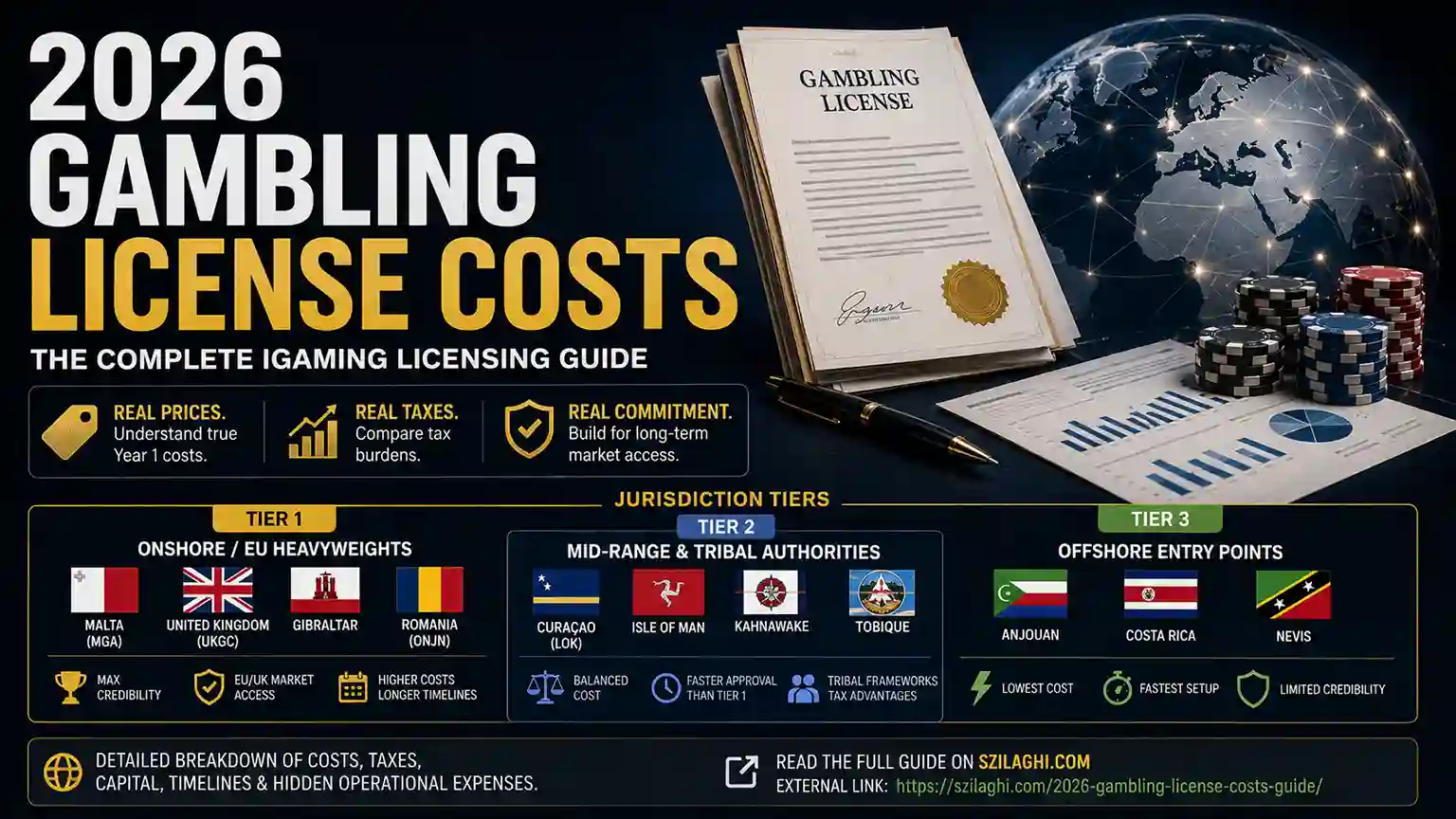
TL;DR: The cheapest gambling license is rarely the cheapest jurisdiction to operate from. In 2026, operators need to compare total Year 1 cost, GGR tax, capital requirements, banking access, compliance obligations and time-to-market — not simply the application fee.
- Tier 1: Malta, the UK, Gibraltar and Romania offer the strongest regulatory credibility and market access, but carry the highest compliance and capital costs.
- Tier 2: Curaçao, Isle of Man, Kahnawake and Tobique offer a middle ground between cost, speed and international credibility.
- Tier 3: Anjouan, Costa Rica and Nevis provide faster and generally cheaper market entry, but may create limitations around banking, payment processing and B2B counterparties.
- Fastest option: Anjouan can potentially reach licensing in weeks rather than months.
- Romania: Operators targeting Romanian players should budget around the 30% GGR authorization tax and its EUR 480,000 annual minimum, alongside capital and guarantee requirements.
- Planning a 2027 launch: see starting an online casino in 2027 for the 22 regimes compared, with changes already announced for 2027.
- Curaçao: The LOK regime has fundamentally changed the jurisdiction; the old master/sub-license model is gone and operators now deal with direct regulatory supervision.
- Best strategy: Choose the jurisdiction based on the markets you intend to serve and the counterparties you need to work with. Tax rate should be part of the decision — not the entire decision.
For most operators, the decisive question is not “Which gambling license is cheapest?” but “Which license gives this business the market access, banking and regulatory credibility it needs at a sustainable total cost?”
A gambling license is not a line item. It is a multi-year commitment that sets your market access, your tax base, your banking relationships, and your cost of capital for as long as you hold it. The headline application fee that appears in marketing material for any given jurisdiction is routinely 5–15% of what the license actually costs to hold through Year 1, once share capital, compliance infrastructure, AML/KYC tooling, key-person requirements, and local substance are added.
Three structural shifts define 2026 licensing decisions:
- Tax convergence at the top end. The UK’s remote gaming duty rose to 40% effective April 2026, and Romania’s online GGR tax reached 30% in August 2025 — both now sit closer to Malta’s effective burden than to the low-single-digit or zero-tax positions that defined “premium” jurisdictions a decade ago. Premium licensing is no longer a low-tax proposition; it is a market-access and counterparty-credibility proposition.
- Curaçao’s credibility repricing. The Landsverordening Op Kansspelen (LOK) framework replaced Curaçao’s old master/sub-license system in 2024. Fees rose several-fold, direct regulatory oversight replaced third-party master licensing, and the jurisdiction now sits meaningfully closer to Isle of Man in cost and closer to a real regulator in supervisory posture — but it is not a Tier 1 substitute, and payment processors and banks price it accordingly.
- New entrants at the low-cost end. Tobique (Canada, Neqotkuk/Tobique First Nation) launched its gaming framework in 2024 and is actively licensing operators in 2026 at a fraction of Kahnawake’s cost and timeline. It belongs in the same conversation as Kahnawake by category — both are indigenous/tribal Canadian frameworks offering fast, low-tax licensing — but not yet by track record.
The rest of this guide breaks every major jurisdiction down by real Year 1 cost, capital requirement, tax structure, and time-to-market, then closes with the hidden operational costs — banking, hosting, local substance, AML/KYC software — that determine whether a license is actually usable once you hold it.
Categorization Matrix
| Tier | Jurisdictions | Positioning |
|---|---|---|
| Tier 1 — Onshore/EU Heavyweights | Malta (MGA), United Kingdom (UKGC), Gibraltar, Romania (ONJN) | Maximum market credibility, EU/UK market access, highest total cost and compliance load, longest approval timelines. |
| Tier 2 — Mid-Range & Tribal Authorities | Curaçao (LOK), Isle of Man, Kahnawake, Tobique | Moderate cost, functional international credibility, faster approval than Tier 1; Kahnawake and Tobique add tax-favorable tribal/indigenous frameworks with materially different track records. |
| Tier 3 — Offshore Entry Points | Anjouan, Costa Rica, Nevis | Lowest cost and fastest setup, minimal-to-no GGR taxation, limited counterparty credibility with tier-one payment processors, suppliers, and B2B platform partners. |
Tier 1 In-Depth Profile
Malta (MGA)
Malta gambling license fits operators who need EU passporting and the deepest bench of tier-one B2B suppliers, payment processors, and game studios willing to integrate without extra due diligence. Budget €150,000–€250,000+ for Year 1 all-in, and plan for a 6–9 month review.
Cost Breakdown
| Item | Amount |
|---|---|
| Application (fit-and-proper) fee | €5,000 |
| Annual license fee | €25,000 |
| Gaming tax | 5% of gaming revenue generated from Malta-based players (not global GGR) |
| Compliance contribution | Tiered, typically €15,000–€25,000+ per year depending on revenue band |
| Minimum issued share capital | €40,000–€100,000, product-dependent |
| Estimated Total Year 1 Cost | €150,000–€250,000+, driven mainly by compliance infrastructure and advisory fees rather than the headline license fee |
| Time-to-Market | 6–9 months |
Key specifications
- AML/KYC: MGA requires a designated MLRO, a documented risk-based AML policy aligned with Malta’s FIAU guidance, and ongoing transaction monitoring — enhanced further by 2026 AML tightening.
- Server hosting: No strict data-localization mandate, but core systems must be auditable and accessible to the MGA on demand; most licensees host critical systems within the EU/EEA for latency and audit convenience.
- Tax structure: 5% on Malta-sourced player revenue, not worldwide GGR — a materially different (and lighter) base than the UK or Romania.
- Best fit: Multi-jurisdictional operators building a long-term EU presence and needing tier-one supplier relationships without side negotiations.
United Kingdom (UKGC)
The UKGC gambling license is for operators actively targeting UK players — it is a point-of-consumption license, not a general credibility badge, and it is now the most expensive major jurisdiction on a tax basis.
Cost Breakdown
| Item | Amount |
|---|---|
| Application fee | £3,000–£10,000, scaled to license category |
| Annual fee | £10,000–£140,000+, revenue-based |
| Remote gaming duty | 40% of gross gambling yield (effective April 2026) |
| General betting duty (sports) | Rising to 25% (effective April 2027) |
| Estimated Total Year 1 Cost | £250,000–£900,000+, dominated by the duty rather than the license fee |
| Time-to-Market | 4–9 months |
Key specifications
- AML/KYC: Among the strictest regimes in the industry — mandatory source-of-funds checks at defined loss thresholds, affordability assessments, and named-individual accountability under the Personal Management License regime.
- Server hosting: No hard data-residency rule, but real-time reporting to the Gambling Commission’s systems is mandatory, and system architecture must support it from day one.
- Tax structure: 40% remote gaming duty as of April 2026 is a step change from the prior 21%; model this before assuming UK access is worth the compliance load.
- Best fit: Operators with a genuine UK go-to-market plan. Not cost-justified as a credibility play alone.
Gibraltar
Gibraltar gambling license suits established operators that can put real people and decision-making in Gibraltar and want a very low duty rate with tier-one credibility. Since 1 April 2026 it is licensed under the Gambling Act 2025, with fees and duty set by LN.2026/065.
Cost Breakdown
| Item | Amount |
|---|---|
| Application fee (B2C betting or gaming) | £30,000, paid 50% at pre-licensing and 50% on the formal application |
| Annual license fee (B2C, per vertical) | £50,000 below £20m GGY · £100,000 at £20m–300m · £200,000 above £300m |
| B2B platform or aggregator | £20,000 application + £85,000 a year |
| Gambling duty | 0.15% of gross profit, first £100,000 exempt |
| Corporate tax | 15% |
| Statutory cost, year 1 (B2C, one vertical, under £20m GGY) | £80,000 plus duty |
| Time-to-Market | 3–6 months, once local substance is in place |
Key specifications
- Substance: The Act’s real-presence test requires a Gibraltar office, local senior management and locally hosted or controlled key equipment.
- AML/KYC: Gibraltar Financial Intelligence Unit oversight, with AML obligations aligned to UK/EU standards despite Gibraltar’s post-Brexit status.
- Tax structure: Duty is 0.15% of gross profit; the main costs are the per-vertical license fee and the people and premises Gibraltar requires, not the tax.
- Best fit: Established groups with a regulated track record. Gibraltar selects its licensees and rarely licenses start-ups.
Romania (ONJN — Class 1 B2C)
Romania gambling license is now a Tier 1 EU jurisdiction on the strength of its enforcement posture and market size, not its tax rate — 30% GGR tax puts it above Malta’s effective burden and close to the UK’s. It fits operators who want direct access to a large, actively-enforced EU retail market rather than a low-tax base.
Cost Breakdown
| Item | Amount |
|---|---|
| Licensing-documentation review fee | approx. EUR 3,500 |
| License issuance fee | approx. EUR 10,500 |
| Annual authorization tax (GGR-based) | 30% of GGR, minimum EUR 480,000/year (raised from 27% in mid-2025, and from 21% before that) |
| Minimum issued share capital (Class 1, online) | reported as low as RON 1M by some current legal guides and up to RON 5M by others — confirm the exact figure with ONJN before incorporating, since sourced figures do not agree and the RON 8.5M figure sometimes quoted in market material could not be verified against a current regulator document |
| Financial guarantee / blocked account | EUR 2,000,000 (non-casino online) to EUR 5,000,000 (online casino) |
| Estimated Total Year 1 Cost (Class 1) | EUR 600,000–900,000+, driven almost entirely by the minimum GGR tax floor and the financial guarantee, not the administrative fees |
| Time-to-Market | 4–8 months |
Key specifications
- AML/KYC: ONJN enforcement has intensified alongside the tax hikes — expect scrutiny comparable to Malta’s FIAU on transaction monitoring and beneficial-ownership disclosure.
- Server hosting: Romanian regulatory practice favors auditable, regulator-accessible infrastructure; confirm current data-handling requirements with local counsel, as this is an area of active rulemaking.
- Tax structure: The 21% → 27% → 30% progression through 2025 reflects Romania’s EU fiscal-deficit commitments — model further upward pressure into any multi-year forecast rather than treating 30% as a ceiling.
- EU recognition: Full EU member-state licensing, with the enforcement credibility that comes from a regulator actively raising rates and auditing incumbents rather than a jurisdiction competing purely on low touch.
- Best fit: Operators targeting the Romanian retail market directly, or building a second EU license alongside Malta for market and counterparty diversification. Not cost-competitive as a low-tax EU alternative to Malta — it isn’t one anymore.
Tier 2 In-Depth Profile
Curaçao (LOK Framework)
Curaçao gambling license under the LOK regime fits operators who want a real, directly-supervised license — not the old sub-license model — at a fraction of Tier 1 cost, and who can accept a materially lower credibility ceiling with tier-one banks and suppliers than Malta or the UK carry.
Cost Breakdown
| Item | Amount |
|---|---|
| Application fee | approx. EUR 4,600 (one-off) |
| Annual B2C license fee | approx. EUR 47,000 (National Treasury + CGA supervisory components combined) |
| B2B supplier license (annual) | approx. EUR 24,500 |
| Gaming tax | None on GGR — the annual fee is fixed regardless of turnover |
| Estimated Total Year 1 Cost | EUR 70,000–110,000, including incorporation, resident director, compliance officer, and MLRO |
| Time-to-Market | 3–5 months for a clean file |
Key specifications
- AML/KYC: The 2024 LOK reform introduced direct Curaçao Gaming Authority (CGA) supervision, mandatory local compliance officer and MLRO roles, and materially tighter oversight than the pre-2024 master/sub-license era.
- Server hosting: No hard localization rule; the CGA’s focus is on auditability and management substance rather than server geography.
- Tax structure: Fixed annual fee, no GGR tax — this is Curaçao’s remaining structural advantage over every Tier 1 jurisdiction.
- Best fit: Operators who need a licensed, bankable entity fast and cannot yet absorb Tier 1 compliance cost, but who need more standing than a Tier 3 license provides.
Isle of Man
Isle of Man gambling license suits operators prioritizing zero corporate tax on gambling profits and a stable, long-established regulator, over the market access that Malta or the UK provide.
Cost Breakdown
| Item | Amount |
|---|---|
| Application fee | £5,000 |
| Annual fee | £10,000–£50,000, scaled to license type and revenue |
| Corporate tax on gambling profits | 0% |
| Estimated Total Year 1 Cost | £50,000–£150,000 |
| Time-to-Market | 3–6 months |
Key specifications
- AML/KYC: Isle of Man Gambling Supervision Commission enforces AML standards aligned with UK/FATF expectations, with regular on-site and desk-based reviews.
- Server hosting: Historically required core systems physically on-island; verify current placement rules with the Commission, as remote-hosting flexibility has expanded in recent license classes.
- Tax structure: 0% corporate tax on gambling profits is the headline advantage — this is the main reason operators choose Isle of Man over Curaçao at a similar cost band.
- Best fit: Operators for whom tax efficiency on profit (not GGR) outweighs the narrower market-credibility profile relative to Malta or the UK.
Kahnawake & Tobique Gaming Authorities (Tribal / Hybrid Section)
Both are Canadian indigenous/First Nation gaming frameworks offering fast approval and materially lower cost than any Tier 1 jurisdiction. They are not interchangeable: Kahnawake is a three-decade-old regulator with a large existing licensee base and an uncontested legal record; Tobique is a 2024-launch framework with a fast, low-cost process and no comparable track record yet. Treat them as the same category, not the same credibility tier.
Kahnawake Gaming Commission
Established 1996 under the Kahnawake Gaming Law, operating on Mohawk Territory jurisdiction (Quebec, Canada) recognized under Canada’s Constitution Act 1982. Licenses interactive gaming operators under a “Client Provider Authorization.” Currently regulates an estimated 50+ operators and roughly 250 gaming sites, and its legal standing has not been successfully challenged since 1996 — the track record is the product.
| Item | Amount |
|---|---|
| Application/initial license fee | US$40,000 (typically credited toward or refundable against the first year, terms vary by case) |
| Annual renewal fee | Reported in the US$15,000–US$40,000 range depending on operation scale — confirm current schedule directly with the Commission |
| GGR/corporate tax | No GGR-based gambling tax under the Kahnawake framework |
| Estimated Total Year 1 Cost | US$100,000–US$150,000, including compliance and local presence obligations |
| Time-to-Market | 4–8 months |
Tobique Gaming Commission
Created by the Tobique First Nation (Neqotkuk, New Brunswick, Canada) under the Tobique Gaming Act 2023; licensing operations opened in February 2024, administered through a direct-licensee portal. As of 2026 this is a young regulator actively courting foreign operators with a fast, low-cost process — evaluate it as an emerging option, not an established one.
| Item | Amount |
|---|---|
| Application fee | CAD 5,000 (non-refundable) |
| Initial license fee (Year 1) | CAD 15,000 |
| Annual renewal | CAD 10,000 |
| Ancillary setup (incorporation, technical audit, compliance setup) | CAD 6,500–10,500 |
| Estimated Total Year 1 Cost | CAD 25,000–35,000, well below every other jurisdiction in this guide |
| Time-to-Market | 2–4 months |
Key specifications (both)
- AML/KYC: Both frameworks require AML/KYC programs and RNG certification; Kahnawake’s requirements are tested by 30 years of enforcement practice, Tobique’s by comparison are new and less externally battle-tested — expect payment processors and B2B suppliers to underwrite that difference in their own due diligence.
- Server hosting: Neither framework imposes strict on-territory hosting mandates; both expect auditable, regulator-accessible systems.
- Tax structure: Neither charges a GGR-based gambling tax, which is the core commercial argument for both over any Tier 1 jurisdiction.
- Best fit: Kahnawake fits operators who want tribal-jurisdiction tax treatment with an established, court-tested regulator behind it. Tobique fits operators who want the same tax and cost profile at an even lower entry cost and faster timeline, and who can accept — or actively want, for a secondary/test-market license — a regulator without Kahnawake’s history. Payment and platform partners will price the difference; confirm bankability before committing a primary license strategy to Tobique alone.
Tier 3 In-Depth Profile
Anjouan, Costa Rica & Nevis
All three suit early-stage operators or specific product lines (skill games, B2B testing, soft-market launches) prioritizing speed and near-zero tax over counterparty credibility. None should anchor a primary license strategy for an operator planning tier-one banking or supplier relationships.
Anjouan
Administered by the Anjouan Offshore Finance Authority (Comoros). Popular as a fast, low-cost entry license, with a 2025 tightening that added a separate B2B recognition requirement.
| Item | Amount |
|---|---|
| Application fee | approx. EUR 17,000 |
| Annual renewal | approx. EUR 13,300 |
| Key Person Authorisation fee | approx. EUR 2,000 |
| B2B annual recognition certificate (as of July 2025) | approx. EUR 9,500 |
| Gaming tax | 0% on GGR; no VAT or corporate income tax on gaming activity |
| Estimated Total Year 1 Cost | EUR 20,000–35,000 |
| Time-to-Market | 2–4 weeks |
Costa Rica
Not a gambling license in the legal sense — Costa Rica has no gaming regulator and issues no gambling license. Operators instead incorporate locally and obtain a municipal “data-processing” commercial permit (patente), a structure widely used for sportsbook and casino back-office operations serving players outside Costa Rica.
| Item | Amount |
|---|---|
| Initial setup (incorporation, notarial, base structure) | US$25,000–45,000 |
| Municipal data-processing patente | 0.075%–0.18% of annual gross income, floor near ₡115,550 |
| Law 9050 data-processing tax (by headcount) | ₡26.3M–₡52.2M annually (~US$58,000–$115,000) depending on staff count |
| Corporate income tax | 30% on Costa Rican-source income only |
| Statutory capital requirement | None |
| Estimated Total Year 1 Cost | US$40,000–65,000, before headcount-driven data-processing tax scales up |
| Time-to-Market | 4–8 weeks (plus 2–6 months for banking relationships) |
Nevis
Administered by the Nevis Online Gaming Authority (NOGA) under a framework updated in April 2025. The simplest cost structure of the three: a single flat annual fee, no GGR tax, and no requirement for a physical Nevis office.
| Item | Amount |
|---|---|
| Application fee / first-year license (flat) | EUR 28,000 (non-refundable) |
| Annual renewal | EUR 28,000 |
| Company formation | EUR 1,500–2,200 |
| Local Reporting Officer | EUR 4,200/year |
| RNG certification | EUR 5,000–15,000 |
| Gaming tax | 0% on foreign-sourced GGR; territorial tax system |
| Estimated Total Year 1 Cost | EUR 35,000–60,000 |
| Time-to-Market | 8–12 weeks |
Key specifications (all three)
- AML/KYC: Minimal statutory requirement at the licensing/registration level itself in Anjouan and Costa Rica; operators there typically build AML/KYC programs to satisfy payment processors and target-market obligations rather than the local regulator. Nevis is the exception in this tier — NOGA mandates identity verification before any withdrawal and enhanced KYC once aggregate deposits reach USD 10,000, closer to a real regulatory floor than Anjouan or Costa Rica impose.
- Server hosting: No mandated hosting jurisdiction in any of the three; NOGA explicitly permits remote management from any jurisdiction with no physical Nevis office required.
- Tax structure: Anjouan and Nevis are both genuinely 0% on gaming activity; Costa Rica’s “tax” is really a data-processing/municipal fee structure with real corporate income tax exposure on local-source income — it is not equivalent to the other two despite sitting in the same tier.
- Best fit: MVP launches, soft-market testing, and operators for whom banking relationships and B2B integrations are already secured through another entity. Nevis’s flat fee and lack of headcount-based scaling (unlike Costa Rica’s Law 9050 tax) make it the more predictable of the three for an operator forecasting a fixed Year 1 budget.
Master Financial Comparison Table
| Jurisdiction | Application Fee | Annual Fee / Tax | Capital Requirement | Est. Total Year 1 Cost | Time-to-Market |
|---|---|---|---|---|---|
| Malta (MGA) | €5,000 | €25,000 + 5% GGR (Malta players) + compliance contribution | €40,000–100,000 | €150,000–250,000+ | 6–9 months |
| United Kingdom (UKGC) | £3,000–10,000 | £10,000–140,000 + 40% remote gaming duty | Business-plan dependent | £250,000–900,000+ | 4–9 months |
| Gibraltar | £30,000 | £50,000–200,000 per vertical + 0.15% duty | Real presence | £80,000 + substance costs | 3–6 months |
| Romania (ONJN Class 1) | ~EUR 14,000 (review + issuance) | 30% GGR, min. EUR 480,000/yr | RON 1M–5M share capital (verify) + EUR 2M–5M guarantee | EUR 600,000–900,000+ | 4–8 months |
| Curaçao (LOK) | ~EUR 4,600 | ~EUR 47,000 (B2C), no GGR tax | Not specified | EUR 70,000–110,000 | 3–5 months |
| Isle of Man | £5,000 | £10,000–50,000, 0% corp. tax on gambling profit | Not specified | £50,000–150,000 | 3–6 months |
| Kahnawake | US$35,000 (US$40,000 from 2027) | US$15,000–40,000, no GGR tax | Not specified | US$100,000–150,000 | 4–8 months |
| Tobique | CAD 5,000 | CAD 10,000, no GGR tax | Not specified | CAD 25,000–35,000 | 2–4 months |
| Anjouan | ~EUR 17,000 | ~EUR 13,300 + EUR 9,500 (B2B), 0% GGR | Not specified | EUR 20,000–35,000 | 2–4 weeks |
| Costa Rica (data-processing structure) | N/A (no license) | Headcount-based data-processing tax + 30% local-source corp. tax | None | US$40,000–65,000 | 4–8 weeks |
| Nevis | EUR 28,000 (flat, doubles as Yr 1 license fee) | EUR 28,000/yr, no GGR tax | Not specified | EUR 35,000–60,000 | 8–12 weeks |
Hidden Costs & Operational Realities
Banking. License in hand is not banking relationship in hand. Tier 1 jurisdictions (Malta, UK, Gibraltar, Romania) open doors to EU/UK acquiring banks and payment processors; Curaçao and Isle of Man require more work but are broadly bankable; Kahnawake carries an established, if narrower, banking network; Tobique’s banking relationships are still being built out and should be confirmed case-by-case before assuming standard payment-processor onboarding; Anjouan, Costa Rica, and Nevis routinely require specialist high-risk payment processors at higher transaction fees, and some tier-one PSPs decline them outright.
Hosting. Budget €5,000–€30,000/year for infrastructure meeting each regulator’s audit-access requirements, independent of any hard data-localization mandate — RNG certification, uptime logging, and regulator-facing reporting integrations all add real engineering cost beyond generic cloud hosting.
Local substance. Malta, Gibraltar, Curaçao, and increasingly Romania expect a resident compliance officer, MLRO, and in some cases a resident director — budget €30,000–€80,000/year in salaries and services for this alone, and treat it as a recurring cost, not a one-time setup item.
AML/KYC software. €20,000–€100,000 in Year 1 for a licensed transaction-monitoring and identity-verification stack (Sumsub, ComplyAdvantage, or equivalent), scaling with transaction volume — this is one of the few costs that is roughly jurisdiction-agnostic once you’re operating at Tier 1 or Tier 2 compliance standards.
RNG and game certification. €5,000–€30,000 per product line for independent testing lab certification (GLI, iTech Labs, or equivalent), required in some form across every jurisdiction in this guide except the lightest Tier 3 structures.
Legal and compliance advisory. €30,000–€150,000 in Year 1 across incorporation, license application drafting, and ongoing regulatory correspondence — this figure scales with jurisdiction complexity and is consistently underestimated in operator budgets built from headline license-fee figures alone.
Strategic Verdict: How to Choose the Right License for Your Business Model
Match the license to the market you are actually entering, not to the license with the best reputation in the abstract. An operator targeting UK players needs UKGC regardless of cost, because point-of-consumption law makes any other license commercially irrelevant for that market. An operator targeting Romanian players faces the same logic post-2023 enforcement tightening — Romania’s 30% tax is the cost of legal access to that market, not a discretionary premium.
For operators building a multi-jurisdictional B2B or platform business without a single dominant target market, Malta remains the strongest anchor license for supplier and payment-processor credibility, with Curaçao under the LOK framework as a lower-cost second license for markets that don’t require EU standing.
For early-stage operators validating a product before committing to Tier 1 compliance spend, Anjouan, a Costa Rica data-processing structure, or Nevis buys speed and optionality at low cost — with the explicit understanding that none of the three is a long-term primary license for an operator planning to scale into tier-one banking relationships. Of the three, Nevis’s flat annual fee and light AML floor make it the most predictable to budget; Anjouan is fastest to issue; Costa Rica avoids a formal license entirely but carries the least regulatory cover of the group.
For operators specifically seeking indigenous/tribal-jurisdiction tax treatment, Kahnawake and Tobique both remove GGR taxation from the model, but they are not interchangeable in risk terms: Kahnawake trades a higher entry cost for three decades of tested legal standing and existing counterparty familiarity; Tobique trades that track record for roughly a quarter of the entry cost and half the timeline. A defensible strategy is to treat Tobique as a genuine option for a secondary license, a specific low-risk product line, or a fast test-market launch — and to size any primary, revenue-critical license decision on Kahnawake, Malta, or another jurisdiction with an established enforcement record, until Tobique accumulates more history for payment processors and B2B suppliers to underwrite against.
Finally, model tax trajectory, not just the current rate, into every multi-year license decision. Both the UK and Romania moved materially in 2025–2026, and neither move was small. A jurisdiction chosen purely for today’s tax rate can become the wrong jurisdiction eighteen months later — build the license strategy around market access and regulatory durability first, tax rate second.
Szilaghi Consulting has advised on gambling licensing and corporate structuring since 2004 and has obtained over 580 licenses in multiple jurisdictions, for clients including internationally recognized content and live casino providers.
📞 +44 7747 224390 | +1 778 819 2518 ✉️ hello@szilaghi.com 🌐 Request a licensing assessment