Executive Summary
Is starting an online casino a worthwhile business opportunity in 2027?
The online gambling industry offers significant commercial opportunities for investors who can combine the right licensing strategy, sufficient capital, reliable technology, compliant marketing and effective operational management.
Online casinos benefit from scalability, mobile accessibility, diverse gaming products, live casino technology, turnkey platforms and opportunities for international expansion.
However, starting an online casino is no longer simply a matter of purchasing a platform and obtaining an inexpensive offshore license.
Regulators increasingly require operators to demonstrate financial stability, transparent ownership, effective anti-money-laundering procedures, responsible gambling controls and reliable technical infrastructure.
Selecting the right licensing jurisdiction is one of the most important decisions an investor will make.
Across the 22 regulatory and corporate regimes examined in this guide, published annual licensing costs range from approximately €17,828 in certain offshore jurisdictions to more than €1.28 million in recurring regulatory charges for an online gambling operator in Romania.
These figures exclude many operational expenses and, where applicable, financial guarantees.
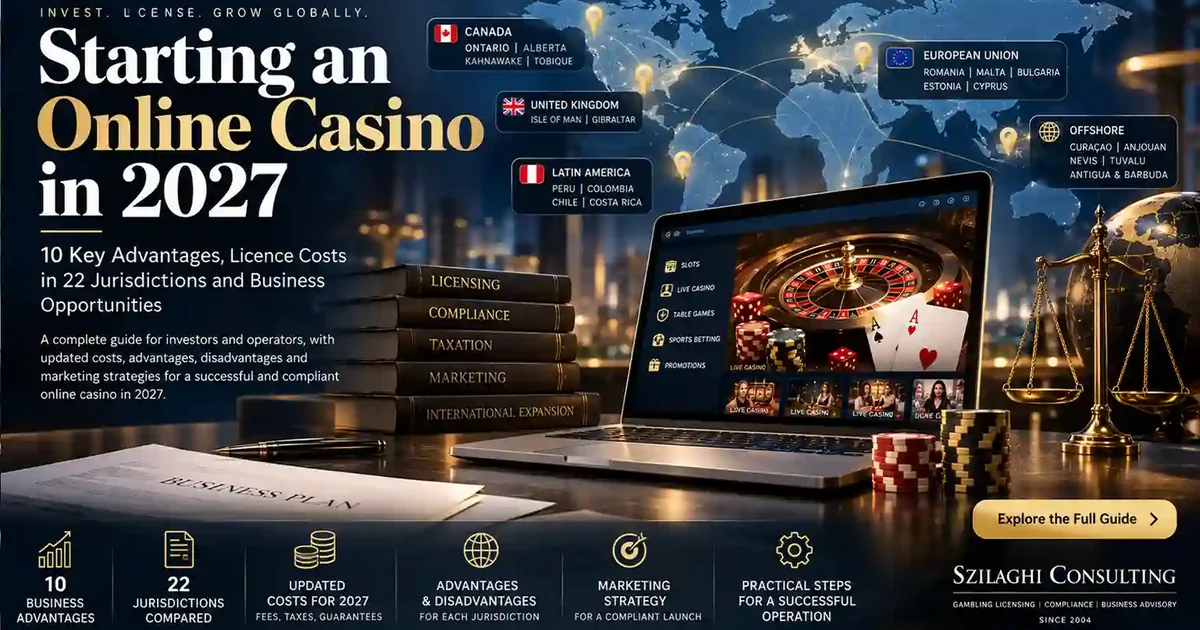
This guide examines ten strategic advantages of entering the online casino industry, compares licensing costs and regulatory requirements, and explains how to develop a sustainable business and marketing strategy for a potential 2027 launch.
Regulatory note: The financial comparisons reflect information available in October 2026, together with changes already announced for 2027. Unless expressly indicated, 2027 fees remain subject to confirmation.
Why Consider Starting an Online Casino in 2027?
The iGaming industry has undergone substantial technological and regulatory development over recent years.
Mobile-first platforms, live casino studios, game aggregation systems, digital payment infrastructure and specialist B2B suppliers have changed how online gambling businesses are created and operated.
Modern operators can access sophisticated technology without developing every component internally.
At the same time, regulators have raised expectations concerning capital adequacy, transaction monitoring, player protection and operational transparency.
For entrepreneurs preparing a 2027 market entry, this creates both opportunities and challenges.
The business model can be highly scalable, but the initial investment, regulatory obligations and ongoing operating costs must be carefully assessed.
A well-structured online casino business needs more than an attractive gaming website. It requires a sustainable commercial strategy supported by appropriate licensing, payment infrastructure, qualified suppliers and internal compliance systems.
The following ten advantages explain why the online casino model continues to attract investor interest.
1. Scalability of a Digital Business Model
Scalability is one of the main advantages of operating an online casino.
Unlike a land-based casino, which requires physical gaming tables, machines, dedicated premises and on-site staff, an online platform can support an expanding customer base through centralized technology.
Additional capacity can be introduced through cloud infrastructure, platform upgrades and specialist service providers.
This allows operators to grow without expanding physical premises in proportion to their customer base.
However, scaling is not cost-free.
Additional users generate higher requirements for processing capacity, payment operations, customer support, regulatory reporting and security.
Business advantage: Online casino operators may achieve a more efficient relationship between operating capacity and business volume compared with equivalent land-based expansion.
For investors, scalability should be measured through realistic unit economics, infrastructure requirements and sustainable operating margins.
2. A Wider Portfolio of Gaming Products
An online casino is not constrained by the physical space available for gaming machines or casino tables.
Subject to licensing requirements, operators may offer a diversified selection of gaming products.
These can include online slots, roulette, blackjack, baccarat, poker and live-dealer casino games.
Modern aggregation platforms make it possible to integrate games from multiple suppliers using standardized technical connections.
This allows an operator to develop its portfolio without producing every game internally.
Diversification can also support differentiated brand positioning and product development.
However, the availability of a game through a supplier does not automatically mean that the operator is authorized to offer it in every market.
The regulatory classification of gaming products, certification requirements and permissions granted under the relevant license must always be checked.
3. Mobile-First Accessibility
Mobile devices have become central to digital entertainment and financial services.
An online casino can provide account administration, payments, transaction histories and customer assistance through mobile-optimized websites and applications.
In 2027, mobile performance should be treated as a core business requirement rather than an optional feature.
Platform speed, security, accessibility and transaction transparency all influence service quality.
For operators, well-designed mobile infrastructure can reduce technical friction and improve operational efficiency.
However, accessibility must remain subject to applicable geographical restrictions, age verification, account controls and self-exclusion requirements.
The business advantage is digital accessibility within authorized markets, not unrestricted global availability.
4. Live Casino Technology and Interactive Products
Live casino technology has created new opportunities to deliver traditional table games through streaming platforms.
Operators can integrate roulette, blackjack and other products featuring real dealers working in specialized studios.
This allows companies to offer live gaming products without necessarily constructing and maintaining their own production facilities.
Specialist B2B suppliers may provide the studio infrastructure, gaming interfaces and streaming technology.
The operator must nevertheless ensure that the supplier, gaming products and technical systems satisfy the requirements of the relevant regulatory authority.
For investors, the advantage lies in expanding product capabilities through specialized partnerships while retaining control over the commercial and compliance model.
5. White-Label and Turnkey Casino Platforms
Developing a complete online gambling platform internally requires substantial technical expertise and investment.
White-label and turnkey technology can offer alternative routes to market.
Depending on the provider, these solutions may incorporate player account management, game aggregation, payment processing interfaces, reporting tools, customer support and regulatory compliance functions.
A turnkey platform may reduce certain development costs and shorten the technical implementation process.
However, these arrangements can also create dependencies involving software ownership, data management, contractual restrictions and ongoing supplier fees. Our comparison of white-label and turnkey casino solutions sets out the trade-offs.
The operator must examine the commercial agreement and ensure that the technology meets the requirements of its target jurisdiction.
A white-label agreement does not automatically replace a gambling operator’s licensing obligations.
In Romania, for example, B2C operators generally require an ONJN Class I license and relevant operating authorizations, while certain specialist suppliers require Class II licenses.
6. Diversified Digital Payment Infrastructure
Payment processing is a critical component of any online casino operation.
Depending on the jurisdiction and the operator’s arrangements with financial institutions, payment methods may include bank transfers, cards and other regulated electronic payment services.
Some jurisdictions may permit particular forms of cryptoasset-related payment infrastructure, subject to separate legal and operational requirements.
Payment flexibility must be balanced with strong verification and financial crime controls.
Operators need systems capable of performing customer due diligence, monitoring transactions, identifying suspicious activity and reconciling financial records.
Modern technology can automate parts of these processes and improve their reliability.
Nevertheless, obtaining a license does not guarantee access to banks, electronic money institutions or payment service providers.
A jurisdiction with relatively low licensing fees may prove commercially unsuitable if appropriate payment services cannot be secured.
7. Automation, Data Analytics and Artificial Intelligence
Online gambling platforms generate operational data that can support more effective management.
Technology can assist with platform monitoring, technical incident detection, payment reconciliation, supplier performance and financial reporting.
Artificial intelligence may also support fraud detection, risk monitoring and the identification of activity requiring responsible gambling intervention.
These capabilities can improve operational efficiency and strengthen compliance.
However, data processing must comply with privacy legislation and applicable gambling regulations.
Operators must not use behavioral analytics to exploit vulnerable players or encourage harmful gambling behavior.
The long-term advantage comes from using technology to strengthen security, transparency, operational controls and customer protection.
8. Access to a Global B2B Supplier Ecosystem
The iGaming industry has developed an extensive international network of specialist service providers.
Operators may work with game studios, aggregators, platform developers, testing laboratories, hosting companies, financial institutions, payment processors and compliance specialists.
This reduces the need to build every operational function internally.
It can also make certain services available to smaller businesses that would otherwise struggle to develop equivalent technology.
Supplier selection remains a regulatory issue as well as a commercial decision.
Depending on the jurisdiction, some suppliers must obtain their own licenses, approvals or certifications. In Romania, for example, Class II suppliers serving online operators carry their own reporting obligations under Law 141/2025.
Contracts should address technical standards, data access, regulatory reporting, business continuity and termination arrangements.
An effective supplier strategy allows operators to benefit from industry specialization without losing control over regulatory responsibilities.
9. Opportunities for International Expansion
An online casino platform can potentially support operations in multiple jurisdictions.
Certain technology, security and operational processes may be reused when entering additional markets.
This provides a structural advantage compared with developing a separate land-based casino in each new location.
However, there is no universal online casino license that automatically authorizes gambling operations worldwide.
Countries and regulated provinces may impose their own licensing, taxation, advertising and player protection requirements.
For example, a license issued in Malta, Curaçao or Anjouan does not automatically authorize an operator to serve players in Romania or Great Britain.
International expansion must therefore be planned jurisdiction by jurisdiction.
The commercial advantage is the ability to develop a reusable operating infrastructure while obtaining the necessary local approvals.
10. Building Long-Term Enterprise Value
A properly structured online casino can develop long-term commercial value through its technology, intellectual property, contracts, operational infrastructure and reputation.
A business with documented processes, reliable payment relationships and a strong compliance culture may be better positioned to respond to regulatory changes and commercial challenges.
Nevertheless, industry growth does not guarantee the success of an individual operator.
Licensing fees, gambling duties, financial guarantees, supplier costs, marketing restrictions and competitive pressures can significantly affect profitability.
Investors should therefore evaluate long-term value through financial forecasts, liquidity, regulatory risks and operational resilience.
The most important advantage is not the prospect of quick profits, but the possibility of building a scalable and sustainable regulated digital business.
How Much Does It Cost to Open an Online Casino in Romania for 2027?
Romania provides an example of why the licensing jurisdiction should be selected before finalizing the business model.
Under Government Emergency Ordinance No. 77/2009, as amended by Law No. 141/2025, the main financial obligations for Class I online gambling operators are substantial.
Romanian ONJN Class I Costs
| Regulatory obligation | Published amount for 2027 planning |
|---|---|
| Annual ONJN Class I license fee | €300,000 |
| Annual operating authorization fee | 30% of Gross Gaming Revenue, minimum €480,000 |
| Annual contribution under Article 10(4) | €500,000 |
| Minimum recurring total of these three items | €1,280,000 |
| Financial guarantee for online casino activity | €5,000,000 |
These are the amounts established under the legislation applicable at the October 2026 review date. They should be checked again against the consolidated rules before a 2027 application.
The financial guarantee is a separate obligation and should not automatically be treated as an annual tax expense.
Its financing and maintenance may nevertheless create substantial liquidity and collateral requirements.
Financial Example: €3 Million Annual GGR
Assume an online casino generates €3 million in annual Gross Gaming Revenue.
The authorization fee at 30% would amount to €900,000.
Adding the annual €300,000 license fee and the €500,000 mandatory contribution produces a combined annual cost of €1.7 million for these three items alone.
This excludes software, gaming content, financial services, employees, cybersecurity, marketing, professional fees and general corporate taxes.
The example demonstrates why a realistic financial model must be developed before committing to the licensing process.
For more information, see Romania Class I gambling licensing and the corporate requirements in Romania Class 1 company formation. Every Romanian fee, contribution and guarantee by game category is set out in our analysis of gambling taxes in Romania.
Online Casino Licensing Costs: Comparing 22 Jurisdictional Regimes for 2027
Choosing the right jurisdiction is among the most important decisions in developing an online casino business.
Regulatory costs differ substantially. Some regimes emphasize low initial fees, while others prioritize extensive supervision, local investment and direct access to regulated markets.
The following comparison includes 22 jurisdictions and related licensing or corporate regimes covered in our jurisdictions register.
Not all of them offer online casino licenses. Some are betting-only jurisdictions, provincial markets or company formation structures.
Pricing basis: Unless a 2027 change is expressly identified, the amounts below are the most recently reviewed 2026 published fees or commercial estimates, included as a budgeting reference for a potential 2027 launch. They are not guarantees of 2027 pricing.
European Union
| Jurisdiction | Licensing costs and taxes | Advantages | Disadvantages |
|---|---|---|---|
| Romania – ONJN | Minimum €1.28 million/year in principal Class I fees and contributions; €5 million online casino guarantee | Direct access to the Romanian regulated market; established ONJN framework | High recurring costs, financial guarantees and reporting requirements |
| Malta – MGA | €5,000 application; €25,000/year B2C fee; Type 1 compliance contribution from €15,000/year | Established regulatory framework, extensive B2B ecosystem and specialist service providers | Local substance, compliance costs, audits and no automatic access to other EU markets |
| Estonia – EMTA | €47,940 activity license + €3,200 remote operating authorization in initial state fees; 5.5% gambling tax under the reviewed 2026 rules | Digital administration, EU jurisdiction and transparent licensing procedures | Capital requirements, technical certification and extensive due diligence |
| Bulgaria – NRA | Online betting reference costs include approximately €10,200 examination and €204,500 one-off authorization charges; gaming taxes and contributions vary by product | EU jurisdiction and established national gambling market | Substantial capital requirements; category-specific taxes mean betting figures cannot be applied automatically to casino products |
| Cyprus – NBA | €30,000 for one year or €45,000 for two years for a Class B online betting license | Regulated online betting market | Online casinos are prohibited; the betting license does not cover online casino operations |
Malta may be suitable for operators seeking established European regulatory infrastructure, industry relationships and access to specialist service providers.
Following changes effective from 1 October 2026, Malta’s gaming tax framework includes a 15% rate for relevant Type 1 casino services provided to players in Malta and 10% for other qualifying categories. This does not constitute a blanket tax on worldwide GGR.
Estonia may be attractive to operators that can meet its capital, certification and compliance requirements.
For investors seeking a casino rather than a sportsbook, Cyprus should not be treated as a valid online casino licensing alternative.
United Kingdom, Isle of Man and Gibraltar
| Jurisdiction | Licensing costs and taxes | Advantages | Disadvantages |
|---|---|---|---|
| Great Britain – UKGC | Remote casino application from £8,185; annual fee from £7,000, according to GGY; 40% Remote Gaming Duty | Direct access to a major regulated market; established regulatory standards | High gaming duty, strict customer protection obligations and extensive compliance |
| Isle of Man – GSC | Approximately £5,250 application and £36,750/year for a full OGRA license; progressive gambling duty generally 0.1%–1.5% | Specialist iGaming ecosystem and established licensing regime | Local directors, hosting and operational substance requirements |
| Gibraltar – Gambling Division | £30,000 B2C application; £50,000, £100,000 or £200,000/year depending on GGY band, per vertical; 0.15% gambling duty, first £100,000 exempt | Established professional services and international operator experience | Local management, premises and significant compliance and licensing costs |
Great Britain remains relevant for operators specifically targeting the British market.
Since 1 April 2026, Remote Gaming Duty has applied at 40% to relevant remote gaming profits. For operators also planning sports betting, a separate 25% rate for certain remote betting activities is scheduled to take effect on 1 April 2027. It should not be confused with casino gaming duty.
Gibraltar’s new licensing and fee framework, under the Gambling Act 2025 and LN.2026/065, came into force on 1 April 2026.
For 2027 planning, investors should calculate licensing costs by gaming category and GGY, rather than assuming a single fixed Gibraltar fee.
Offshore Jurisdictions
| Jurisdiction | Licensing costs and taxes | Advantages | Disadvantages |
|---|---|---|---|
| Curaçao – CGA | Approximately €4,592 application and €47,450/year for B2C licensing and supervision | Reformed LOK framework, established industry relationships and B2B availability | Local substance requirements and restrictions on access to regulated markets |
| Anjouan – AOFA / ALSI | Approximately €17,828 for issuance and €17,828/year for renewal | Lower nominal costs and comparatively straightforward commercial structure | Banking acceptance, legal recognition and regulatory credibility require careful assessment |
| Nevis – NOGA | Approximately €28,000 initially, including the first year, and €28,000/year for renewal | Predictable nominal pricing and a developing B2C/B2B framework | Relatively new regime with a limited track record compared with established regulators |
| Tuvalu – Commercially marketed regime | Approximately US$15,850/year, based on third-party commercial quotations | Low advertised cost | Independent confirmation of statutory authority and official fees remains insufficient; heightened legal and commercial risk |
| Antigua and Barbuda – FSRC | Approximately US$15,000 application and US$100,000/year for interactive casino gaming; additional gambling taxes may apply | Established history of interactive gaming regulation | More expensive than several offshore alternatives; local infrastructure and company requirements |
Curaçao has transitioned to a modernized direct licensing regime under the National Ordinance on Games of Chance, commonly referred to as the LOK.
Operators should not use the historical sublicensing model as the basis for a new 2027 application.
Anjouan and Nevis may be relevant for investors evaluating lower-cost structures, but they require careful examination of market access, banking, payment processing and legal enforceability.
For Tuvalu, the figures should be treated as unverified commercial indications rather than confirmed government fees.
Canada and Associated Licensing Regimes
Canada does not provide a single federal commercial online casino license.
Regulation and commercial market access must be assessed provincially.
Kahnawà:ke and Tobique are separate regimes and do not automatically authorize operations in Ontario or Alberta.
| Jurisdiction or regime | Licensing costs and taxes | Advantages | Disadvantages |
|---|---|---|---|
| Canada – Provincial framework | No single national fee; examples include CAD 100,000/site/year in Ontario and CAD 150,000/site/year in Alberta | Access to regulated provincial markets | Separate provincial approvals and commercial arrangements |
| Ontario – AGCO / iGaming Ontario | CAD 100,000/site/year, plus contractual and operational obligations | Established regulated market and formal operator registration process | Certification, reporting, contractual obligations and substantial compliance costs |
| Alberta – AGLC / AiGC | CAD 50,000 application + CAD 150,000/site/year, plus the provincial revenue-sharing framework | Regulated market launched in July 2026; structured access for eligible operators | Significant setup costs, local requirements and commercial revenue allocation |
| Kahnawà:ke – KGC | US$40,000 for complete new CPA applications submitted from 1 January 2027, including the first annual fee; US$20,000/year thereafter | Long-established gaming commission and specialist infrastructure | Does not replace provincial authorizations; hosting and acceptance requirements |
| Tobique – TGC | Approximately €43,000 in the first year, with commercially quoted renewals of approximately €18,000–€25,000, excluding some ongoing services | Relatively accessible indicative costs | Newer regime, non-standardized commercial quotations and uncertain recognition in certain markets |
A Confirmed Kahnawà:ke Change for 2027
The Kahnawà:ke Gaming Commission has announced that the Client Provider Authorization application fee will rise from US$35,000 to US$40,000 for complete applications submitted on or after 1 January 2027.
The annual CPA fee remains US$20,000.
For investors preparing a 2027 application, this is a formally announced change that can be incorporated into the initial licensing budget.
Ontario and Alberta should be assessed separately based on their respective registration, regulatory and contractual frameworks.
Alberta’s regulated iGaming market launched on 13 July 2026 and allocates 80% of net iGaming revenue to operators and 20% to government after designated allocations totaling 3% of GGR.
Latin America
| Jurisdiction | Licensing costs and taxes | Advantages | Disadvantages |
|---|---|---|---|
| Peru – MINCETUR | Relatively small administrative authorization fees; financial guarantee of at least approximately PEN 3.3 million using the reviewed 2026 reference; 12% remote gaming tax on the statutory base, plus applicable ISC | Regulated online casino and betting market with defined authorization procedures | High financial guarantees, additional taxes and local compliance obligations |
| Colombia – Coljuegos | Fixed contractual right equivalent to 811 statutory monthly minimum wages, approximately COP 1.42 billion using 2026 reference values, plus generally 15% of GGR and other applicable charges | Established regulated market and formal concession structure | Significant statutory costs, tax complexity and local operational requirements |
| Chile – Pending framework | No operational online casino license available under the framework reviewed in October 2026 | Potential future opportunity if licensing legislation is adopted | No current basis to treat a commercial online casino license as available |
| Costa Rica – Corporate structure | No dedicated online casino license; company incorporation and municipal permits carry variable costs | Corporate structuring and certain related business activities | A municipal permit is not a recognized online casino license for foreign regulated markets |
Peru and Colombia may be appropriate for investors seeking regulated access to those national markets.
Chile should remain a legislative monitoring opportunity until a valid licensing framework becomes operational.
Costa Rica is better evaluated as a possible corporate structuring jurisdiction than as a substitute for an online casino license.
Which Online Casino Jurisdiction Should Investors Consider for 2027?
The appropriate jurisdiction depends on the proposed products, the intended markets, the available capital and the requirements of financial and commercial partners.
| Business objective | Jurisdictions to assess | Main consideration |
|---|---|---|
| Lower published licensing costs | Anjouan, Nevis | Legal recognition, payments and market restrictions |
| Offshore operations under a developed regulatory framework | Curaçao | LOK requirements and commercial acceptance |
| Established European iGaming infrastructure | Malta, Isle of Man, Gibraltar | Ongoing fees, local substance and supplier relationships |
| Direct access to Romania | Romania | ONJN licensing, tax burden and financial guarantee |
| Direct access to Great Britain | Great Britain | UKGC licensing and gaming duty |
| Canadian regulated-market entry | Ontario, Alberta | Provincial registration and commercial agreements |
| Latin American expansion | Peru, Colombia | Local tax, guarantees and regulatory requirements |
Why the Cheapest License May Not Be the Best Investment
A low-cost license may appear attractive when evaluating the initial investment.
However, difficulties obtaining banking services, integrating payment providers or accessing the intended market can outweigh any savings on licensing fees.
The total investment should include regulatory charges, technology, certification, personnel, financial guarantees, local substance and ongoing compliance. For a cost-by-cost breakdown, see gambling license costs in 2026; for typical timelines, how long it takes to get a gaming license; and for entity, capital and local requirements, gambling company formation.
An effective licensing strategy should therefore start with the location of the intended players and the applicable legal requirements.
Online Casino Marketing Strategy for 2027
Marketing is an important part of the commercial model, but it must be designed around the rules of the markets in which the operator is authorized to operate.
An effective marketing plan should not be developed independently from licensing and compliance.
Build a Credible and Transparent Brand
Long-term brand development depends on the quality and reliability of the service.
Transparent payment procedures, accessible support, clear terms, data protection and responsible gambling safeguards all contribute to commercial credibility.
Marketing materials should not present gambling as a reliable source of income or make promises of guaranteed winnings.
Regulatory compliance should be visible in the way the business communicates its services.
Develop Useful SEO and Educational Content
Where legally permitted, operators can publish accurate information about games, account security, payment procedures and responsible gambling.
Educational content should explain product rules and risks without misleading users or exploiting vulnerable groups.
For investors and B2B suppliers, educational content can also demonstrate professional expertise in licensing, technology and regulatory compliance.
Search visibility should be treated as a long-term information and brand-management function rather than a justification for aggressive gambling promotion.
Structure Affiliate and Commercial Partnerships Correctly
Affiliates, content partners and marketing agencies can support a business where those activities are permitted.
However, some jurisdictions require affiliates or certain service providers to obtain licenses or approvals. In Romania, affiliates need an ONJN Class 2 license; see Romania’s Class 2 affiliate license.
Contracts should define authorized markets, advertising standards, data processing responsibilities and obligations to remove non-compliant promotions.
The operator should maintain effective oversight of third-party marketing rather than assuming that regulatory responsibility ends when promotional services are outsourced.
Apply Responsible Advertising Standards
Gambling advertising may be subject to strict geographical, age-related and content restrictions.
Marketing programs should include approval processes for campaigns, verification of publishers and restrictions on targeting minors and other vulnerable audiences.
Operators must also consider the requirements of individual advertising platforms, which may impose restrictions in addition to national legislation.
A campaign that is technically possible to publish is not necessarily legally permissible.
Connect Marketing Budgets to Financial Sustainability
Customer acquisition costs, operational expenses and marketing budgets should be evaluated alongside regulatory charges and the operator’s capital requirements.
Commercial performance should not be assessed solely by new registrations or turnover.
Operators need to understand the relationship between GGR, mandatory contributions, operating margins and the cost of providing compliant services.
For a business planning its 2027 launch, financial modeling should include conservative revenue scenarios and realistic compliance expenditure.
A sustainable marketing strategy supports a regulated business model; it should not depend on excessive promotional pressure or harmful player behavior.
Practical Steps to Prepare an Online Casino Launch in 2027
Investors should approach launch planning as a coordinated regulatory, financial and operational project.
Step 1 — Define the Target Market
Identify where players will be located, which products will be offered and whether local licenses or authorizations are required.
Do not assume that an offshore license grants global access.
Step 2 — Choose the Legal and Licensing Structure
Determine the appropriate operating entity, jurisdiction, ownership structure and regulatory category.
Assess the implications for directors, beneficial owners, source of funds and local substance.
Step 3 — Build a Complete Financial Model
Include application fees, recurring regulatory charges, taxes, financial guarantees, platform costs, employees and contingencies.
Model base, downside and growth scenarios.
Step 4 — Select Technology and Suppliers
Evaluate white-label or proprietary platforms, games, payment service providers, cybersecurity arrangements and certifications.
Confirm that relevant suppliers hold the required permissions.
Step 5 — Establish Compliance Systems
Implement KYC, AML/CFT, responsible gambling, privacy, reporting and incident management controls.
Ensure that procedures work operationally and are not merely formal documents. For EU-facing operators, our AML compliance guide for Romania 2026–2027 explains the €2,000 linked-transaction rule that applies under Regulation (EU) 2024/1624 from 10 July 2027.
Step 6 — Prepare Market Entry and Marketing
Develop the commercial strategy only for authorized products and markets.
Align branding, communications, affiliate relationships and advertising procedures with applicable restrictions.
Step 7 — Obtain Approvals Before Launch
Do not commence operations until the required licenses, authorizations, technical approvals and payment arrangements are in place.
A realistic 2027 plan should allow time for regulatory review, testing, remedial work and supplier onboarding.
Conclusion: Planning for a Sustainable Online Casino Business in 2027
Online casinos offer meaningful commercial advantages through scalable technology, diversified gaming products, specialized suppliers and potential international expansion.
However, the industry is increasingly regulated and capital-intensive.
The 22 regimes examined in this guide demonstrate that licensing costs are only part of the decision.
Investors must consider taxation, guarantees, banking, technology, advertising restrictions, local substance and ongoing compliance.
For a 2027 launch, the most effective strategy is to develop the regulatory and financial foundations before committing substantial resources to technology or marketing.
A successful online casino business is not simply one that obtains a license. It is one that can finance, operate and maintain compliance while building long-term commercial value.
Why Work With Szilaghi Consulting
Szilaghi Consulting provides specialist advisory services for gambling licensing, corporate structuring, market entry and regulatory compliance.
Working with operators, B2B suppliers and investors, we assist with jurisdiction selection, licensing applications, financial planning, regulatory documentation, corporate structures and ongoing obligations.
Our services cover Romania’s ONJN Class I and Class II frameworks, international gaming jurisdictions, financial and operational compliance, and relationships with specialist service providers.
With experience in the gambling licensing sector since 2004, our team helps clients evaluate the commercial and regulatory implications of entering new markets.
Planning an online casino launch in 2027?
The first decision should be choosing the jurisdiction and business structure that match your intended market, available capital and operational objectives.
Compare the 22 jurisdictional regimes, explore our gambling consulting services or contact Szilaghi Consulting to discuss your project.
Important: This is a 2027 planning guide prepared using the regulatory information available on 11 October 2026 and announced future changes. The jurisdictional comparisons include estimated costs where official fixed prices are not available. They do not constitute confirmation that every current rate will remain unchanged in 2027. This material is for general information and does not constitute individualized legal, tax or investment advice. Regulatory conditions, local-market access and licensing fees should be verified before any financial commitment or application. Legal research date: 11 October 2026; intended business planning period: 2027.