Updated: October 13, 2026 | Szilaghi Consulting
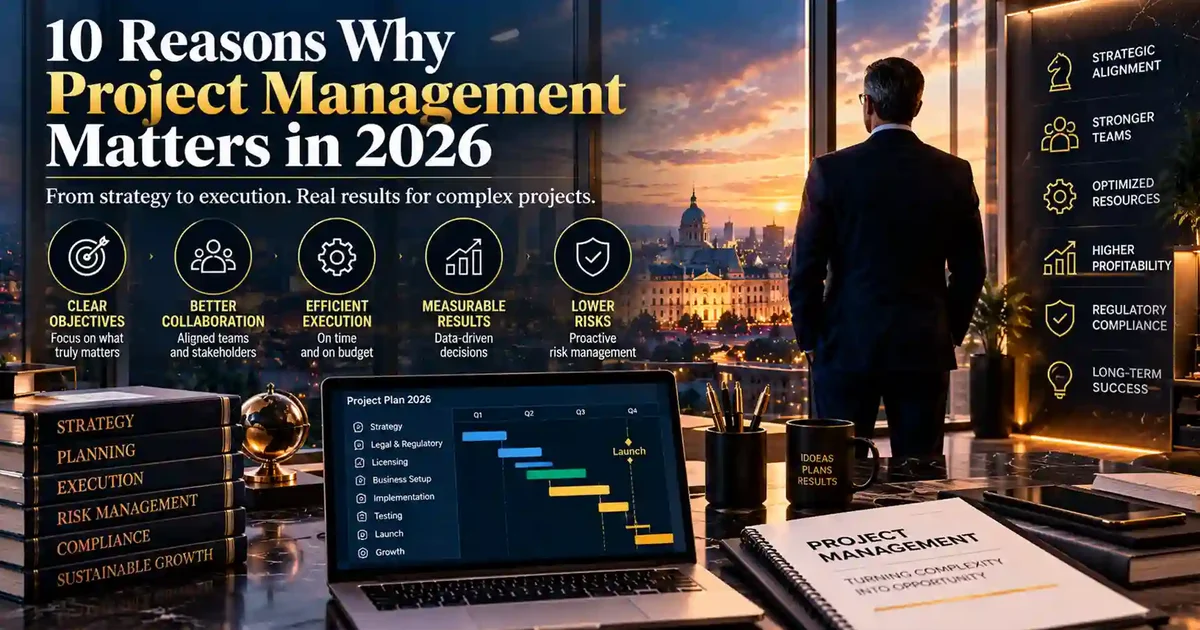
Why is project management important in 2026? Because it helps businesses turn strategic objectives into measurable results through effective planning, budget control, risk management, team coordination, and performance monitoring.
A project may have sufficient funding, experienced professionals, and modern technology. Yet without clear responsibilities and effective coordination, it can still fall behind schedule, exceed its budget, or deliver results that no longer meet the company’s needs.
Project management is not simply about Gantt charts, task lists, and progress meetings. It is the discipline that connects business investment with successful execution.
In 2026, this function is becoming increasingly important. Organizations are managing distributed teams, artificial intelligence, automation, changing regulations, and complex initiatives involving multiple suppliers and stakeholders.
An experienced project manager cannot eliminate every risk. However, effective project management creates the conditions for identifying, evaluating, and addressing problems before they become substantial financial or operational liabilities.
Here are ten reasons why project management matters more than ever.
What Is Project Management?
Project management is the application of knowledge, skills, methods, and tools to achieve defined project objectives.
Unlike repetitive operational activities, a project has a specific purpose, a beginning, an end, and measurable deliverables.
For example, incorporating a new company, obtaining a regulatory license, launching a digital platform, implementing financial software, or entering an international market can all be managed as projects.
In each case, the organization must establish what needs to be achieved, who is responsible, how much the project will cost, which activities depend on others, and how success will be measured.
Today, project success is no longer defined exclusively by completing the work on time, within budget, and according to the original scope.
It also involves commercial benefits, stakeholder satisfaction, regulatory compliance, and the value generated after implementation.
This broader approach is reflected in the PMBOK Guide – Eighth Edition, published by the Project Management Institute (PMI) in November 2025, which addresses value delivery, adaptability, accountability, artificial intelligence, and governance.
1. Project Management Turns Business Strategy into Clear Objectives
The first major benefit of project management is clarity.
Many business initiatives begin with broad ambitions: expanding the company, increasing sales, reducing operating costs, or entering a new market.
These ambitions are not yet executable projects.
A project manager helps transform them into specific objectives, deliverables, deadlines, responsibilities, and acceptance criteria.
For example, entering an international market may involve incorporating a company, securing licenses, selecting suppliers, opening bank accounts, recruiting employees, and preparing for operational launch.
Without an integrated project plan, each department may pursue a different interpretation of the original business objective.
Effective project management establishes a shared understanding of what success looks like and how it will be achieved.
Business benefit: Management and operational teams work toward the same commercial outcome, while the investment remains connected to the company’s strategic priorities.
2. Project Management Establishes Accountability and Eliminates Operational Confusion
Complex projects often involve legal, financial, commercial, IT, marketing, and compliance departments.
When responsibilities are unclear, organizations experience delays, duplicated work, missed decisions, and disagreements over accountability.
Project management defines who performs each activity, who approves the deliverable, who must be consulted, and who needs to be informed.
A RACI matrix—Responsible, Accountable, Consulted, and Informed—can be particularly effective for establishing these relationships.
For example, when launching a digital platform, the technology department may be responsible for implementation, compliance specialists for regulatory verification, and senior management for approving the investment.
Each function has a distinct role, but all must work within the same project structure.
Business benefit: Every team member understands what must be delivered, when it is required, and to whom potential issues must be reported.
3. Project Management Creates Realistic Timelines and Controls Dependencies
A project deadline does not become realistic simply because management approves it.
Effective scheduling requires an understanding of individual activities, their duration, resource requirements, and interdependencies.
Some activities can be performed simultaneously. Others cannot begin until earlier stages have been completed.
For example, a company may prepare commercial agreements while selecting suppliers, but it cannot assume that regulated operations may commence before the necessary licenses or authorizations have been obtained.
A project manager identifies the critical path, monitors dependencies, updates completion forecasts, and highlights delays that may affect the entire project.
This also helps management distinguish between minor scheduling changes and issues that threaten the launch date.
Business benefit: Project deadlines are based on operational realities rather than unsupported expectations.
4. Project Management Controls Budgets and Protects Return on Investment
Budget overruns do not always result from inaccurate initial estimates.
They may arise from uncontrolled scope changes, repeated work, incomplete contracts, delayed decisions, or operational inefficiencies.
An effective project management process begins with an approved budget and tracks actual expenditure, contractual commitments, and the estimated final cost.
It is particularly important to distinguish between money already spent and financial obligations committed for future stages.
Project management also connects spending to value creation.
Completing an initiative within budget is not necessarily a success if the resulting product, system, or operation fails to deliver the expected business benefits.
A well-managed project therefore evaluates financial performance alongside operational and commercial outcomes.
Business benefit: Management can identify cost deviations early and make informed decisions about whether to adjust, continue, or discontinue an initiative.
5. Project Management Identifies Risks Before They Become Problems
Every project involves uncertainty.
Risks may be financial, technological, contractual, operational, legal, or related to human resources.
Project management provides a structured process for identifying these risks, evaluating their probability and impact, assigning responsibility, and developing appropriate responses.
For a regulated market-entry project, a major risk could be a delay in obtaining a license.
For a technology project, it might be an integration failure between two essential systems.
For an international expansion, it could involve unexpected banking restrictions or changes in legislation.
Not every risk can be eliminated.
Some can be reduced, transferred, accepted, or avoided by changing the project approach.
The purpose of risk management is to ensure that critical exposures are understood before they cause significant disruption.
Business benefit: Management gains visibility over potential problems and can take preventive action before deadlines, budgets, or commercial objectives are compromised.
6. Project Management Improves Team Collaboration and Communication
Communication failures are common in projects involving several departments, external advisers, and technology providers.
Important information may remain in private conversations, decisions may be interpreted differently, and changes may reach the relevant people too late.
A project manager establishes communication procedures appropriate to the scale and complexity of the initiative.
These may include progress meetings, written status reports, decision logs, issue registers, escalation procedures, and shared project dashboards.
The objective is not to organize as many meetings as possible.
It is to reduce wasted time, eliminate uncertainty, and ensure that the right information reaches the right people when they need it.
Transparent communication also improves relationships with investors, clients, regulators, and other stakeholders.
Business benefit: Teams work with consistent information, understand common priorities, and can make decisions more efficiently.
7. Project Management Protects Quality and Regulatory Compliance
A project delivered on time can still fail if the final result does not meet the agreed requirements.
Quality management establishes acceptance criteria, testing procedures, verification activities, and responsibilities before delivery.
In regulated industries, these requirements may include data security, anti-money laundering controls, licensing obligations, consumer protection, contractual compliance, and financial reporting.
Project management does not replace legal advisers, auditors, technical specialists, or compliance officers.
Instead, it coordinates their responsibilities and integrates the necessary checks into the implementation process.
This distinction is important.
Compliance should not be treated as an administrative exercise performed after the operational launch.
It must be considered throughout the project lifecycle.
For example, a digital gambling platform should not reach its intended launch date only for management to discover that essential technical certifications remain incomplete.
Business benefit: Potential deficiencies are identified before final acceptance or operational launch, reducing corrective costs and regulatory exposure.
8. Project Management Enables Controlled Adaptation to Change
Project requirements can change.
New technologies, commercial opportunities, regulatory amendments, and stakeholder expectations may alter the original assumptions.
A rigid approach that rejects every modification can be as ineffective as a project that accepts all requested changes without evaluating their consequences.
In 2026, organizations can choose between predictive, Agile, and hybrid project management approaches.
Predictive methods are useful when requirements and deliverables can be clearly established in advance.
Agile approaches support incremental development, continuous feedback, and adaptation.
Hybrid models combine elements of both.
The appropriate approach depends on the project’s complexity, technology, regulatory constraints, stakeholder expectations, and degree of uncertainty.
Regardless of methodology, changes should be assessed for their impact on costs, timelines, risks, and expected benefits.
Business benefit: Organizations can respond to changing circumstances without losing control over budgets, responsibilities, and strategic objectives.
9. Project Management Uses Artificial Intelligence Without Losing Human Oversight
Artificial intelligence has become increasingly relevant to project management.
Depending on the tools used and the organization’s internal policies, AI can assist with:
- preparing initial project plans and reports;
- organizing information from large document collections;
- identifying potential dependencies and issues;
- summarizing meetings and action points;
- preparing scenario analyses;
- automating repetitive administrative activities;
- supporting resource planning and progress monitoring.
However, automatically generated output should not be confused with verified information.
Data may be incomplete, algorithms may generate inaccurate estimates, and third-party AI services may introduce confidentiality or information-security risks.
Consequently, budgets, legal conclusions, approval decisions, and material risk assessments must be reviewed by appropriately qualified professionals.
Organizations should establish internal rules governing data access, AI tool selection, output verification, and accountability.
The objective is to use technology to support better execution—not to transfer responsibility for important decisions to an algorithm.
Business benefit: AI can reduce the time spent on repetitive work while allowing specialists to focus on judgment, negotiation, problem-solving, and strategic decisions.
10. Project Management Turns Experience into Long-Term Business Performance
A project should not end merely with the delivery of its final output and the archiving of its documentation.
At completion, the organization should understand what worked, what caused delays, how costs evolved, and whether the expected business benefits were achieved.
This information can improve future estimates, procedures, resource allocation, and management decisions.
For companies managing multiple initiatives, a Project Management Office (PMO) or a portfolio management function can help standardize reporting, prioritize investments, and improve resource allocation.
Not every organization requires a permanent PMO.
Its structure should reflect the size, complexity, and number of projects being managed.
The fundamental objective is to ensure that knowledge gained from completed projects remains available to the business.
Business benefit: Project experience becomes an organizational asset rather than information that disappears when the project team moves on.
What Does the Research Say About Project Management Success?
According to the Project Management Institute’s Pulse of the Profession 2025 report, project professionals with stronger business acumen reported better project outcomes than other respondents.
The research identified the following differences:
| Performance indicator | High business acumen | Other respondents |
|---|---|---|
| Business objectives achieved | 83% | 78% |
| Projects delivered within budget | 73% | 68% |
| Projects delivered on schedule | 63% | 59% |
| Projects considered failures | 8% | 11% |
Source: PMI Pulse of the Profession 2025, based on PMI’s global research. These figures describe reported statistical associations and do not establish that stronger business acumen automatically produces these outcomes.
For business leaders, the main implication is that project management should be connected to commercial strategy rather than limited to task monitoring.
Which Project Management KPIs Should Companies Track in 2026?
An effective project dashboard should focus on indicators that are relevant to the initiative’s objectives.
| KPI | What it measures |
|---|---|
| Milestone completion | Whether project stages are completed on schedule |
| Budget variance | Difference between planned and actual costs |
| Estimate at completion | Forecast of the project’s total final cost |
| Open critical risks | Significant exposures requiring management attention |
| Accepted deliverables | Outputs formally approved against established criteria |
| Approved change requests | Impact of changes on scope, cost, and schedule |
| Benefits realization | Business value generated after implementation |
| Stakeholder satisfaction | Extent to which relevant expectations are met |
Not every project needs all these indicators.
A small project may be effectively controlled through a simple dashboard, while an international project portfolio may require specialized reporting systems.
The important principle is to measure what supports decisions, not to generate reports merely for administrative purposes.
How Can a Company Implement Project Management?
Effective implementation does not necessarily begin with purchasing expensive project management software.
It begins by identifying existing projects, responsibilities, recurring problems, and performance expectations.
A practical implementation plan can follow five stages.
Step 1: Assess the Current Situation
Identify active projects, operational bottlenecks, existing costs, reporting processes, and areas where responsibilities are unclear.
Step 2: Establish a Project Management Framework
Define project roles, approval procedures, essential documentation, reporting methods, and minimum performance indicators.
Step 3: Test the Methodology
Apply the proposed framework to one or two representative projects.
Evaluate whether the processes improve visibility and decision-making without creating excessive administrative work.
Step 4: Train the Team
Ensure that project managers, department heads, and participating employees understand the methodology and their responsibilities.
Step 5: Evaluate and Expand
Identify improvements, correct weaknesses, and adapt the methodology to other projects or business units.
A process that is unnecessarily complicated can itself become a source of cost.
The level of control should remain proportionate to project risk, investment size, and operational complexity.
When Should a Company Hire an External Project Manager?
An external project manager may be valuable when an organization lacks sufficient internal capacity, is undertaking a specialized initiative, or requires independent coordination of several providers.
For example, entering a new international market may involve lawyers, tax advisers, technical specialists, banks, licensing authorities, and operational suppliers.
Coordinating these activities requires competencies that may differ substantially from those involved in everyday business administration.
Before appointing an external project manager, the company should clearly define:
- scope of responsibility;
- expected deliverables;
- decision-making authority;
- project milestones and deadlines;
- reporting requirements;
- fee structure and contractual conditions.
There is no universal percentage of the project budget that represents the correct project management fee.
The cost of external project management should be assessed against the initiative’s duration, complexity, risk exposure, and required expertise.
Conclusion: Project Management Is an Investment in Business Results
In 2026, organizations must deliver projects in an environment characterized by rapid technological change, financial pressure, and increasingly complex operational requirements.
Effective project management provides clarity, accountability, financial visibility, and the ability to respond to uncertainty.
Artificial intelligence can support planning, forecasting, and reporting, but it does not eliminate the need for professional judgment, financial control, or human accountability.
The true measure of project success is not how many projects an organization completes, but the value those projects create.
How Can Szilaghi Consulting Help?
Szilaghi Consulting provides advisory services covering project management assessment, methodology implementation, project portfolio management, PMO development, and the improvement of project governance.
Our services can include:
- assessment of existing project management processes;
- design and implementation of project management methodologies;
- project and portfolio performance monitoring;
- project coordination and operational oversight;
- PMO implementation and optimization;
- training and mentoring for project managers;
- coordination of complex international and regulated projects.
If your organization is managing complex initiatives or needs greater control over its investments, contact Szilaghi Consulting to discuss your project management objectives.
Editorial note: This article was updated in October 2026. Operational examples are illustrative. Project management methodologies, governance procedures, and performance indicators should be adapted to the requirements of each organization.