The next jurisdiction worth adding to your licensing stack just surfaced — and almost nobody in Western Europe is talking about it yet.
Yes — and if you move early, it may be one of the smartest additions to your licensing stack in 2026.
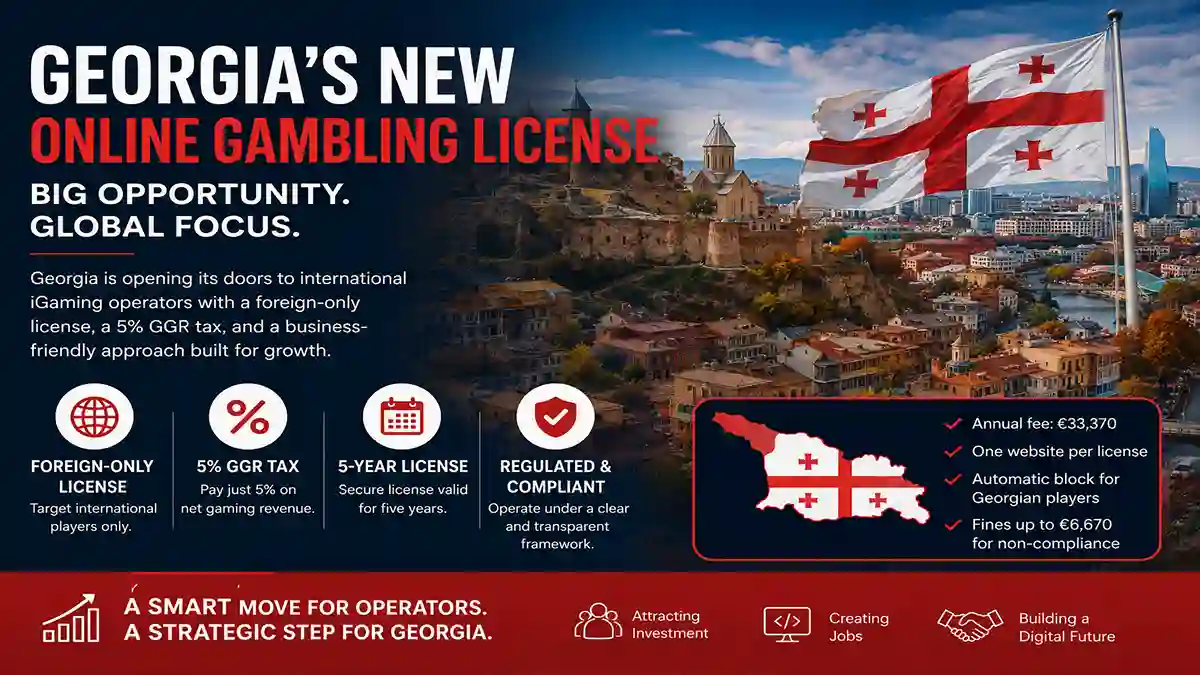
Georgia is rolling out a foreign-only online gambling license with a 5% GGR tax rate, a five-year term, and an annual fee of roughly €33,370. It’s built exclusively for operators targeting international players — Georgian citizens are blocked by design, not by policy you have to enforce yourself. The compliance burden is minimal. The cost is low. The window is open.
This article breaks down exactly what the license covers, how the numbers compare to Malta, Gibraltar, and Estonia, and what operators need to do right now — before the queue fills up.
Most jurisdictions that promise “favourable tax regimes” for iGaming operators deliver one of two things: a rate that sounds good until you read the fine print, or a regulatory environment so thin that banking and payment processing become a permanent headache.
Georgia is shaping up to be different. Not because it’s perfect — no emerging licensing jurisdiction is — but because the legislation currently moving through parliament is structured with unusual clarity, and the numbers are genuinely competitive with jurisdictions that took years to build their reputations.
If you’re an operator or a game studio actively building your international footprint, this is the article to read before the window fills up with everyone else who finally noticed.
What Georgia Is Actually Offering
The Georgian government has tabled draft legislation — fast-tracked through parliament — that creates a standalone licensing category for online casino and sports betting operators serving exclusively non-Georgian customers.
The headline terms:
- 5% GGR tax, calculated on net revenue (stakes minus winnings)
- Five-year license duration — long enough to build a real business around
- Annual fee of GEL 100,000, approximately €33,370 — modest by any major jurisdiction’s standard
- One license per website — clean, straightforward, no ambiguity about scope
- Automatic geo-blocking of Georgian citizens built into the compliance framework
That last point deserves more attention than it usually gets. Georgia isn’t asking operators to self-police domestic player exclusion — the restriction is structural. Georgian citizens and stateless residents cannot access foreign-licensed platforms. The compliance burden for operators on this front is essentially zero. You either serve foreign players or you don’t have a license. There’s no grey area to manage.
The Tax Rate in Context
5% GGR is the number that should make you look twice. Here’s how it sits against the jurisdictions operators already know:
Malta’s standard rate runs to 5% of GGR, but the fee structure, compliance overhead, and operational costs in a mature EU jurisdiction add up fast. Gibraltar’s rate is broadly similar but access to the license is selective. The Isle of Man has long been competitive on tax but is geographically peripheral to most target markets.
The most relevant comparison right now is Estonia. Tallinn is in the middle of a phased reduction that will bring its GGR rate to 4% by 2029 — and that’s drawing serious attention from operators who want EU regulatory credibility. Georgia can’t offer EU passporting. That’s worth saying plainly. But for operators whose core markets are already served via other licenses, a 5% offshore-comparable rate from a stable Caucasus jurisdiction is a genuinely useful addition to a multi-license stack.
What Georgia offers that no established European hub can: an uncrowded space. You’re not competing with 500 other operators for licensing officer attention. You’re early.
Why the Domestic Restrictions Actually Help You
At first glance, blocking Georgian citizens from your platform sounds like it shrinks your market. In practice, for an international operator, it does the opposite of that.
Georgia’s domestic gambling landscape is unusually restricted. The legal gambling age was raised to 25 in 2024. Public-sector employees are banned. Citizens with criminal records are excluded. Over 1.5 million people in a country of 3.8 million are now formally prohibited from gambling — that’s nearly 40% of the population.
This is not a market you want to accidentally serve, even if you could. The compliance exposure from capturing Georgian players on a foreign-facing license would be significant, and the domestic player base that does exist is heavily regulated and already served by established operators like Flutter’s Adjarabet and Betsson Georgia.
The foreign-only structure removes that entire risk category. You get the tax advantage. You skip the domestic compliance complexity. The regulatory intent is entirely aligned with how a sensible international operator would want to structure things anyway.
What You Get Operationally
A five-year license covers meaningful runway. Most operators need 18 to 24 months to properly build out a market before they’re optimising rather than launching — a five-year term gives you that without the distraction of a renewal process interrupting your second year.
The single-site restriction per license is the one genuine constraint to plan around. If you’re running multiple brands, you’ll need a license per domain. Budget accordingly: at €33,370 per year per license, even a portfolio of three or four brands is a manageable annual cost — especially against a 5% GGR rate that leaves significantly more margin than most European alternatives.
The non-compliance fine structure is clear: GEL 20,000 (around €6,670) for breach of license conditions or missed payments. Strict enough to take seriously, scaled appropriately for smaller operators who shouldn’t be priced out of maintaining compliance.
The Jobs Angle Matters for Your Application
Georgian lawmakers have been explicit that this framework is designed partly to attract technology and marketing employment into the country. That’s not incidental — it’s the political argument that gets the legislation through parliament and keeps the regulatory environment stable after it does.
Operators who can demonstrate a genuine local footprint — tech support, compliance staff, regional marketing operations — will be better positioned in the licensing process than those treating Georgia purely as a tax address. This isn’t unique to Georgia; it’s how every jurisdiction that actually wants a lasting iGaming sector operates. Malta built its ecosystem the same way.
The difference is that in Georgia, you’re building that footprint now, before the competition arrives. The operators who established early presences in Malta in the 2000s didn’t look like geniuses at the time. They just moved while others waited for more certainty.
The Honest Assessment
Georgia is not a replacement for your MGA license, your UKGC registration, or your Dutch KSA approval for those respective markets. It’s a complementary piece — the kind of license that makes your international structure more efficient, reduces your effective tax burden on markets outside the core regulated jurisdictions, and gives you a credible, stable base for growth in markets that don’t require EU-standard licensing.
The framework is still at draft legislation stage. Parliamentary approval and the licensing authority’s operational setup will take time. But this is exactly when to begin due diligence, identify your local representative structure, and ensure you’re first in the queue when applications open — not scrambling to catch up six months after the licensing office is overwhelmed.
The operators who thrive in emerging jurisdictions are the ones who start when it still looks like preparation rather than reaction.
The Bottom Line
A 5% GGR tax rate. Foreign players only — which means clean compliance. A five-year license with a modest annual fee. A jurisdiction that’s actively trying to build an iGaming sector and has the regulatory architecture to do it seriously.
Georgia isn’t the next Malta. It doesn’t need to be. It’s its own opportunity — accessible now, competitively priced, and structurally sound in a way that a lot of low-tax jurisdictions simply aren’t.
The question isn’t whether this license belongs in your portfolio. The question is how long you’re willing to wait before making that call.
Interested in the Georgia licensing timeline, local representative requirements, or how this fits into a multi-jurisdiction structure? Get in touch with Szilaghi Consulting — we’re tracking this framework from draft to implementation.
Get Expert Assistance with Your Georgian Gambling License
Navigating the Georgian gambling licensing process can be challenging, especially with varying requirements for resident and non-resident companies. Szilaghi Consulting specializes in helping businesses obtain their gambling license efficiently and compliantly.
✅ Expert legal and financial guidance
✅ Assistance with company formation and tax registration
✅ Compliance support for Georgian licensing requirements
📞 Contact Szilaghi Consulting today to streamline your licensing process and start operating in the Georgian gambling market!