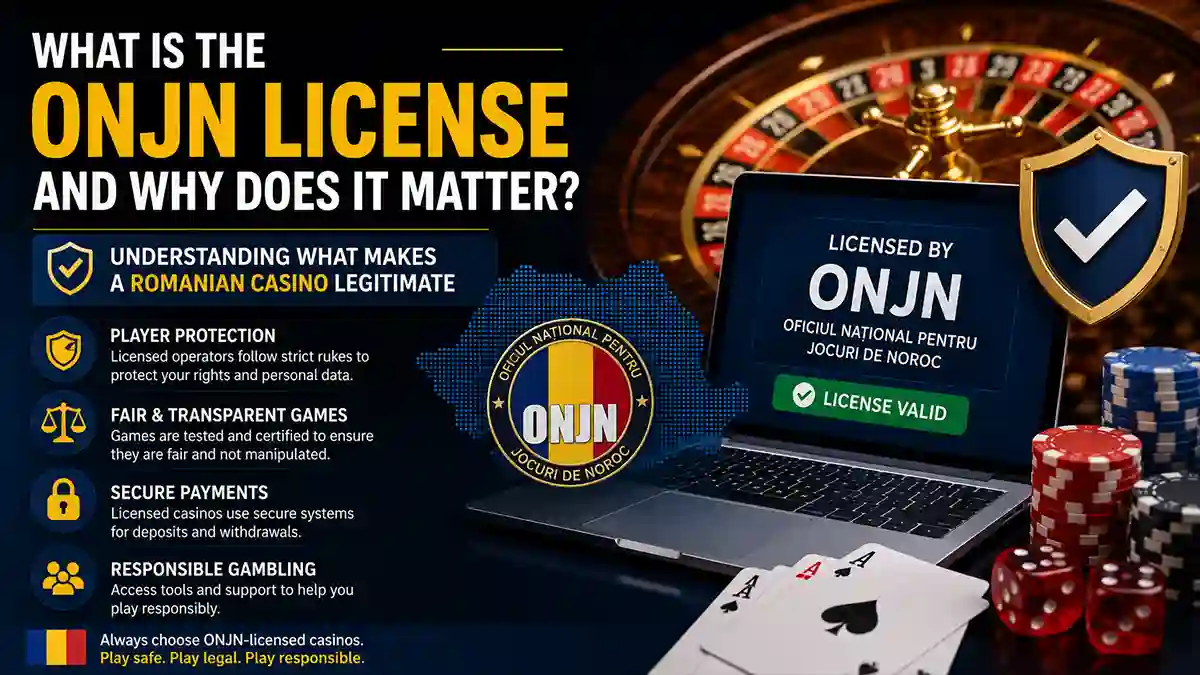
The ONJN license is the authorization issued by Romania’s National Gambling Office (Oficiul Național pentru Jocuri de Noroc) under OUG 77/2009. It is the only credential that makes gambling legal in Romania. An operator needs a Class 1 license plus a valid operating authorization to accept players in Romania; a license from Malta, the UK or Curaçao does not count. You can check any site in about five minutes against the ONJN’s public registers.
This post answers the practical question: what the license proves and how to verify it. If you are a company looking to obtain one, our guide to Romanian gambling license classes and costs covers fees, timelines and the procedure.
What the ONJN actually is
The ONJN is Romania’s single gambling regulator for both land-based and online gambling. It issues licenses and operating authorizations, supervises licensees, enforces responsible-gambling rules, keeps the national self-exclusion register and pursues unauthorized operators. It also maintains a public blacklist of illegal gambling domains, which internet service providers must block.
There is no side door into the Romanian market. No grandfathering, no EU passport and no recognition of foreign licenses. An operator either holds an ONJN license and authorization, or it is operating illegally in Romania.
What an ONJN license certifies
An ONJN license is not a registration or a fee receipt. Before granting it, the regulator assesses the applicant’s ownership, financial standing, legal structure, technical systems and security. For an online operator that includes a Romanian company or permanent establishment, certified games and random number generators, a mirror server in Romania that gives ONJN access to data, and a financial guarantee of €2,000,000, or €5,000,000 for online casino.
The license lasts ten years, but operating also requires an authorization renewed every year, tied to payment of the annual fees and to continued compliance. That annual cycle is the reason a license from five years ago tells you little; the current authorization is what matters.
The two license classes
- Class 1 (B2C). Operators that deal with players: online casinos, sportsbooks, poker and bingo, and land-based casinos, betting shops and slot halls. This is the license that governs whoever holds your money.
- Class 2 (B2B). Suppliers to licensed operators: game studios, platform providers, aggregators, payment processors, hosting providers, test labs and affiliates. Players never sign up with them, but their systems run the games. See our Class 2 license guide for the supplier route.
Since 2025 Class 2 suppliers have been barred from serving blacklisted sites that accept Romanian players, and payment and software providers must detect and report such access. That rule makes the Class 2 register a useful check for business partners, too.
Why the license matters more than the welcome bonus
A large bonus or a long game list protects no one when something goes wrong. The license does.
Player protection. Licensed operators must verify identity, keep player funds traceable, publish clear terms and handle complaints. Players can escalate unresolved complaints to the ONJN. On an unlicensed site, you depend on the operator’s goodwill.
Fair games. Games and RNGs offered by licensees must be certified by an accredited laboratory, and the ONJN has access to operator data through the mirror server. Certification does not guarantee wins; it guarantees the published rules are the ones that run.
Secure payments. Licensed operators work with regulated payment providers and are reporting entities under the anti-money-laundering law, Law 129/2019.
Responsible-gambling tools. Deposit limits, reality checks, account monitoring and self-exclusion are mandatory for licensees. Land-based self-exclusion runs through a national register under ONJN Order 79/2025; extending that register to online operators required a new emergency ordinance that, as of August 2026, had been drafted but not adopted. Our post on self-exclusion breaches and ONJN enforcement covers what operators must do.
Why so few sites hold one: what the license costs
The short register is not an accident. Romania is one of the most expensive places in Europe to hold an operator license, which is why a site that claims one is making a claim worth checking.
A Class 1 online operator pays every year a €300,000 license fee, a €500,000 responsible-gambling contribution and, since 1 August 2025 under Law 141/2025, an authorization fee of 30% of gross gaming revenue with a €480,000 minimum. That is a fixed floor of €1,280,000 a year before the first player deposits; the full fee schedule is in our analysis of gambling taxes in Romania in 2026. The operator must also post the €2,000,000 or €5,000,000 guarantee and hold share capital of RON 1,000,000 for remote gambling.
A Class 2 supplier pays far less: €10,500 at issuance, then a €20,000 license fee and a €15,000 contribution, or €35,000 a year, with no tax on revenue. That gap is why the Class 2 register lists hundreds of companies (413 entries for 355 companies as of 5 October 2026) while the Class 1 register lists a few dozen.
For players, the practical point is simple. An operator that has paid this entry price and posted a seven-figure guarantee has something to lose if it mistreats customers. An unlicensed site has paid nothing and risks nothing in Romania.
How to verify a license yourself
- Read the footer, then treat it as a claim. A licensed Romanian site shows the operator’s company name, the license number and the ONJN logo. Images can be copied, so this is a starting point only.
- Check the ONJN Class 1 register. Search the register on onjn.gov.ro for the company name and confirm that the exact domain you are on is listed. Many brands run several domains; only the listed ones are authorized. As of 5 October 2026 the register showed 28 entries covering 92 domains.
- Check the blacklist. If the domain, or a near copy of it, appears on the ONJN blacklist, leave. The list held 2,881 domains as of 25 September 2026, and in a single meeting in July 2026 the ONJN added about 800 sites.
- Look at the company details. A legitimate operator shows its registered name, address and contact details openly. Vague or missing information is a warning sign.
Business partners should run the same check, then ask for the license decision and the current authorization. Our post on how sites get blacklisted and how to become legal explains the listing process from the operator’s side.
What you risk on an unlicensed site
- No Romanian legal protection and no ONJN complaint route.
- Withdrawals that stall or disappear, and support that stops answering.
- Bonus terms written to block cash-outs.
- No self-exclusion or deposit limits that actually bind.
- Payment flows that may be masked, which can put your own bank account under review.
The ONJN estimates that more than 70% of Europe’s online gambling market is run by operators without a local license. The scale of that problem is covered in our analysis of the black market and the ad platforms.
Does an international license count? No.
The Malta Gaming Authority and the UK Gambling Commission are serious regulators in their own markets. A Maltese license gives you Maltese protections and Maltese complaints routes, and nothing more in Romania. A site that offers a foreign license instead of an ONJN authorization to Romanian players is either mistaken about the law or relying on players not knowing it. Either way, the ONJN can blacklist the domain, and Romanian payment and software providers are required to cut it off.
The short version
Check the footer, check the register, check the company. If the ONJN license is missing, hidden or replaced by a foreign badge, do not deposit. For operators and suppliers planning to enter the market legally, start with the Romania licensing guide linked above or book a free fit call.