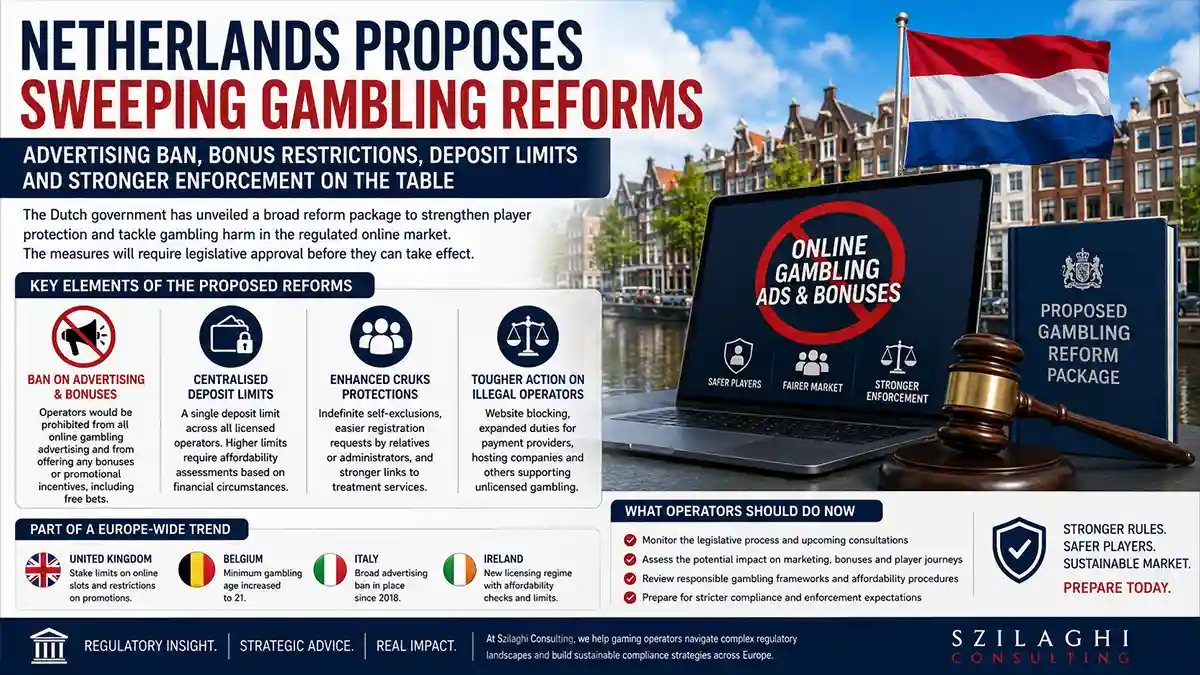
Yes, the Netherlands is proposing one of the most restrictive online gambling reforms in Europe, including a potential ban on gambling advertising, the elimination of bonuses and promotional offers, centralized deposit limits, enhanced affordability checks, and stronger enforcement powers against unlicensed operators. If adopted, these measures would significantly reshape how licensed operators acquire, retain, and monitor players in the Dutch market, while further strengthening the country’s focus on consumer protection and gambling harm prevention. This article examines the proposed reforms, their potential impact on operators and players, and what businesses should do now to prepare for the next phase of Dutch gambling regulation.
On 12 June 2026, State Secretary for Justice and Security Claudia van Bruggen presented a comprehensive legislative package aimed at tightening the Dutch remote gambling framework under the Remote Gambling Act (Wet Kansspelen op Afstand, “KOA”), which entered into force on 1 October 2021. The proposals, if adopted, would place the Netherlands among the most restrictive regulated gambling jurisdictions in the European Union.
Regulatory Context
Since the launch of the licensed market, the Dutch regulator (Kansspelautoriteit, “KSA”) has progressively narrowed the advertising and player-protection framework, including the 2023 prohibition on the use of role models and influencers in gambling marketing and the subsequent ban on untargeted advertising. Despite these measures, the government has concluded that participation rates among young adults and indicators of gambling-related financial harm continue to warrant intervention. The current package represents a marked policy shift from channelization (moving consumers from the illegal to the licensed market) toward harm minimization as the dominant regulatory objective.
Key Proposed Measures
1. Advertising and Bonus Prohibition
The package proposes a near-total ban on gambling advertising, together with the elimination of promotional incentives, including welcome bonuses, free bets, free spins, and account-opening offers. For licensees, this would require a fundamental restructuring of customer acquisition strategy, shifting reliance toward retention, product differentiation, and owned-channel engagement, areas where promotional mechanics are similarly constrained.
2. Centralized Deposit Limits and Affordability Assessments
A cross-operator deposit monitoring system is proposed, under which player spending would be assessed on a market-wide rather than per-operator basis. Players seeking to exceed prescribed thresholds would be subject to affordability checks examining income, debt, payment arrears, and any guardianship or financial administration arrangements. Operators should anticipate significant technical and compliance integration requirements, including data-sharing infrastructure across licensees and the regulator.
3. Expansion of the Cruks Self-Exclusion Register
Proposed reforms to Cruks include making voluntary self-exclusions indefinite absent active revocation by the registrant, simplifying third-party registration requests by relatives or financial administrators on behalf of vulnerable individuals, and deepening integration between Cruks and addiction treatment services. This reflects an explicit reframing of gambling exclusion as a public health mechanism rather than a purely administrative compliance tool.
4. Enhanced Enforcement Against Unlicensed Operators
The package would expand the KSA’s enforcement toolkit against illegal operators, including website-blocking powers, additional obligations on payment service providers, and new responsibilities for hosting providers and other technical intermediaries. This aligns with the stated objective of preserving channelization while simultaneously tightening controls on the licensed market.
Broader European Context
The Dutch proposals track a wider continental trend toward stricter consumer-protection regulation, including UK stake limits on online slots and bonus restrictions, Belgium’s increase of the minimum gambling age to 21, Italy’s longstanding advertising restrictions, and Ireland’s new licensing regime with affordability requirements. Operators active across multiple EU and EEA markets should expect this trajectory to continue.
Practical Recommendations for Operators
Licensees and prospective entrants to the Dutch market, including B2B suppliers whose commercial terms may be affected by downstream operator constraints, should begin assessing:
- Marketing and customer acquisition models, with particular attention to reliance on bonus-driven onboarding;
- Bonus and promotional contractual arrangements with affiliates and platform partners;
- Responsible gambling and affordability assessment procedures, including system readiness for centralized deposit monitoring;
- Data-sharing and compliance infrastructure required for Cruks and cross-operator deposit limit integration;
- Contractual risk allocation clauses addressing regulatory change, given the legislative timeline remains subject to parliamentary process and potential amendment.
The legislative process is ongoing, and the proposals may be amended prior to adoption. Operators should monitor developments closely and seek jurisdiction-specific legal advice before implementing structural changes to marketing or compliance frameworks.
Get Expert Assistance with Your Romanian Gambling License
Navigating the Romanian gambling licensing process can be challenging, especially with varying requirements for resident and non-resident companies. Szilaghi Consulting specializes in helping businesses obtain their Class 2 gambling license efficiently and compliantly.
✅ Expert legal and financial guidance
✅ Assistance with company formation and tax registration
✅ Compliance support for ONJN licensing requirements
📞 Contact Szilaghi Consulting today to streamline your licensing process and start operating in the Romanian gambling market!