Updated: October 2026 | Market Analysis and 2027 Outlook
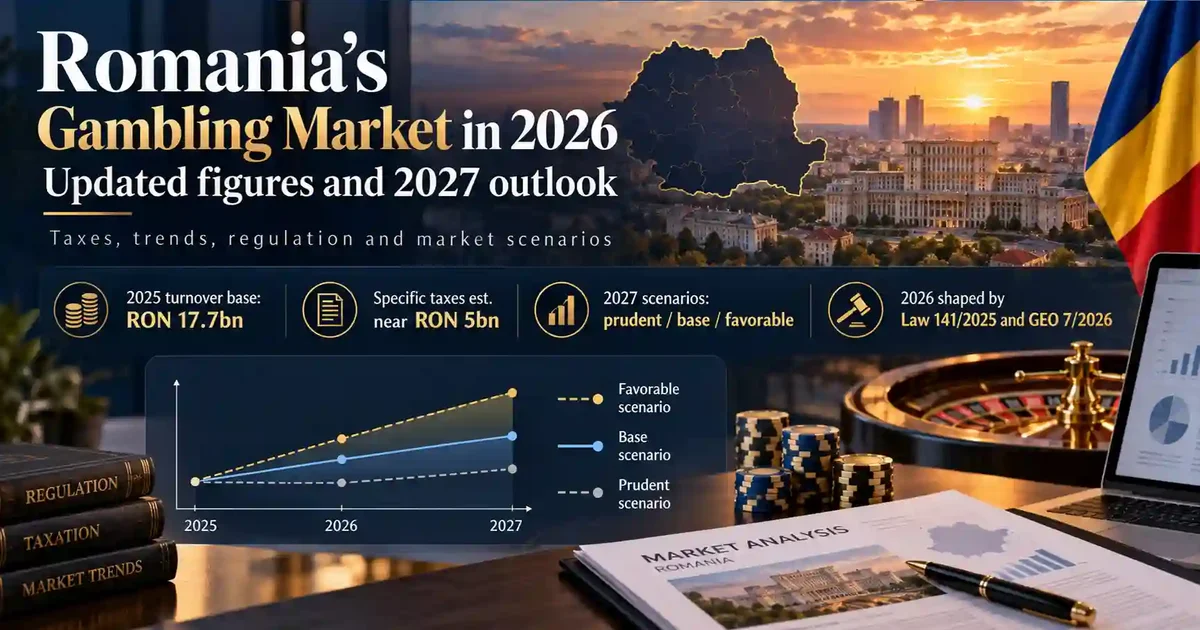
Full-year figures for Romania’s gambling market in 2026 are not yet available. The latest reference point is aggregate turnover of about RON 17.7 billion reported for 2025 by companies under CAEN code 9200, and gambling-specific taxes were estimated at about RON 5 billion. For 2027, our base-case scenario puts aggregate turnover at about RON 18.6 billion.
Romania’s gambling market has evolved significantly since 2019, when the industry was estimated to be worth approximately €1 billion. Today, the sector operates in an increasingly complex environment characterized by higher taxation, stricter regulatory requirements and continuous changes in business models.
According to a financial analysis published by economist Iancu Guda in July 2026, based on the financial statements of companies classified under NACE/CAEN code 9200, the Romanian gambling industry’s aggregate turnover reached approximately RON 17.7 billion in 2025. Separately, gambling-specific tax revenues for 2025 were estimated at approximately RON 5 billion.
These figures highlight the economic significance of Romania’s gambling industry. However, turnover, gross gaming revenue (GGR), total betting stakes and government tax receipts are different financial indicators and should not be confused.
With important legislative changes introduced in 2025 and 2026, the Romanian gambling market is entering a new phase in which regulatory compliance, financial sustainability and operational efficiency will play an increasingly important role.
How big is Romania’s gambling market in 2026?
As of October 2026, consolidated financial figures covering the entire 2026 calendar year are not yet available. The most relevant reference point is the approximately RON 17.7 billion in aggregate turnover recorded by companies operating under CAEN code 9200 in 2025.
From a fiscal perspective, Romania’s National Gambling Office (ONJN) reported approximately RON 4.30 billion in gambling-specific tax collections for 2024, according to data cited by the Romanian gambling industry federation FEDBET. For 2025, sector estimates presented in July 2026 suggest that gambling-specific taxes reached approximately RON 5 billion.
| Indicator | Year | Value | Source | Type |
|---|---|---|---|---|
| Aggregate turnover, CAEN 9200 | 2025 | ~RON 17.7bn | Iancu Guda financial analysis, July 2026 | Reported |
| Gambling-specific taxes collected | 2024 | ~RON 4.30bn | ONJN data cited by FEDBET | Reported |
| Gambling-specific taxes | 2025 | ~RON 5bn | ONJN and FEDBET, in the July 2026 analysis | Estimate |
| Direct employees, CAEN 9200 | 2025 | ~23,674 | Iancu Guda financial analysis, July 2026 | Reported |
| Jobs across the ecosystem | 2025 | ~45,000 | FEDBET | Estimate |
| Aggregate turnover, base case | 2027 | ~RON 18.6bn | Szilaghi Consulting | Editorial projection |
This evolution illustrates the sector’s growing importance to public finances. However, increased tax collections do not necessarily indicate equivalent growth in gambling activity. Higher statutory tax rates can increase government revenue even when individual operators experience slower growth or declining profitability. For investors and operators evaluating the Romanian market, this distinction is particularly important.
Romania’s gambling industry and its economic contribution
Beyond direct gambling operations, the Romanian gambling industry supports a wider ecosystem of economic activities. According to the financial analysis covering 2025, companies classified under CAEN 9200 employed approximately 23,674 people directly. Broader industry estimates suggest that the sector and its associated activities may support approximately 45,000 jobs, including indirect employment.
The industry generates commercial opportunities for businesses operating in areas such as:
- software development and gaming technology;
- payment processing and financial services;
- regulatory compliance and legal advisory services;
- anti-money laundering (AML) and identity verification;
- cybersecurity and fraud prevention;
- technical auditing and game certification;
- responsible gambling technology;
- marketing, advertising and affiliate services.
The expansion of regulated gaming creates demand for specialized services, particularly as operators must adapt to increasingly detailed reporting, player protection and compliance obligations.
Nevertheless, the industry’s economic contribution should be assessed alongside its social impact, including gambling-related harm, addiction prevention, protection of minors and the effectiveness of self-exclusion mechanisms.
How gambling taxation changed in Romania
One of the most significant developments affecting the Romanian gambling industry has been the introduction of higher operating taxes. Law No. 141/2025 substantially modified several fiscal obligations applicable to gambling operators.
| Activity | Authorization tax from August 2025 | Annual minimum |
|---|---|---|
| Class I remote gambling | 30% of GGR | €480,000 |
| Traditional fixed-odds betting | 25% of gaming revenue | €240,000 |
| Class A slot machine | annual fee per machine | €6,000 |
These amounts are separate from other applicable obligations, including annual license fees, responsible gambling contributions, financial guarantees and general corporate taxes. Every component is set out in our analysis of Romanian gambling fees in 2026.
The resulting financial pressure is particularly important for smaller operators and businesses considering entry into the Romanian market. A company planning to obtain an ONJN gambling license must now evaluate the full cost of market entry rather than focusing exclusively on the initial licensing procedure. Because the €480,000 minimum applies until GGR is high enough, a smaller online operator pays an effective rate above 30%; the break-even is modeled on our ONJN Class I license page.
For established operators, increased taxation may encourage operational consolidation, technology investment and closer scrutiny of profitability. For prospective investors, accurate financial modeling has become essential.
GEO 7/2026: new local restrictions on land-based gambling
Another major regulatory development occurred in 2026 through Government Emergency Ordinance (GEO) No. 7/2026. The ordinance introduced an important additional role for Romanian local authorities in regulating land-based gambling.
Local councils may determine whether gambling activities are permitted within their administrative territories and establish conditions for annual local operating authorizations, including permitted areas and applicable local fees. For businesses already operating when the ordinance entered into force, transitional arrangements apply in connection with the expiry of existing authorizations.
These changes could significantly influence the geographical distribution of gambling establishments. Municipalities adopting restrictive approaches may see fewer gambling venues, while other locations may continue to accommodate regulated operations. Consequently, the economic impact may differ considerably between cities and regions.
For operators managing multiple land-based locations, local regulatory monitoring has become an important component of business planning. The effects of these measures should also be considered when forecasting the size and structure of Romania’s gambling industry in 2027.
Romania’s gambling market forecast for 2027
Given the absence of consolidated financial results for 2026 and a directly comparable official forecast for 2027, three indicative economic scenarios can be constructed using the 2025 aggregate turnover of RON 17.7 billion as a starting point.
| Scenario | Assumed annual change, 2026–2027 | Estimated 2027 turnover |
|---|---|---|
| Conservative | −5% per year | RON 16.0 billion |
| Base case | +2.5% per year | RON 18.6 billion |
| Optimistic | +7% per year | RON 20.3 billion |
Methodology
These are illustrative editorial scenarios calculated by applying the assumed annual growth or contraction rate twice to the 2025 turnover figure (for example, 17.7 × 1.025 × 1.025 ≈ RON 18.6 billion). They are not official forecasts issued by ONJN, FEDBET or Romania’s National Institute of Statistics. They represent nominal turnover projections, not GGR or total betting stakes.
Conservative scenario: RON 16.0 billion
The conservative scenario assumes an annual contraction of 5% during 2026 and 2027. Potential contributing factors include higher operating costs, stricter local restrictions, reduced profitability and the closure or consolidation of certain land-based businesses. It also reflects the possibility that regulatory changes could reduce market activity faster than technological development compensates for it.
Base-case scenario: RON 18.6 billion
The base case assumes moderate nominal annual turnover growth of 2.5%. Under this scenario, the industry adapts to the revised fiscal and regulatory framework while maintaining relatively stable commercial activity. Technology investment, operational efficiency and continued demand for regulated gambling services could help support this outcome.
Optimistic scenario: RON 20.3 billion
The optimistic scenario assumes annual nominal growth of 7%. This would require stronger commercial performance, continued investment in regulated digital services and relatively favorable economic conditions. Growth could also be supported by specialist technology suppliers and improvements in operational efficiency. However, such an outcome would depend on companies successfully absorbing higher regulatory and fiscal costs.
Actual market performance could fall outside these scenarios. The projections should be revised once the full 2026 financial statements and official regulatory statistics become available.
Online gambling and the digital transformation of the Romanian market
Digital gambling services remain an important part of the Romanian industry’s business and regulatory landscape. Online casinos, sports betting platforms and other remote gambling products require sophisticated technical infrastructure and ongoing regulatory oversight.
Unlike traditional gambling venues, remote operators rely heavily on technology-driven services covering customer onboarding, identity verification, transaction monitoring and regulatory reporting, including the obligations described in our guide to AML compliance in Romania.
In Romania, businesses contracting directly with players generally operate under the ONJN Class I licensing framework, while certain suppliers and providers of associated services require Class II licenses. These distinctions are essential when evaluating opportunities in the Romanian iGaming market. A gaming platform provider, for example, may have different licensing obligations from the casino operator using its software. Similarly, affiliate marketing businesses, payment processors and software developers must assess the specific Romanian provisions applicable to their activities.
For international businesses, holding a gambling license in another jurisdiction does not automatically authorize operations targeting Romanian players. Our Romania gambling licensing overview compares both license classes side by side.
Opportunities for gaming operators and technology suppliers
Despite a more demanding regulatory environment, Romania continues to present opportunities for established operators and specialist B2B service providers. Particularly relevant segments include gaming technology, cybersecurity, responsible gambling solutions, regulatory reporting systems and payment infrastructure.
Opportunities for B2C operators
Companies operating directly with players should prioritize sustainable financial structures, customer protection, compliance monitoring and long-term profitability. Higher fiscal obligations make accurate forecasting and efficient cost management essential, and operators must also evaluate how local restrictions may affect physical gambling premises. Our guide to starting an online casino business in 2027 compares Romania’s costs across all 23 jurisdictions we cover.
Opportunities for B2B suppliers
Technology providers may benefit from demand for solutions that help licensed operators meet their obligations, including:
- Know Your Customer (KYC) systems;
- AML transaction monitoring;
- responsible gambling software;
- player identity and age verification;
- technical auditing and certification;
- secure payment technology;
- regulatory reporting and data management.
For many suppliers, obtaining the appropriate ONJN Class II license is a critical step toward entering the regulated Romanian gambling market.
What should investors consider before entering Romania’s gambling market?
The Romanian gambling industry offers a sizable regulated market, but successful market entry requires detailed commercial and legal analysis. Investors should assess several factors before committing resources:
- Regulatory eligibility: determine whether the proposed activity requires Class I or Class II licensing and identify the applicable authorization conditions.
- Total operating costs: account for license fees, authorization taxes, guarantees, technology, staffing, regulatory reporting and ongoing compliance.
- Local restrictions: for land-based operations, examine the municipal rules applicable to the intended business location.
- Market positioning: evaluate the competitive landscape and identify viable customer segments or specialist services.
- Regulatory change: build flexibility into financial projections to accommodate future legislative amendments.
Working with experienced gaming regulatory advisers can help businesses identify licensing obligations and avoid expensive structural mistakes.
Conclusion: what will Romania’s gambling industry look like in 2027?
Romania remains an important regulated gambling market in Europe. However, the industry’s future development will increasingly depend on taxation, regulatory enforcement, operational efficiency and responsible gambling obligations.
Financial data for 2025 indicates substantial commercial activity, with aggregate sector turnover of approximately RON 17.7 billion and estimated gambling-specific tax contributions approaching RON 5 billion. Looking ahead to 2027, our base-case scenario suggests aggregate turnover of approximately RON 18.6 billion, although actual performance will depend on economic conditions, local regulatory decisions and the ability of operators to adapt to higher costs.
For gambling operators, technology providers and investors, Romania continues to offer opportunities, but regulatory planning and financial sustainability are more important than ever. For the full picture of the market, the ONJN licensing process, tax, AML, payments and a step-by-step entry roadmap, download the free Romania Gambling Market Report 2026 (25 pages).
How Szilaghi Consulting can help
Szilaghi Consulting assists gaming operators and B2B suppliers with ONJN licensing requirements, regulatory compliance, business structuring and gambling-market entry strategies in Romania. For professional guidance, see our gambling licensing and consulting services or contact our team to discuss your licensing and compliance requirements.
Editorial note: market forecasts are illustrative scenarios based on historical turnover and stated assumptions. They do not represent official government projections.