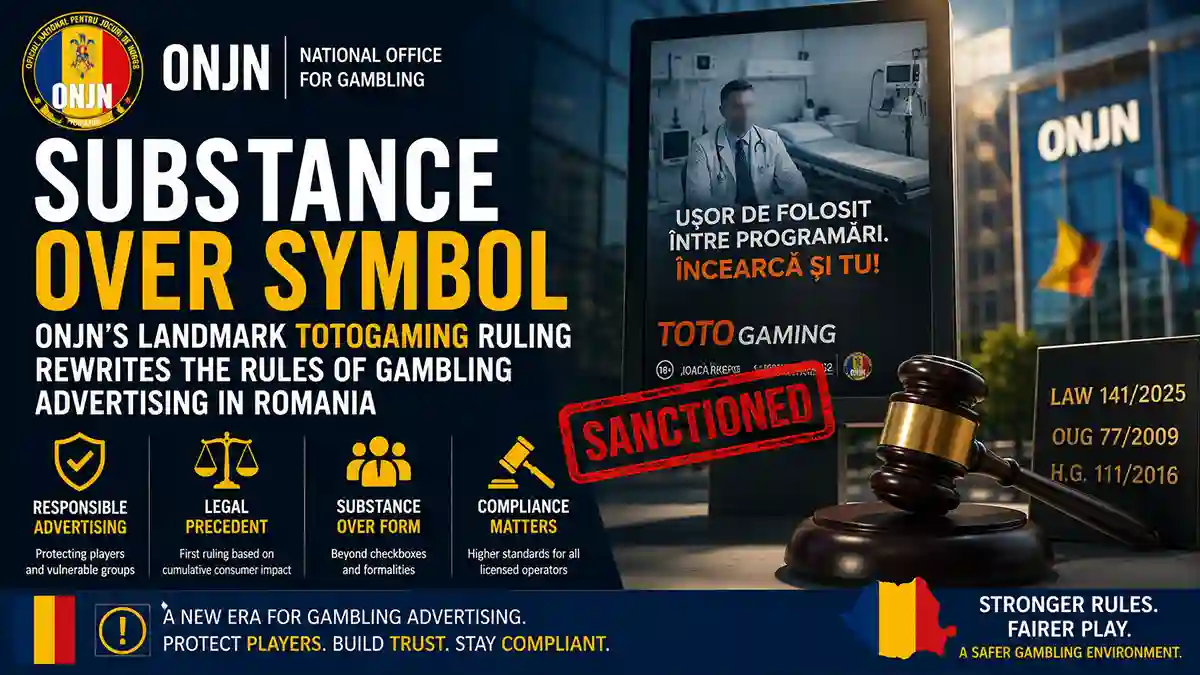
On 20 August 2026 Romania’s National Gambling Office (ONJN) fined TG Malta Limited, the operator of totogaming.ro, RON 20,000 over a doctor-themed advertising campaign and proposed suspending its license. The legal basis was the responsible-participation principle in art. 1^2(1) and art. 10(3) of OUG 77/2009, read with art. 6(1) of the methodological norms approved by HG 111/2016. It is the first time the ONJN has judged an ad by its overall effect on the consumer rather than by its formal elements alone.
What the campaign showed
The campaign ran on a street billboard in Florești (Cluj county), on the brand’s YouTube channel and on the “TotoGaming România” Instagram page. It featured a character presented as a physician, in a white coat with a stethoscope, in a consulting room with an examination bed and medical equipment.
Two lines drew the regulator’s attention:
- “Easy to use between appointments. Try it too!” (Ușor de folosit între programări. Încearcă și tu!)
- “In my office, after the last patient” (În cabinetul meu, după ultimul pacient)
Why the regulator found it non-compliant
The ONJN did not object to advertising as such, or to a commercial call to action. Advertising a licensed gambling product is lawful if it respects the gambling law and the principle of responsible participation. The problem was four elements working together:
- Gambling as gap-filler. Linking play to the time “between appointments” presents betting as something to do in any spare minute.
- The imperative. “Try it too!” invites the viewer to copy the behavior shown.
- The professional setting. Placing gambling inside a working day makes it look like an ordinary part of the routine.
- Borrowed medical authority. The ONJN singled this out most sharply: a doctor lends gambling a false impression of safety and low risk of addiction.
The legal basis and the penalty
The fine was RON 20,000. The ONJN also proposed suspending the operator’s license. Its Supervisory Committee decides on that proposal, taking into account the number of breaches, the operator’s conduct after the sanction and the consequences of the breach.
The audiovisual part of the campaign was referred to the National Audiovisual Council (CNA), which applies its own Audiovisual Code (CNA Decision 573/2025) to broadcast gambling advertising. That creates a parallel process with its own sanctions.
The ONJN cannot pre-approve advertising or remove ads from public spaces or television itself. Its escalation path is a fine, then suspension, then revocation. For its separate powers against illegal ads online, see ONJN’s action against illegal ads on Google and Meta.
The doctrine: form is a floor, not a shield
ONJN’s then-president, Vlad-Cristian Soare, called the decision a reference point for the whole industry. His position was that responsible-gambling notices cannot offset a message that points the other way, and that industry custom cannot override the legal standard ONJN must enforce. The regulator published an extract of its reasoning on onjn.gov.ro, which compliance teams should keep on file.
The practical consequence: the 18+ mark, ONJN logo, license details and responsible-gambling line are now the minimum. The regulator will also judge the setting, the persona, the call to action and the lifestyle the campaign promotes.
What operators should do now
- Drop “fit it into your day” concepts. Lines such as “between meetings”, “whenever you have a minute” or “on your break” now carry clear risk.
- Avoid trusted professionals. Doctors are the obvious case, but nurses, teachers and financial professionals raise the same issue of borrowed authority.
- Review campaigns as a whole. One concept across billboard, YouTube and Instagram is assessed as one campaign, so a flaw is repeated in every placement.
- Plan for two regulators. Any audiovisual element can open a separate CNA file.
- Put creative approval in the compliance calendar. Pre-launch legal review should sit alongside the other recurring obligations in the deadlines and taxes that keep your license alive, not in a standalone marketing sign-off.
Our compliance team reviews campaign concepts against the ONJN and CNA rules before launch.
What applies now (October 2026)
The day after the ruling, on 21 August 2026, the interim government replaced Soare with Valentin-Ioan Tomescu, who previously worked in the ONJN’s Supervision and Control directorate. The legal standard the ruling applied has not changed: art. 1^2 and art. 10(3) of OUG 77/2009 and art. 6(1) of the HG 111/2016 norms still govern gambling advertising content, and the CNA’s Audiovisual Code still governs broadcast slots. We have not seen a published Supervisory Committee decision on the suspension proposal as of 9 October 2026.
Advertising rules are also tightening on other fronts, including proposals on access age and online ads covered in Romania turns the screw on gambling. Operators applying for or holding a Class 1 license should review live and planned creative now, especially anything using professional personas or everyday-routine messaging.