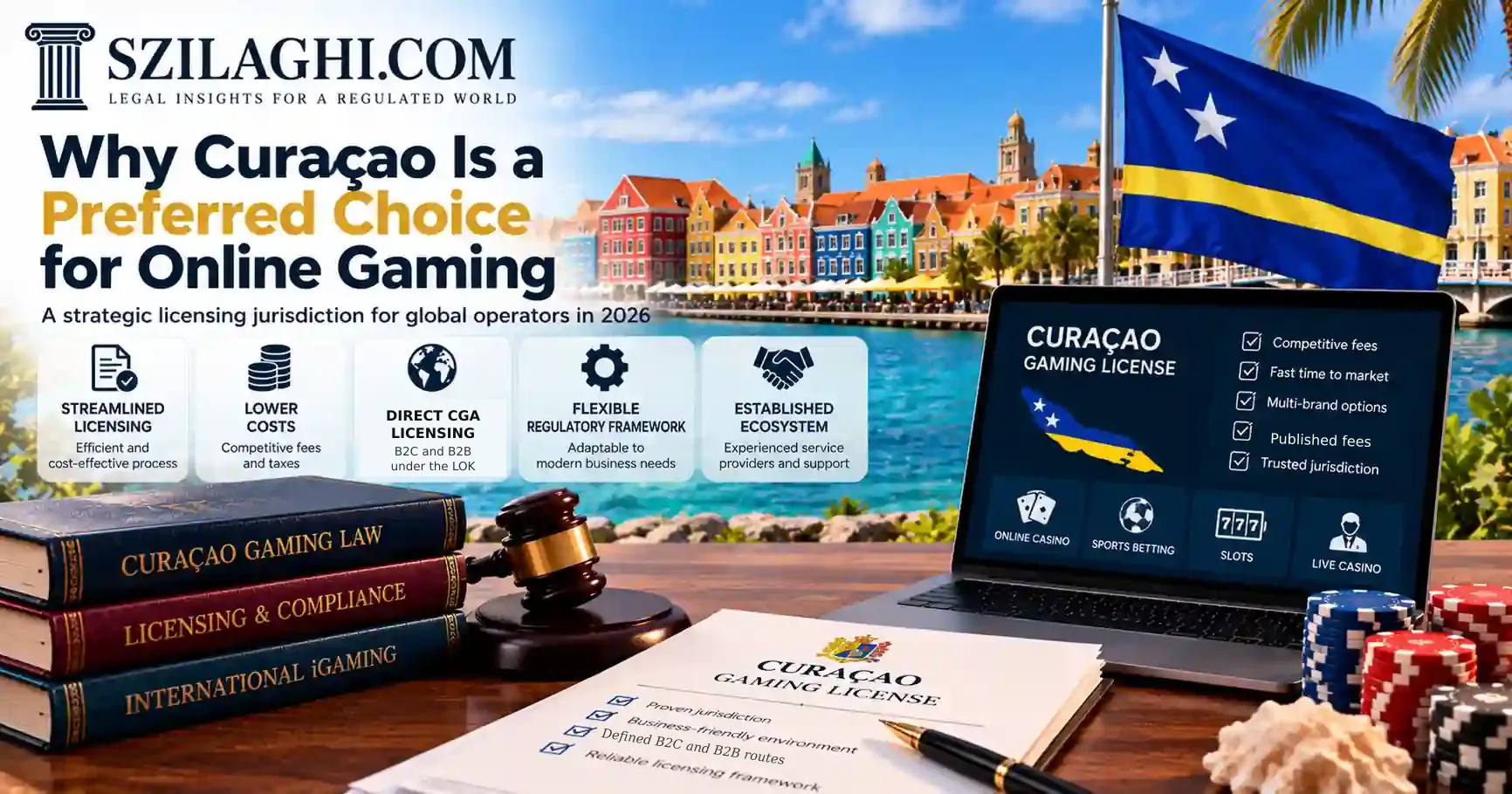
Is Curaçao still a good jurisdiction for an online casino or sportsbook in 2026? Yes, for businesses that are structured for it and understand its limits. Curaçao has moved from privately issued master-license sublicenses to direct supervision by the Curaçao Gaming Authority (CGA) under the National Ordinance on Games of Chance (LOK), in force since 24 December 2024. It offers defined B2C and B2B licenses, a published fee schedule and a long-established gaming services sector. It does not give unrestricted access to regulated countries, guaranteed banking or an automatically low tax rate.
The full cost table, documents and process are in our Curaçao gambling license guide. This article explains why operators still choose Curaçao, and where its limits are.
Curaçao in 2026 at a glance
| Question | Position |
|---|---|
| Regulator | Curaçao Gaming Authority (CGA) |
| Law | Landsverordening op de Kansspelen (LOK), in force 24 December 2024 |
| License types | B2C online gaming; B2B critical supplier |
| Application fee | €4,592, B2C or B2B, plus due-diligence fees per checked person |
| Annual fees, B2C | €47,450 (€24,490 license fee + €22,960 supervisory fee) |
| Annual supervisory fee, B2B | €24,490 |
| Local levy on international GGR | 0%; profit tax applies separately |
| Typical timeline | About 2–5 months for a prepared file; not a statutory deadline |
| Market access | Each player’s country decides; no worldwide passport |
Fees per the CGA “License Fees under the LOK” schedule, reviewed October 2026. Company formation, local substance, vetting, testing, professional services, payments and tax are extra.
1. The master-license model is history
The old system relied on four master-license holders issuing sublicenses. That model no longer applies: the LOK abolished master and sublicensing, old sublicenses expired, and the transitional “orange seal” ended on 15 October 2025. Today the CGA licenses each operator or supplier directly. Anyone offering a cheap sublicense from an old master-license holder is describing a route that no longer exists.
The change matters because a license’s holder, status and obligations can now be checked against the CGA’s own records. Before contracting with a Curaçao-licensed operator or supplier, verify the legal entity and the license it actually holds.
2. Why operators still choose Curaçao
An established ecosystem. Curaçao has years of experience with casino platforms, sportsbooks, compliance staff, testing providers and specialist payment firms.
Defined B2C and B2B routes. The B2C license covers player-facing gaming. The B2B license covers critical suppliers such as platforms, game developers and aggregators. Not every marketer or general contractor needs a supplier license.
Published fees. A B2C annual baseline of €47,450 can be compared with other jurisdictions before committing to incorporation or integration. For comparisons, see our gambling license costs in 2026.
Commercial flexibility, within the law. Operators can run several brands and international supplier networks, subject to CGA approval, technical requirements, responsible-gambling controls and each destination country’s rules. Several brands do not mean unlimited markets.
A more formal supervisor. Direct CGA licensing and published policies give a clearer compliance reference than the old system, but the controls have to be funded and maintained.
3. What a Curaçao license costs in 2026
| Item | Amount | When |
|---|---|---|
| Application fee, B2C or B2B | €4,592 | On filing, non-refundable |
| Due-diligence checks | Per UBO or qualifying interest holder | On filing |
| B2C license fee | €24,490 | Yearly, to the Treasury |
| B2C supervisory fee | €22,960 | Yearly, to the CGA |
| B2C annual total | €47,450 | |
| B2B annual supervisory fee | €24,490 | Yearly |
The first year’s fees are prorated from the issue date, then due by 15 January each year. Government fees are not the same as consulting fees or banking collateral; check the current CGA schedule before budgeting.
Tax is not automatic. The claim that every Curaçao gaming company pays 2% corporate tax is unsafe. There is no local levy on GGR from international operations, but the company can owe profit tax (15% up to XCG 500,000 and 22% above) and other taxes depending on its structure, and the countries where players live can impose their own duties.
4. Who can apply, and what they must prove
A serious application starts by deciding which entity will operate the gaming, hold player funds or supply critical software. The CGA’s requirements include:
- a Curaçao company with its seat on the island, a local managing director and office, and a local MLRO and key persons as the rules phase in;
- ownership, beneficial-ownership and source-of-funds records;
- fit-and-proper disclosures for UBOs and key-position holders, on the CGA’s separate personal forms;
- a business plan and product description;
- platform architecture and contracts with essential suppliers;
- AML/CFT, player-protection, complaints and security procedures;
- game testing and certification where required;
- financial projections and a sustainable operating plan.
The file differs for B2C and B2B. The CGA’s online gaming page lists the forms, policies and license conditions.
5. The application process
- Choose the license class. Identify the player-facing business and any critical supplier functions. A white-label agreement is not an exemption.
- Check eligibility and funding before spending on technology: ownership, key persons, structure and financing.
- Build the compliance file: policies, technical architecture and supplier due diligence.
- File through the CGA’s current portal. After a breach of its previous portal, run by an outside provider, the CGA closed it and moved license handling to a temporary portal from 19 October 2026. Confirm the active channel with the CGA before filing.
- Answer questions and fix gaps. Approval depends on the applicant and the CGA’s findings; no adviser can guarantee a license.
- Stay compliant after approval. Assess changes to ownership, platforms, brands and target countries before making them.
The 2026 portal breach
The CGA found on 17 September 2026 that its licensing portal and database had been accessed without authorization since December 2025, and data belonging to license holders was published online. On 7 October it decided not to reopen the portal and to end its use of the provider, and it scheduled a temporary portal from 19 October. Existing licenses remain valid and holders must keep meeting their obligations; the CGA said it would notify affected parties directly. Applicants should keep copies of everything they file and confirm submission channels directly with the CGA.
6. Banking, payments and crypto
A CGA license supports due diligence, but no bank, e-money institution or payment provider is obliged to accept the business. Expect requests for UBO records, financial statements, source of funds, permitted countries, transaction-flow diagrams, AML policies and key contracts.
Crypto payments have to be assessed against CGA policies, AML/CFT rules, banking arrangements and the law of each target market. Being technically possible does not make them lawful for every operator or every player’s country.
7. Curaçao is not an EU gambling passport
Curaçao is a constituent country of the Kingdom of the Netherlands, but it is not part of the EU single market for gambling. A Curaçao license does not authorize taking players from the Netherlands, Germany, Great Britain, Romania, US states or any other market that requires a local license; see which jurisdictions recognize foreign gambling licenses and where online gambling is legal.
Before marketing, map each country’s law, set product and age controls and geolocation rules, and keep a documented list of blocked markets. Affiliates and agencies must stay within the operator’s lawful territories.
8. Curaçao, Malta, Anjouan or Romania?
There is no universal winner. Curaçao suits international businesses ready to meet a defined CGA framework and work with specialist payment providers. Malta suits those who need an EU regulator and tier-one partners. Anjouan has a different cost and supervisory profile; see Anjouan versus Curaçao. Romania’s ONJN license is mandatory for anyone serving Romanian players.
Choose by where the customers are, which entity takes the bets, what the banks will support and the real first-year and recurring costs. Our jurisdictions register compares 25 regimes side by side, and why a start-up needs a Curaçao license covers the early-stage view.
The value of Curaçao is now in the compliance file
Curaçao remains a relevant international licensing jurisdiction, but the reason to choose it has changed. The advantage is no longer a cheap sublicense bought from a master-license holder; it is a direct statutory B2C or B2B license with defined obligations. Compare the full cost of compliance, the lawful target markets and banking feasibility before incorporating. The strongest application is one where the company structure, source of funds, technical systems and policies tell the same verifiable story.
Curaçao licensing with Szilaghi Consulting
Founded by Alex Szilaghi, licensing gambling businesses since 2004, Szilaghi Consulting has over 580 licenses obtained in multiple jurisdictions. We can assess whether Curaçao fits your business, set up the company structure and run the CGA application; see our licensing and compliance services or book a free fit call.
Reviewed 27 October 2026. Fees and CGA procedures change; check the current CGA schedule and portal notices before filing. General information, not legal or tax advice for a particular applicant.