Updated: October 14, 2026 | Szilaghi Consulting
How can you tell whether an online casino is trustworthy? Start by verifying that the operator is legally authorized to offer gambling where you live. Then check the exact website domain, account security, withdrawal rules, bonus terms, customer complaints procedures and responsible gambling protections.
A casino license is an important starting point, but it is not a guarantee that a platform is safe, fair or financially secure. Likewise, a professional website, an HTTPS connection or a familiar payment logo does not establish that a gambling business is legitimate.
In 2026, consumers must also consider cloned gambling websites, misleading advertisements, impersonated regulator seals, payment fraud and operators advertising services in countries where they are not authorized.
This guide explains seven checks that can help you identify warning signs before sharing personal information or depositing money.
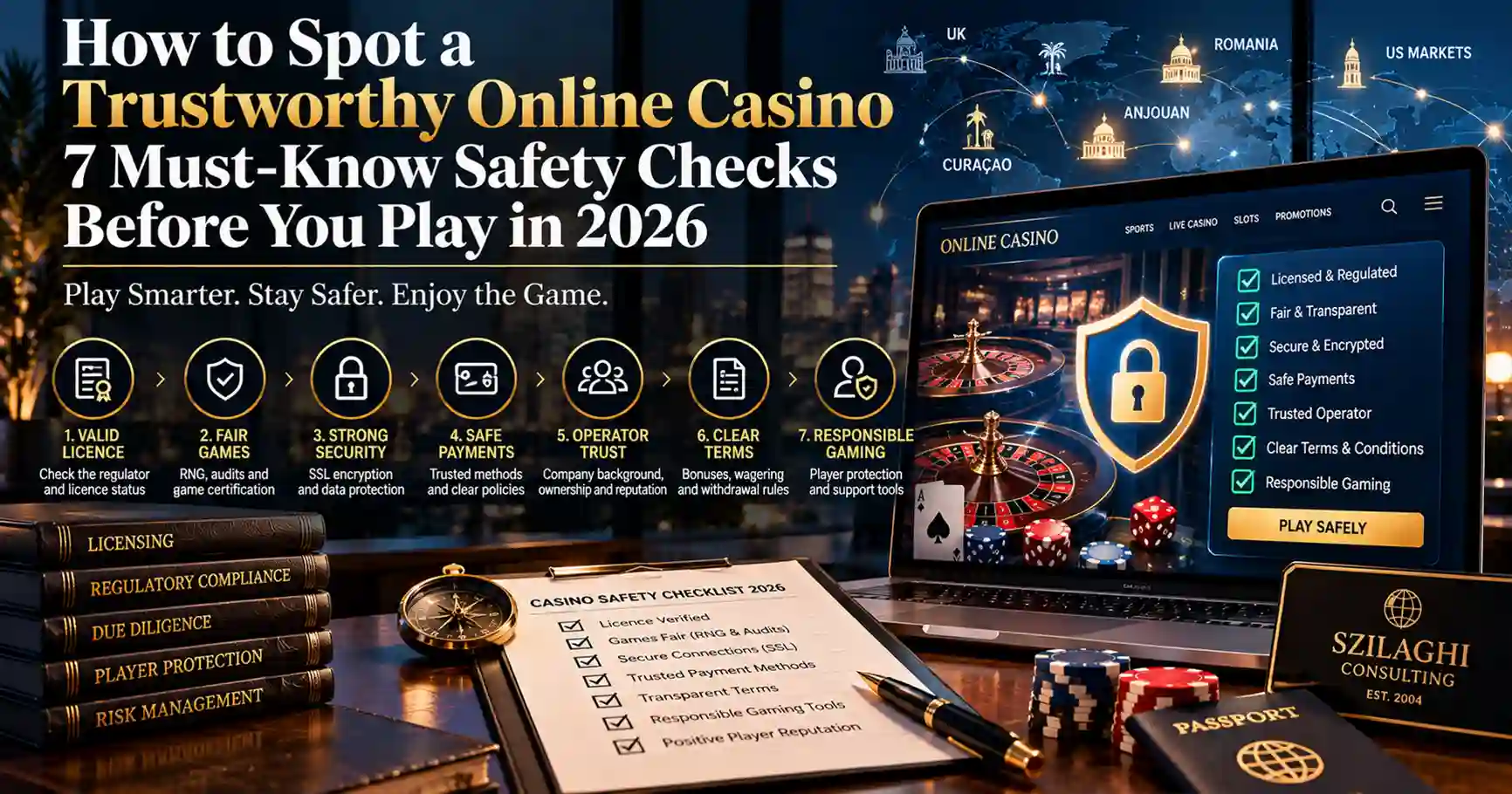
Online casino safety checklist for 2026
| Safety check | What to verify | Major warning sign |
|---|---|---|
| 1. Legal licensing | Active authorization for your country and the exact casino domain | Unverifiable license or offshore-only authorization |
| 2. Website security | Correct URL, encrypted connection, account safeguards | Lookalike domain, suspicious redirects or requests for passwords |
| 3. Payments and withdrawals | Fees, withdrawal conditions, customer fund protection | Requests for extra deposits to release winnings |
| 4. Terms and bonuses | Clear wagering rules, limitations and account conditions | Misleading bonuses or hidden restrictions |
| 5. Game integrity | Identifiable game providers and relevant testing information | Unverifiable claims of independently certified games |
| 6. Operator accountability | Legal company, support channels and complaints procedure | Anonymous ownership and no meaningful dispute process |
| 7. Responsible gambling | Age checks, deposit limits, self-exclusion and support | No effective player-protection measures |
If the operator cannot be independently verified or is not legally authorized in your location, do not deposit.
1. Verify the casino’s license and its right to serve your country
Is the casino legally licensed?
A legitimate online casino should clearly identify the company responsible for its gambling operations and provide verifiable licensing information.
However, the most important question is not simply whether the casino has a license. It is whether that authorization permits the operator to serve customers in your jurisdiction. A license issued in one country does not automatically grant permission to offer gambling in another.
For example, a casino licensed in Malta or Curaçao cannot rely on that authorization alone to serve customers in Great Britain if it lacks the required British regulatory authorization under the UK gambling licensing framework.
Where can you verify an online casino license?
Use official regulator websites rather than relying exclusively on the casino’s footer.
- Great Britain — UK Gambling Commission (UKGC). Check the UKGC public register, which shows licensing status, legal entities, trading names, domains and regulatory actions.
- Malta — Malta Gaming Authority (MGA). Use the MGA URL checker or licensee register on the MGA website and confirm that the website is connected to the operator named in the official register.
- Ontario, Canada — iGaming Ontario. Consult the official directory of regulated gaming websites. Ontario’s framework is geographically specific: a site appearing in another jurisdiction’s register does not automatically qualify for regulated play in Ontario.
- Romania — National Gambling Office (ONJN). Verify that the operator holds the appropriate Class 1 license and operating authorization and that its domain is authorized under the Romanian framework. See our guide to Romanian online casino licensing requirements.
- Other jurisdictions. Use the regulator or official directory responsible for the market where you are physically located. In the United States, online casino authorization is generally assessed at state level.
How to check a casino’s identity
Compare the legal company name, license number, trading brand, official website domain and authorization status.
A mismatch does not always prove fraud, because gambling groups can use multiple licensed companies or brands. Nevertheless, an unexplained discrepancy warrants further investigation. Do not rely on a static regulator logo: fraudulent websites can copy regulatory badges.
Bottom line: verify the actual operator and domain through an independent official source.
2. Check website security, domain authenticity and data protection
Does HTTPS mean a casino is trustworthy?
No. HTTPS helps protect information transmitted between your device and a website, but it does not prove that the website or its operator is legitimate. Fraudulent websites can also obtain valid encryption certificates.
Check the exact domain name and watch for additional characters, misspellings, unusual extensions or lookalike addresses intended to imitate an established brand. If you reach a casino through an advertisement, social media post, influencer link or unsolicited message, verify the address independently before submitting any information.
What account-security features should you look for?
A credible gambling platform should use appropriate safeguards, which may include:
- encrypted connections and secure account access;
- multifactor authentication where available;
- alerts or other controls for suspicious account activity;
- clear privacy and data-retention information;
- appropriate handling of identity documents and financial details;
- secure payment integration.
Do not send passwords or one-time login codes to customer service representatives. Be cautious if someone claiming to represent the casino requests remote access to your computer or asks you to install unfamiliar software.
What about personal information?
Online gambling operators may need identity information to meet age verification, anti-money laundering, fraud prevention and other legal obligations. A request for verification is not automatically suspicious. However, the operator should explain why the information is needed and provide a suitable process for submitting it securely.
Bottom line: verify the precise website address, review its data-protection information and never treat a padlock icon as proof of legitimacy.
3. Understand payment rules, withdrawals and protection of customer funds
How can you recognize transparent withdrawal terms?
Before depositing, read the casino’s withdrawal policy. It should explain the available methods, applicable fees, minimum and maximum amounts, expected processing procedures and the circumstances in which verification may be required. A trustworthy operator should not invent new payment conditions after a customer requests a withdrawal.
Are identity checks before withdrawal normal?
Sometimes. Regulated operators may need to verify identity, investigate suspicious activity or comply with anti-money laundering rules.
In Great Britain, online gambling businesses must obtain proof of age and identity before customers gamble. The UK Gambling Commission also states that an operator generally must not delay identity verification until withdrawal if it could reasonably have completed the checks earlier, although additional legal checks may sometimes be necessary.
This is more precise than assuming that every withdrawal taking longer than a fixed number of days is fraudulent.
Are deposits automatically protected if a licensed casino goes bankrupt?
No. A gambling license does not automatically protect customer balances in the same way as insured bank deposits. In Great Britain, remote gambling operators holding customer funds must disclose the applicable level of protection. The UKGC uses three broad categories:
| Protection category | General meaning |
|---|---|
| Not protected | Customer funds may not be recoverable if the operator becomes insolvent |
| Medium protection | Additional arrangements exist, but repayment is not absolutely guaranteed |
| High protection | Stronger arrangements, such as an independent trust structure, apply |
Operators must disclose the relevant classification to customers, and since 31 October 2025 additional reminders have applied to customers whose funds are not protected. Rules differ internationally, so check the specific arrangements governing the operator.
Payment red flags
Treat unexpected requests for additional payments with caution, particularly when the casino claims that winnings cannot be released until you pay a special tax, activation charge or verification deposit to a third-party account.
Unexplained changes to payment details, requests to transfer money to individuals and inconsistent withdrawal policies also require scrutiny.
Cryptocurrency payments may introduce additional recovery challenges. A platform’s acceptance of cryptocurrency does not prove legitimacy or make an otherwise unauthorized casino lawful.
Bottom line: understand how you can withdraw funds and what happens to your account balance if the operator fails.
4. Read the terms and conditions — especially bonus rules
What should you look for in casino terms?
The casino’s terms form part of the contractual relationship between the player and the operator. Before registering, review the provisions on eligibility, verification, deposits, withdrawals, account closures, inactive balances, complaints and changes to the terms.
If the wording is unclear or material conditions are hidden, do not assume the casino will interpret them in your favor.
What are wagering requirements?
A wagering requirement determines how much a customer must stake before certain bonus funds or associated winnings become withdrawable.
For example, a £20 bonus with a 10× wagering requirement could require a total of £200 in qualifying wagers, depending on the precise bonus calculation. That does not mean the player will ultimately receive £200, or that completing the wagering requirement is financially advantageous. Wagering conditions may also specify which games count, maximum permitted stakes and expiry dates.
Important 2026 change: Great Britain’s 10× cap
From 19 January 2026, the UK Gambling Commission introduced a cap of 10× on wagering requirements for incentives covered by the revised rules, and restricted mixed-product promotional incentives.
This means the former general advice that wagering requirements below 40× indicate a reasonable offer is unsuitable for 2026 readers. The 10× requirement is a British regulatory standard under the applicable rules, not a universal international limit; in other jurisdictions, different laws and promotional restrictions may apply.
Bottom line: a bonus should never outweigh concerns about licensing, withdrawals or personal financial safety.
5. Check game integrity and understand what fair gaming really means
How can you assess whether casino games are fair?
Regulated online casino games may be subject to technical standards, testing and certification requirements. Depending on the jurisdiction and product, these may cover random number generators (RNGs), game rules, reported return-to-player information and system integrity.
However, an assertion that a casino uses independently tested games is not enough by itself. Check whether the platform identifies its game providers and whether its testing claims can be connected to credible laboratories or documentation.
Examples of recognized testing and certification organizations in the gaming industry include eCOGRA, GLI and iTech Labs. A laboratory’s name or logo should not be treated as conclusive evidence unless the relevant claim can be verified.
Does an independently tested game guarantee winnings?
No. A game may function as designed and still carry a mathematical house advantage.
Return to Player (RTP) is a statistical measure calculated over a substantial volume of play. It is not a guarantee of what any individual will receive during a particular session. An advertised theoretical RTP of 96% does not mean that a customer who stakes €100 will necessarily receive €96 back; individual outcomes can vary substantially.
Other technical warning signs
Be cautious of unverifiable claims about guaranteed wins, manipulated results favoring the player, or systems that allegedly make casino losses impossible. Gambling outcomes should not be represented as dependable investment returns.
Bottom line: look for verifiable technical information, but understand that compliant games still involve financial risk.
6. Verify the operator’s identity, support and complaints procedure
How do you know who operates the casino?
The website should clearly disclose the relevant legal entity, the jurisdiction of incorporation, licensing information and a means of contacting the operator.
Customer support availability is useful, but a quick live-chat response does not prove that a gambling business is properly licensed. A more meaningful test is whether the operator provides clear written explanations of its policies and offers a formal procedure for addressing complaints.
What happens if the casino refuses to pay?
Document the issue. Retain transaction records, account communications, screenshots of the applicable terms and the dates of your withdrawal requests. Then follow the operator’s official complaints procedure.
In Great Britain, gambling operators must maintain complaints arrangements and give customers access to independent Alternative Dispute Resolution (ADR) for eligible disputes that remain unresolved after the applicable process. The UK framework generally provides for escalation after eight weeks, or earlier when the parties reach a final position or deadlock.
Other jurisdictions have different procedures, regulators and consumer remedies.
Should you rely on online reviews?
Use them as supplementary evidence. Independent reviews and player discussions can reveal recurring complaints about blocked accounts, withheld payments or misleading advertising. However, reviews may be sponsored, manipulated, outdated or written without full knowledge of the dispute, and a casino with positive ratings can still fail a regulatory check.
Prioritize official licensing registers, regulatory actions and documented complaints mechanisms over star ratings or influencer endorsements.
Bottom line: a trustworthy operator must be identifiable, accountable and subject to a credible complaints process.
7. Check responsible gambling tools and player protection
What responsible gambling safeguards should a legitimate casino offer?
In regulated markets, gambling operators are generally subject to player-protection requirements appropriate to the jurisdiction. These may include age verification, deposit limits, account restrictions, self-exclusion, responsible gambling information and procedures for identifying potentially harmful gambling patterns. The exact requirements vary by regulator.
In Great Britain, changes effective from 30 September 2026 require relevant online operators to offer gross deposit limits under the updated technical standards. Customers should also be able to obtain clear information about the relevant self-exclusion arrangements.
What is self-exclusion?
Self-exclusion allows an individual who wants to stop gambling to restrict their ability to gamble with an operator or, where available, through a wider exclusion scheme.
For example, GAMSTOP provides a multi-operator self-exclusion scheme covering UKGC-licensed online gambling operators. In Ontario, players can obtain information about the province’s BetGuard self-exclusion program through official channels.
Do not assume that self-exclusion from one casino or jurisdiction automatically covers all gambling platforms worldwide.
Why is this a safety check?
A casino that aggressively encourages continued gambling while making limits or exclusion difficult to access raises serious player-protection concerns. No gambling operator can make gambling risk-free.
Players should not use gambling as a way to repay debts, recover losses or generate reliable income. If gambling is causing financial stress or distress, stopping and seeking support is more important than finding a different casino.
Bottom line: effective player protection is an essential part of assessing an operator, not an optional website feature.
Warning signs of a potentially unsafe online casino
The following situations should prompt you to stop and verify the business before making any payment:
| Warning sign | Why it matters |
|---|---|
| License number cannot be verified | The operator may lack valid authorization |
| Casino is not on the relevant local register | It may not be authorized for your jurisdiction |
| Website imitates an established casino brand | Possible phishing or impersonation |
| Operator asks for extra money to release winnings | Possible payment fraud |
| Withdrawal rules change unexpectedly | Potential unfair treatment or misconduct |
| Bonus offers promise guaranteed profits | Misleading representation of gambling risk |
| Customer service cannot identify the legal operator | Weak accountability |
| No meaningful responsible gambling controls | Potential failure to protect consumers |
A single concern does not establish fraud in every case. But an unresolved problem with legal authorization, domain authenticity or payment demands is sufficient reason not to proceed.
What to do if you suspect an online casino is a scam
If you suspect that a casino is fraudulent, avoid sending further funds, identity documents or passwords. If you have already provided sensitive information, secure your accounts and contact your payment provider promptly.
Preserve transaction references, website addresses, emails, messages and screenshots. Report suspected illegal gambling to the competent gambling regulator, and suspected financial fraud to the appropriate police, consumer-protection or cybercrime authority in your country.
Where a casino is licensed but a dispute remains unresolved, use the formal complaints and escalation procedures available in that jurisdiction.
Do not pay an alleged recovery agent who promises to retrieve casino funds in exchange for an advance payment without independently verifying the service.
Conclusion: online casino safety starts with independent verification
A trustworthy online casino is not defined by advertising claims, welcome bonuses, attractive website design or positive online reviews.
The strongest indicators are verifiable legal authorization, clear contractual terms, transparent withdrawal arrangements, appropriate technical safeguards, effective complaints procedures and responsible gambling protections.
These checks can reduce exposure to fraud and regulatory risk. They cannot eliminate the financial risks inherent in gambling. Before providing personal information or depositing money, verify the operator independently. If material concerns remain unresolved, do not proceed.
A note for gaming operators: compliance is part of consumer trust
For licensed gaming businesses, consumer safety should be embedded in the operating model rather than presented as a marketing slogan.
Szilaghi Consulting advises gambling operators and B2B suppliers on regulatory licensing, corporate structuring, AML procedures, responsible gambling, technical certification, payment infrastructure and compliance. Our work includes preparing and reviewing the regulatory procedures operators need to meet their obligations in the markets they serve.
For help with licensing and compliance, see our gambling regulatory consulting services or contact Szilaghi Consulting.
This article is educational material, not an endorsement of any casino or an invitation to gamble. Last editorial review: October 14, 2026. Gambling legislation, licensing permissions and consumer remedies depend on the relevant country or state; always consult official regulatory information before relying on an operator’s claims.