Updated: October 13, 2026 | A guide for investors and entrepreneurs
Can you open a sports betting franchise in Romania in 2026? Yes, provided that the commercial arrangement complies with Romanian gambling legislation, the activity operates under an appropriately licensed gambling operator, customer interaction is handled by the organizer’s staff or by a company affiliated with it, and the premises meet the requirements of the National Gambling Office (ONJN) and the relevant local authority.
A sports betting franchise may allow an entrepreneur to take part in running a retail betting shop within the network of an established licensed operator without developing an entire sportsbook infrastructure from scratch.
However, a franchise agreement does not constitute a gambling license, nor does it automatically transfer the operator’s regulatory authorizations to the franchise partner.
In 2026, location verification has become particularly important. Government Emergency Ordinance (GEO) No. 7/2026 gave local councils additional powers over the approval of gambling activities, annual operating permits for physical gambling establishments and local fees.
Consequently, choosing a sports betting franchise involves considerably more than finding commercial premises and negotiating a commission. It is an investment that requires legal, operational and financial due diligence before signing any agreements.
1. What is a sports betting franchise?
A sports betting franchise or commercial partnership generally involves cooperation between a licensed gambling operator and an individual or company that contributes to the running of a retail betting location.
The licensed operator may provide its brand, betting system, sports betting products, technology infrastructure and operating procedures.
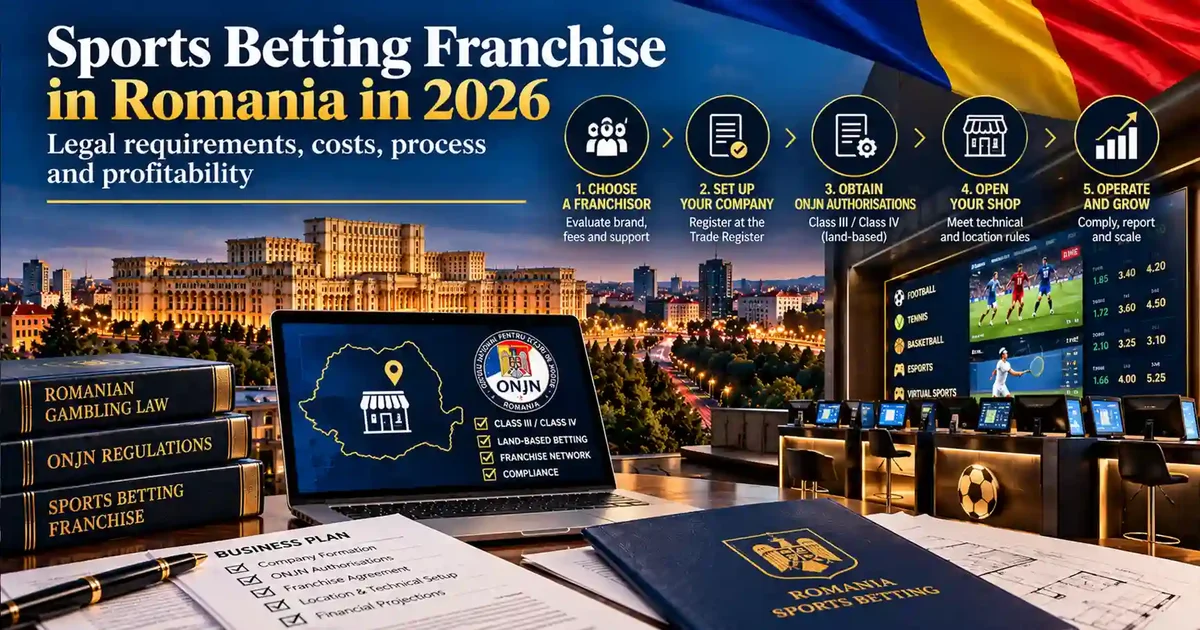
The local partner may contribute commercial premises, shop fittings, logistics and other resources specified in the agreement, within the limits allowed by law. The staff who interact with players must be employed by the organizer or by a company affiliated with it (see section 2).
Not every arrangement described commercially as a franchise qualifies as a franchise under general Romanian franchise legislation. Some relationships may instead be structured as leases, service agreements, management contracts, agency arrangements or other commercial partnerships.
The contractual structure matters because it determines the legal, financial and tax responsibilities of each party.
Who is responsible for bets and player winnings?
Where the licensed operator organizes the gambling activities, it remains responsible for the statutory obligations associated with those operations.
Nevertheless, the parties must determine who handles cash transactions, validates betting tickets, processes winnings, employs the staff and assumes liability for cash shortages or operational errors.
These responsibilities should not be inferred simply because the betting shop operates under the bookmaker’s brand. They must be clearly documented in the commercial agreement and approved operating procedures.
2. Do you need an ONJN license to operate a betting franchise?
The organization of traditional sports betting is regulated by GEO 77/2009 and its implementing regulations approved by Government Decision (GD) No. 111/2016. Our Romania gambling licensing overview compares the license classes and their costs.
The gambling operator must hold the appropriate license and applicable operating authorizations; the requirements are set out on our ONJN Class 1 license page.
An entrepreneur providing premises or services to an established licensed operator does not automatically become the holder of a separate gambling license. At the same time, a commercial partnership does not authorize the entrepreneur to organize gambling independently without the necessary regulatory approval.
What Law 107/2024 changed
Since April 28, 2024, art. 1(5) of GEO 77/2009, as amended by GEO 82/2023 and approved by Law 107/2024, restricts the classic franchise model:
- joint operation of gambling is permitted only between licensed organizers, under contracts concluded in accordance with the law;
- customer interaction must be handled exclusively by the organizer’s own qualified staff or by a company affiliated with the organizer;
- allowing an unlicensed entity to run gambling, explicitly or in disguise, is a contravention punished with a fine of RON 150,000–200,000 and confiscation of the sums obtained.
As a result, an unlicensed partner cannot run the shop with its own employees, even under the operator’s brand and systems. Its role must be structured so that it does not involve organizing gambling or interacting with players, unless it is a company affiliated with the organizer.
The precise position depends on the partner’s actual responsibilities. Before launching the business, verify:
- the legal entity holding the ONJN gambling license;
- the validity of the relevant licenses and operating authorizations;
- whether the proposed betting shop is covered by the authorized activities;
- the operator’s right to use the partner’s premises, and who provides the staff who interact with players (the organizer’s own staff or an affiliated company’s);
- responsibilities for betting equipment, data reporting and transaction records;
- cash management and payment of player winnings;
- local authority requirements for the proposed location.
The practical rule is straightforward: confirm the legal right to operate before investing in the premises.
3. What changed in 2026? New local authorization requirements
The most significant regulatory development for investors opening physical betting shops was introduced by GEO No. 7/2026, which added Article 18¹ to GEO 77/2009.
Under this provision, the local council decides whether gambling activities may be carried out within its administrative territory. Where they are permitted, operators must obtain the required annual local operating authorization before commencing operations, subject to the applicable legal framework.
Local councils may establish:
- areas where gambling establishments are permitted;
- criteria for approving applications;
- conditions concerning public order, health and safety;
- annual local fees calculated according to the surface area of the premises.
The local fee must be paid within the statutory period of 30 days from the issuance of the authorization.
What happens to existing betting shops?
GEO 7/2026 contains transitional provisions for operators holding valid ONJN authorizations when the amendments entered into force. For these operators, the application of the new local requirements is linked to the expiry of existing authorization periods, in accordance with the transitional rules.
This transitional treatment should not be interpreted as a permanent right to continue operating regardless of future local decisions. For a new betting shop, local authorization requirements should be verified before making any significant investment.
4. Technical requirements for opening a sports betting shop
GD 111/2016 establishes specific technical requirements for traditional sports betting agencies. Relevant conditions include:
| Requirement | Regulatory condition |
|---|---|
| Betting activity area | Minimum 15 m² |
| Information screens | At least 3 monitors |
| Betting terminal | At least one specialized dependent betting terminal |
| Ticket issuance | Appropriate printing equipment and infrastructure |
| Connectivity | Data transmission to the operator’s central system |
| Personnel | Staffing that covers the declared operating schedule, provided by the organizer or an affiliated company |
Meeting the minimum floor-space requirement does not necessarily mean that the premises are commercially or operationally suitable. A betting shop may need additional space for customer circulation, furniture, security, cashier operations, accessibility and other applicable requirements.
Fire safety, lawful use of the premises, signage and any other approvals required for the property must also be reviewed.
5. How to choose the right sports betting operator
Brand recognition matters, but it should not be the only factor when selecting a franchise partner. A potential partnership should be evaluated on the operator’s financial stability, technology, commercial terms and the support it offers its betting shop network.
Before signing, request a draft agreement and clarify the following:
Commission and remuneration. Will the partner receive a percentage of a defined contractual amount, a fixed commission or a combination of both? Is the remuneration based on total stakes, gaming revenue after the payment of winnings or another indicator?
Operating expenses. Who pays the rent, shop fittings, equipment, internet, electricity, salaries and maintenance?
Cash management. Who provides the initial cash float? Who is liable for cash shortages, fraudulent transactions, incorrect payments or operational errors?
Financial guarantees. Does the operator require a contractual deposit or guarantee from the partner? Under what circumstances can it be enforced, and when must it be returned?
Contractual conditions. Does the agreement include territorial exclusivity, minimum performance targets, penalties or mandatory additional investments?
Termination and exit. Who owns the installed equipment? Who removes the operator’s branding? What happens if the premises lose the required local authorization?
Investors should never assume that commercial terms advertised several years ago remain available in 2026.
6. How much does a sports betting franchise cost in Romania in 2026?
There is no single official price for opening a sports betting franchise in Romania. The initial investment depends on the city, commercial location, size of the premises, required improvements, equipment, staffing and the operator’s conditions.
The original 2019 version of this article referred to franchise fees of €100 to €5,000 and an initial investment of €4,000–€10,000. These figures should not be presented as representative of the 2026 market without current commercial quotations.
What should your investment budget include?
| Cost category | Items to consider |
|---|---|
| Premises | Rental deposit, advance rent, required modifications |
| Shop fittings | Furniture, installations, lighting, signage |
| Equipment | Monitors, betting terminals, printers, security systems |
| Personnel | Staff costs borne under the agreement, within the structure the law allows |
| Operations | Internet, electricity, cleaning, insurance |
| Franchise agreement | Potential entry fees and contractual guarantees |
| Authorizations | Administrative costs and local obligations, depending on the law and the contract |
| Working capital | Reserves for the launch and for months with reduced income |
Prepare at least two financial scenarios: one assuming lower-than-expected revenue and one based on achieving the operator’s commercial targets. Do not spend all available capital on fitting out the premises without keeping sufficient working capital.
7. Who pays the ONJN taxes in 2026?
A distinction must be made between the licensed gambling operator and the commercial partner contributing to the betting shop.
From August 1, 2025, following the amendments introduced by Law No. 141/2025, the annual authorization tax for traditional fixed-odds betting is 25% of the relevant gaming revenue at organizer level, with a minimum annual payment of €240,000.
This is an obligation under the licensed operator’s regime. It is not a standard tax automatically payable in full by every franchise partner. The full fee structure is covered in our analysis of Romanian gambling fees in 2026.
Separately, the local operating authorization fee introduced under the 2026 framework may affect the financial arrangements for an individual betting shop.
The franchise agreement should establish which party economically bears each category of expense. However, contractual cost allocation does not remove the statutory liability of the party legally responsible for the obligation.
The local partner may also have its own corporate tax, employment tax and accounting obligations, depending on its legal structure and the nature of its income.
8. How profitable can a sports betting franchise be?
Profitability depends on the contractual remuneration structure and operating expenses, not simply on the number of customers entering the shop. A high volume of stakes does not automatically generate a proportionately high profit for the franchise partner.
Example: monthly operating costs
Assume the partner bears the following monthly costs:
| Expense | Illustrative monthly amount |
|---|---|
| Rent | RON 4,000 |
| Staff costs borne under the agreement | RON 10,000 |
| Utilities and communications | RON 1,500 |
| Other operating expenses | RON 2,500 |
| Total monthly costs | RON 18,000 |
To cover these costs, the partner needs at least RON 18,000 in monthly contractual remuneration, before other adjustments, taxes, depreciation and financing expenses.
If monthly remuneration reaches RON 22,000, the simplified operating result is RON 4,000. If it falls to RON 15,000, the business records a simplified operating loss of RON 3,000.
This is a hypothetical illustration, not an industry average or earnings forecast.
The payback period should be calculated from the profit actually available, not from the gross value of bets placed.
9. How to open a sports betting franchise in Romania: step by step
Step 1: Verify the municipality
Identify the local council decisions adopted under GEO 7/2026. Confirm whether gambling is permitted in the municipality, whether the proposed address falls within an authorized area and which approval criteria apply.
Step 2: Verify the gambling operator
Request information on the operator’s ONJN license, relevant authorizations and the commercial model offered to partners, including who will provide the shop’s staff.
Step 3: Assess the corporate structure
Determine whether a new company is required, which business activities must be registered and which tax and operational obligations apply. Our corporate structuring services and company formation guide cover the options.
Step 4: Negotiate the franchise agreement
Clarify remuneration, operating expenses, financial guarantees, compliance obligations, duration and termination conditions.
Step 5: Evaluate the premises
Review the surface area, accessibility, utilities, technical requirements and the feasibility of obtaining the necessary approvals.
Step 6: Prepare the authorization documentation
Coordinate with the licensed operator on the ONJN documentation and the local authorization procedure. Clearly establish which legal entity applies for each approval.
Step 7: Fit out the shop and prepare operations
Install the required authorized equipment and agree with the operator on cashier procedures and the training of the staff who interact with players on access restrictions, payments, self-exclusion and incident management.
Step 8: Open only after meeting all legal requirements
Do not start betting activities on the strength of a contractual promise or an authorization application that is still pending.
10. Main risks of a betting franchise in 2026
Investors should carefully evaluate local authorization risk, the risk of a non-compliant contractual structure, commercial risk and dependence on a single licensed operator.
A location with substantial customer traffic may become unusable for betting if it fails to meet the conditions imposed by the local council. Signing a long-term lease before verifying authorization eligibility could turn an apparently attractive investment into a costly commitment.
A model in which an unlicensed partner actually runs the shop with its own employees exposes both the partner and the operator to the sanctions introduced by Law 107/2024.
Contractual remuneration may also fluctuate with business performance, commission adjustments or the operator’s commercial decisions. To protect the investment, negotiate clear provisions on failure to obtain authorization, suspension of activities, legislative changes and termination.
11. Is a sports betting franchise worth it in 2026?
A sports betting franchise may be an opportunity for entrepreneurs with suitable premises, adequate working capital and administrative capacity, in a structure compatible with the 2024 rules.
The main advantage is the possibility of using the technology, brand and operational experience of an established licensed operator, subject to a legally compliant commercial structure. Disadvantages include reliance on the operator, contractual margins, fixed operating costs and exposure to changing local rules.
In 2026, a successful betting shop investment starts with verifying the authorization requirements, not with signing the lease.
A proper assessment should answer three questions:
- Can the proposed location operate legally?
- Is the commercial agreement financially sustainable?
- Can the business withstand several months of below-budget results?
If these questions cannot be answered with documented evidence, the project is not yet ready for launch. For other markets, our jurisdictions register compares licensing regimes internationally.
How can Szilaghi Consulting help?
Szilaghi Consulting provides advisory services covering gambling licensing, corporate structuring and regulatory compliance in Romania.
For investors and commercial partners, a preliminary assessment may include reviewing the proposed legal structure, verifying contractual responsibilities, identifying the applicable ONJN requirements and evaluating the main authorization risks.
Planning to open a sports betting shop or partner with a licensed operator in Romania? Contact Szilaghi Consulting before committing significant capital to clarify your project’s legal structure and regulatory requirements.
Legal framework
- GEO No. 77/2009 on the organization and operation of gambling, as amended, including art. 1(5) and art. 18¹;
- GD No. 111/2016 and its implementing regulations, particularly the provisions on traditional betting agencies;
- GEO No. 82/2023, approved by Law No. 107/2024 (joint operation and staff interacting with players);
- Law No. 141/2025 on amendments to gambling taxation;
- GEO No. 7/2026 on local authority powers over gambling activities;
- National Gambling Office (ONJN) — licensing and operator authorization information;
- the local council decisions applicable to the proposed location.
This article is provided for informational purposes and reflects the regulatory framework reviewed as of October 13, 2026. Local rules, contractual arrangements and tax obligations must be verified for each project before committing to an investment.