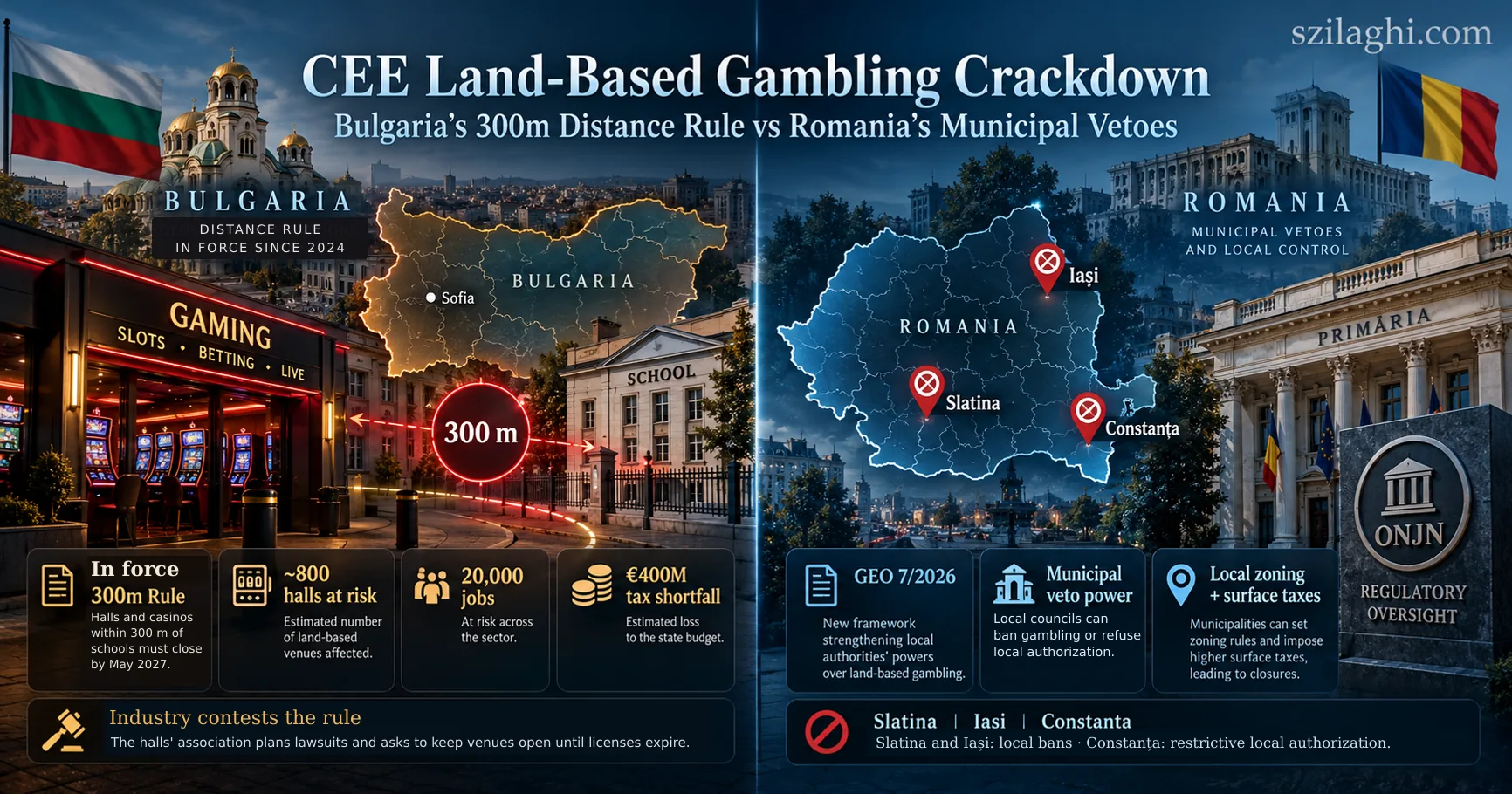
What is changing for land-based gambling in Bulgaria and Romania? Bulgaria’s Gambling Act, amended in 2024, requires gaming halls and casinos to be at least 300 meters from schools, playgrounds and similar sites, and existing venues must comply when their grace period ends in May 2027. Romania’s OUG 7/2026 instead lets each local council ban land-based gambling or allow it only in set zones against a local fee. Both put licensed venues at risk: a national license no longer guarantees that a particular address can stay open.
The two systems work differently. Bulgaria asks whether a venue is too close to a protected site. Romania asks whether the council wants the activity in the municipality at all. For operators, investors and landlords, that difference decides how to check a site, value a license and write a lease.
Bulgaria vs Romania at a glance
| Issue | Bulgaria | Romania |
|---|---|---|
| Legal basis | Gambling Act, art. 44, amended in 2024 | OUG 77/2009, art. 18¹, added by OUG 7/2026 |
| Mechanism | National distance and population rules | Municipal ban or local authorization, zones and fee |
| Who decides | National law; National Revenue Agency supervises | Local council, alongside the ONJN license |
| Venues covered | Gaming halls and casinos | Land-based gambling venues; online is not covered |
| Location test | ≥ 300 m from schools, playgrounds and similar sites; towns over 10,000 people | Whatever the council decides: ban, zones or conditions |
| Existing venues | Three-year grace period ending May 2027 | Current ONJN authorizations run to expiry; no renewal where banned |
| Local fee | None equivalent | Annual fee per square meter, set by each council |
| Status, October 2026 | In force; draft adds proof-of-compliance deadline of 30 April 2027 | In force; about 90 councils had decided by August 2026 |
| Main risk | An existing address fails the distance test | The council bans or refuses the activity |
1. Why location now matters as much as the license
For years, entering a Central and Eastern European market meant national licensing, tax, equipment certification and technical compliance. Those still matter. But in 2026 a new question comes first for physical venues: can gambling lawfully take place at this address at all?
Bulgaria answers it through national geography: a fixed minimum distance from protected sites. Romania answers it through local politics: the council decides. The first can be checked with a measurement; the second depends on a vote that can change.
2. Bulgaria’s 300 m rule
The 2024 amendments to the Gambling Act, in force since May 2024, require gaming halls and casinos to be at least 300 meters from schools, kindergartens, universities, community centers (chitalishta), children’s playgrounds, student dormitories and social services for children and young people. Venues in four- and five-star hotels are exempt. Halls and casinos are also barred from settlements with fewer than 10,000 residents, except national resorts and towns within 30 km of a border checkpoint.
Existing venues were given three years to comply, so the grace period ends in May 2027. The rule is not a 2026 proposal. What is new is a Ministry of Finance draft amendment, under public consultation in October 2026 and planned to apply from 1 January 2027, that would require licensed operators to prove compliance to the National Revenue Agency by 30 April 2027, on pain of losing the license. The draft does not repeal the location restrictions.
How the distance is measured
Bulgaria regulates the measurement itself. Draft rules published in 2024 measure along the shortest pedestrian route rather than in a straight line, with municipal certificates for some protected sites. A straight line on an online map is not a substitute: operators need a measurement that will stand up when the National Revenue Agency checks it.
3. Why Bulgaria’s industry is threatening to sue
The Association of Organizers of Gambling Games and Activities in Bulgaria estimates that about 800 of roughly 1,000 gaming halls would have to close, putting up to 20,000 jobs and about €400 million a year in taxes and fees at risk. These are industry estimates, not government forecasts, but they show the scale of the concern. Its chairman, Milen Totev, has said the industry will sue the state; even Bansko, with 10,090 residents and no national-resort status, could lose its casinos if its population dips below 10,000.
The association says it supports protecting children and limiting aggressive advertising, but asks for halls to keep operating at least until their current licenses expire, arguing that licensees invested on the strength of those licenses. It also points to betting points, which it says do not face the same distance rule and could take over demand from closed halls. A different treatment of different products is not automatically unlawful, but it is the kind of inconsistency that courts weigh when judging proportionality.
4. Romania’s OUG 7/2026: the license meets the council
OUG 7/2026, published in Monitorul Oficial no. 146 and in force since 25 February 2026, added art. 18¹ to OUG 77/2009. Each local council now decides by resolution whether land-based gambling may take place in its territory. If it allows it, the council sets the permitted zones and an annual local authorization fee per square meter of the venue, payable within 30 days of the authorization.
An ONJN license therefore no longer guarantees the right to open, or keep, a venue in a given town. Operators face two layers:
- National: the ONJN license and annual operating authorization.
- Local: the council’s decision to ban or allow, its zoning, and the local operating authorization and fee.
Existing ONJN authorizations run until they expire, but they cannot be renewed where the council has banned the activity. Online Class 1 operators and Class 2 suppliers are not subject to the local layer. The effect has been sharp: ONJN authorized 2,337 slot positions in February–May 2026, against 18,981 in the same months of 2025, and by early August only about 90 of roughly 3,100 local authorities had decided, 35 with bans and 55 allowing gambling. See Romania’s local council veto and how Romania lost most of its slot machines.
5. Slatina, Iași and Constanța: three different outcomes
Slatina: a ban. On 13 March 2026 Slatina became the first Romanian city to vote a full ban, covering gambling halls and betting agencies and keeping only state lottery games. The city had about 70 halls and 20 betting agencies; they close as their authorizations expire.
Iași: a ban, then a county-wide one. The Iași local council voted unanimously on 27 April 2026 for its “no slot machines” project, after a draft that covered slot machines, betting, casinos, poker and bingo. The city had about 150 halls and 2,127 slot machines. In July 2026 all 98 councils in Iași county voted to close slot venues; ONJN said the last authorizations there expire in February 2027.
Constanța: restriction, not a ban. On 27 August 2026 Constanța’s council rejected a total ban and adopted, by 17 votes to 9, a regulation on gambling in physical venues, after amendments that critics said made it much more permissive. Venues now apply for local authorization one by one: seven applications were on the council’s agenda for 29 October 2026. Constanța should not be described as a city that has banned gambling.
Many other councils have acted, from bans in Cluj-Napoca, Ploiești, Bacău and Vaslui to restrictive models such as Pitești’s, which would allow gambling only in accredited hotels and large malls. There is no national list: each council’s decision has to be read for its scope, exceptions and transition.
6. What Romania’s local layer adds to costs
A land-based business plan in Romania now has to include:
- the ONJN license and authorization fees;
- the local fee per square meter, which varies by council (Iași’s draft proposed about RON 500 per square meter a year);
- rent and operating costs, within the zones the council allows;
- the cost of relocating or closing venues in towns that ban;
- equipment transport or disposal, staff restructuring and possible disputes.
A fee or authorization in one municipality says nothing about the next. Check the local decision before signing any lease, acquisition or expansion. For the national costs, see the Romania Class 1 license and slot-machine licensing in 2026; for betting shops, opening a sports betting franchise in Romania.
7. The EU dimension
Bulgaria and Romania are EU member states, but gambling is an area where EU law leaves states wide room to restrict for consumer protection and public order. Restrictions must still be consistent, proportionate and non-discriminatory. Questions are most likely where:
- different gambling products are treated very differently;
- existing licensees face new restrictions after large investments;
- local decisions follow no clear criteria;
- approvals are refused without adequate reasons;
- a measure goes further than its stated public-interest goal requires.
An EU company registration or a national license does not override a valid location rule or council decision. Equally, the authorities must be able to justify their measures. Any challenge needs a close look at the measure, the evidence and the national and EU case law.
8. What operators and investors should do
In Bulgaria, measure first. Map every hall and casino against the protected sites and the 10,000-resident threshold, get measurements that follow the official method, and identify venues at risk before the April–May 2027 deadlines. Review leases for regulatory-change and relocation clauses.
In Romania, check the council first. For every existing or planned venue, find the local decision, its zones and conditions, the authorization procedure and the expiry date of the current ONJN authorization.
When buying a gaming business, look past the license. Ask:
- Can the business keep operating at each of its current addresses?
- Are the licenses and authorizations valid, and when do they expire?
- Is there a documented plan for the location rules?
- Which local permissions are needed, and could a council vote close or move venues?
- What would restructuring the portfolio cost?
- Are legal challenges pending or planned?
A valuation that ignores location risk can badly overstate what a land-based portfolio is worth.
9. A divergent Europe
While Bulgaria and Romania tighten physical gambling, other markets are opening online: Finland’s competitive online market launches on 1 July 2027, with 12 licenses already granted. There is no single European license or entry strategy; for each country, check both the license and the right to operate the product through the planned channel. Our Bulgaria gambling license guide and Romania gambling license overview cover the national routes.
The license is no longer the whole investment
Bulgaria applies a national distance rule to existing halls and casinos; Romania lets municipalities decide whether gambling can operate locally at all. Both make the physical premises, and their long-term eligibility, central to land-based compliance. A national license may establish the right to run a regulated activity. It no longer guarantees that every existing venue remains a place to run it.
Land-based regulatory advice from Szilaghi Consulting
Founded by Alex Szilaghi, licensing gambling businesses since 2004, Szilaghi Consulting advises operators and investors on licensing, structuring and compliance in Romania and across the region. If your venues in Romania or Bulgaria face a local ban or distance rule, see our licensing and compliance services or book a free fit call for a portfolio review.
Updated 27 October 2026. Bulgaria’s 30 April 2027 proof-of-compliance deadline is a draft; the industry figures are association estimates. Council decisions change; check the current decision for each address. General information, not a legal opinion for a particular business.