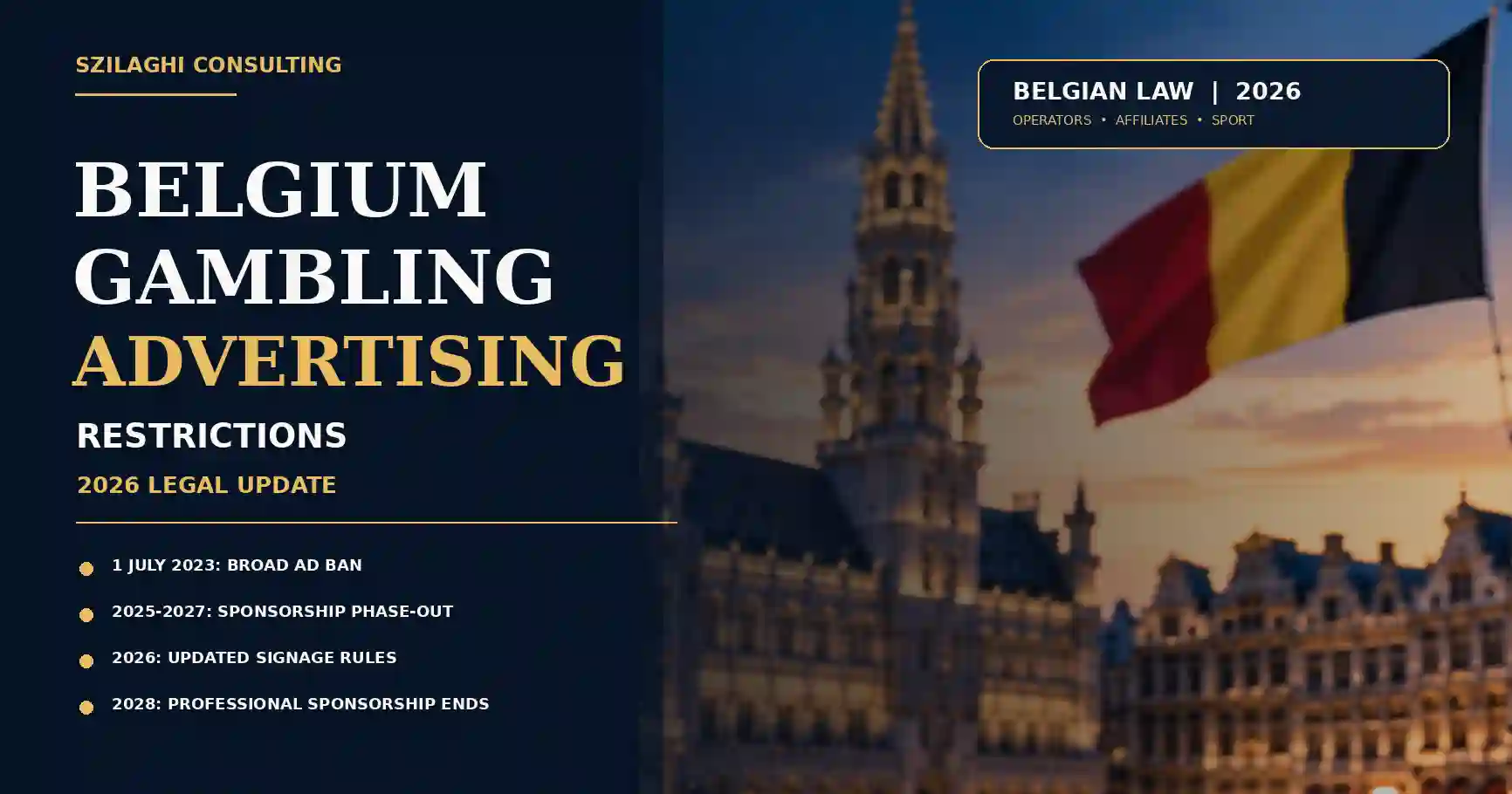
Is gambling advertising completely banned in Belgium in 2026? Not entirely. Belgium broadly prohibits gambling advertising under rules in force since 1 July 2023, but specified exceptions remain for licensed operators: narrowly regulated search advertising, own-site communications and certain transitional sponsorship arrangements. Further professional sports sponsorship restrictions take effect on 1 January 2028.
The restrictions reach television, radio, online campaigns, social media, sponsorship, branding and third-party marketing. In September 2026, new rules on the signage of certain betting shops also entered into force.
For operators and their commercial partners, the question is no longer simply whether advertising is prohibited. It is whether a specific communication falls within one of the forms Belgian law expressly permits. This guide sets out the rules, the exceptions and the practical compliance steps as of October 2026.
Belgium gambling advertising rules: key dates
| Date | Development |
|---|---|
| 27 February 2023 | Royal Decree setting detailed restrictions on gambling advertising |
| 1 July 2023 | Main advertising restrictions enter into force |
| 1 September 2024 | Amended Gambling Act (Act of 18 February 2024): statutory general advertising ban, exceptions only by royal decree; bonuses banned; minimum age 21 |
| 1 January 2025 | Further sports advertising restrictions and transitional arrangements |
| 14 September 2026 | Amendment on signage for specified Class F2 betting establishments |
| 31 December 2027 | Transitional period for certain sports-shirt branding ends |
| 1 January 2028 | Remaining professional sports sponsorship permission repealed |
Read these dates together with the applicable license classes, permitted formats and any regional or municipal rules. In judgment 101/2024 of 26 September 2024, the Constitutional Court confirmed that the 2023 decree remains applicable under the amended Act until replaced.
1. What does Belgium’s gambling advertising ban actually cover?
Article 2 of the Royal Decree of 27 February 2023 sets the core principle: only the advertising forms expressly listed in Chapter 2 of the decree are permitted. It applies to holders of Belgian license classes A, A+, B, B+, F1, F1+, F1P, F2 and E.
Advertising is defined broadly: any communication intended directly or indirectly to promote gambling, including the use of an operator’s brand or logo. A campaign cannot escape the rules by avoiding an explicit invitation to bet — a branded post by an influencer can be gambling advertising even without the words “play now”.
Is every form of advertising prohibited? No. The decree keeps narrow exceptions for trade-directed advertising, incidental exposure during event coverage, restricted sports sponsorship, specified search advertising and limited advertising on the operator’s own digital channels. Each must be read according to its exact conditions. A license does not confer general advertising rights.
2. Which advertising channels are restricted?
Mass-market gambling advertising is heavily restricted. There is no general permission to advertise on television, radio, in print, on billboards or through ordinary social media campaigns.
| Channel | Position in 2026 |
|---|---|
| Television and radio | Broadly prohibited outside the exceptions |
| Newspapers and magazines | No general mass-market permission |
| Outdoor billboards | Broadly restricted |
| Search-engine advertising | Narrow exception under Article 10 |
| Operator’s own website | Limited advertising under Article 11 |
| Operator’s own content-sharing accounts | Restricted communication under Article 12 |
| Third-party affiliates | Significant restrictions; assess the activity and the pay model |
| Sports sponsorship | Transitional and product-specific limits |
| Betting-shop signage | Only within the statutory limits |
| Trade-directed advertising | Narrow exception for communications aimed only at gambling-sector workers |
3. Can licensed operators still advertise on Google?
Article 10 lets qualifying license holders promote themselves through a search advertising program in response to gambling-related search terms, as paid search results. It does not permit display advertising, programmatic campaigns, remarketing or social media ads, and the content, age-protection and targeting rules still apply.
Before activating a search campaign, confirm:
- which entity pays for and benefits from the ad;
- its Belgian license status;
- the search terms and the ad format;
- the approved brand and products;
- the geographic targeting;
- the required warnings and age information;
- any further conditions set by the regulator or the platform.
A platform accepting the campaign is not proof that it complies with Belgian law.
4. What advertising is permitted on an operator’s own website?
Article 11 lets relevant license holders advertise themselves and their games on their own websites, provided that:
- the advertising allows no interaction within the ad content;
- no third party is paid for carrying out that advertising;
- moving images last no more than five seconds.
Article 12 sets comparable conditions for the operator’s own accounts on content-sharing platforms. A brand-owned social account is not permission to run paid campaigns, sponsored influencer content or interactive promotions; distinguish ordinary account information, permitted advertising and prohibited communications.
5. Are gambling affiliates allowed to advertise in Belgium?
Traditional third-party affiliate marketing faces substantial restrictions. The decree authorizes the specified license holders to advertise within the permitted forms; several digital exceptions are framed around the licensee advertising itself, and Articles 11 and 12 bar payments to third parties for advertising through those channels. A conventional affiliate model — paid articles, influencer endorsements, banners or sponsored content aimed at Belgian consumers — may therefore be incompatible with the regime.
Is every affiliate website illegal? Not necessarily. An independent site with factual information about gambling regulation is not automatically advertising; the assessment depends on content, commercial relationships, compensation, links, audience and purpose. But a site paid to send consumers to operators needs particular scrutiny, and calling content an “independent review” does not remove its advertising character.
What about CPA and revenue share? The pay model is not the first question. Belgian law first asks whether the underlying advertising is permitted; an attractive commission structure cannot make prohibited advertising lawful. Operators should review legacy affiliate contracts, links, creatives and traffic sources before letting campaigns continue.
6. Sports sponsorship: what changes in 2028?
Belgium phased out gambling sponsorship to let existing relationships transition. The decree restricted sports branding and added measures from January 2025, limiting logo placement, branding surface and the athletes involved: no branding on the front of sports shirts, and restrictions for players under 21. Certain narrow sponsorship arrangements remain possible in 2026 under those conditions.
On 1 January 2028, the remaining provision permitting sponsorship of professional sports associations is repealed. Non-professional sport, incidental coverage and other communications still need separate assessment under the rules in force at the relevant date.
What clubs and operators should review in 2026:
- contract expiry and renewal dates;
- termination rights linked to regulatory change;
- permitted logo placements;
- broadcasting and event-promotion arrangements;
- sponsorship payments running beyond 2027;
- branding-removal obligations;
- potential compensation claims.
A contract that is attractive today can create real compliance problems if it runs into 2028 without the right provisions.
7. September 2026: new betting-shop signage limits
An amendment in force from 14 September 2026 addresses specified Class F2 betting establishments. Advertising relating to betting may occupy no more than one-fifth of the applicable space and 3 m² in total. The rule sits alongside the general provisions on gambling-establishment facades and any regional or municipal requirements, so one signage standard cannot simply be applied to every retail premises — the license category and configuration matter.
8. What must permitted gambling advertising contain?
Even within a permitted category, content is regulated. Permitted advertising must not, among other things:
- target vulnerable groups or people under the minimum age;
- use personalized advertising;
- make unfounded claims about winnings;
- encourage irresponsible or excessive gambling;
- present gambling as an alternative to work or savings, or as a way out of financial problems;
- associate gambling with social, financial or sexual success;
- use specified depictions or celebrity voices;
- link gambling with certain alcohol, tobacco or credit promotions.
It must also carry the minimum-age indication and the prevention message. A generic advertisement built for another European market is rarely suitable for Belgium: compliance needs both a permitted channel and compliant content. Compare the approach taken in the UK’s gambling advertising rules and the Dutch KSA advertising guide — similar themes, different legal tests.
9. Is the advertising ban the same as Belgium’s licensing rules?
No. Advertising permission and gambling licensing are separate questions. The Belgian Gaming Commission administers the licensing framework, with different license classes for different activities and establishments; certain online authorizations are linked to licensed land-based activity. A business can hold the right license and still be restricted in how it advertises, and a marketing company cannot rely on an operator’s license as a blanket exemption.
For international groups, the analysis should establish:
- which company holds the relevant gambling license;
- which products are authorized;
- which website or brand is involved;
- whether the proposed advertising format is expressly permitted;
- who creates, publishes and pays for the advertisement;
- which audience will receive it.
Advertising rules differ by market as much as licenses do — see how to compare regulated gambling jurisdictions, or the license guides for the United Kingdom, Malta and Romania’s ONJN framework. In Romania, ONJN has gone further and forced Google and Meta to remove illegal gambling ads.
10. What are the risks of non-compliant advertising?
Unauthorized gambling advertising can expose operators and their partners to investigation, administrative measures, financial penalties, licensing consequences or enforcement under other legislation, depending on the provision breached. Routing a campaign through a supplier incorporated outside Belgium does not remove the exposure if it targets Belgian consumers — a particular risk for cross-border affiliates, international agencies and brands with centrally managed digital marketing.
11. Compliance checklist for operators and affiliates
| Item | Review |
|---|---|
| License status | Belgian licensee and authorized activity |
| Classification | Does the content qualify as gambling advertising? |
| Statutory exception | The exact provision that permits the communication |
| Platform | Does the channel fit the permitted format? |
| Creative content | Prohibited claims, representations and targeting |
| Audience | Age restrictions and vulnerable-player safeguards |
| Third-party pay | Affiliate, influencer and agency agreements |
| Sports sponsorship | 2025–2028 transition and contract duration |
| Retail signage | License category and the 2026 rules |
| Evidence | Approvals, ads, contracts and publication records |
| Monitoring | Changes in legislation, guidance and enforcement |
Set up a written approval process before any campaign goes live, with legal, marketing and compliance responsibilities clearly assigned.
12. Preparing for 2027 and 2028
The next commercial milestone is the end of the professional sports sponsorship transition. Operators with contracts running into 2028 should review them now; agencies should test whether their Belgian digital services remain viable. Licensed operators need an inventory of promotional assets, a review of sponsorship rights and a documented approval procedure. International groups should make sure campaigns built for other countries cannot be distributed to Belgium automatically — a central marketing platform should carry jurisdiction-specific restrictions rather than rely on manual fixes.
Conclusion: Belgium restricts gambling advertising — but the details matter
Belgium’s framework is among the strictest in Europe. The main restrictions began on 1 July 2023, the statutory ban followed in September 2024, sports limits tightened in 2025, signage rules changed in September 2026 and professional sports sponsorship ends in January 2028. The essential point is that Belgium severely restricts gambling advertising without prohibiting every communication by licensed businesses: operators, affiliates and sports organizations must identify the precise statutory exception before approving any advertising. A valid license, an established customer base or a historical sponsorship contract is not protection against non-compliant promotion.
How Szilaghi Consulting can help
Szilaghi Consulting, led by a founder advising gambling businesses since 2004, assists operators and B2B businesses with licensing, corporate structuring and gambling regulatory compliance services, and coordinates specialist local advice for international gambling consulting and market entry. For companies active in Belgium, that can mean reviewing licenses, marketing and affiliate contracts, supplier relationships and the practical effect of the advertising restrictions. Request a gambling compliance review.
Legal and editorial review: 18 October 2026. General information, not an individual legal opinion. Review advertising formats, sponsorship contracts and license obligations against the legislation applicable to the specific activity.