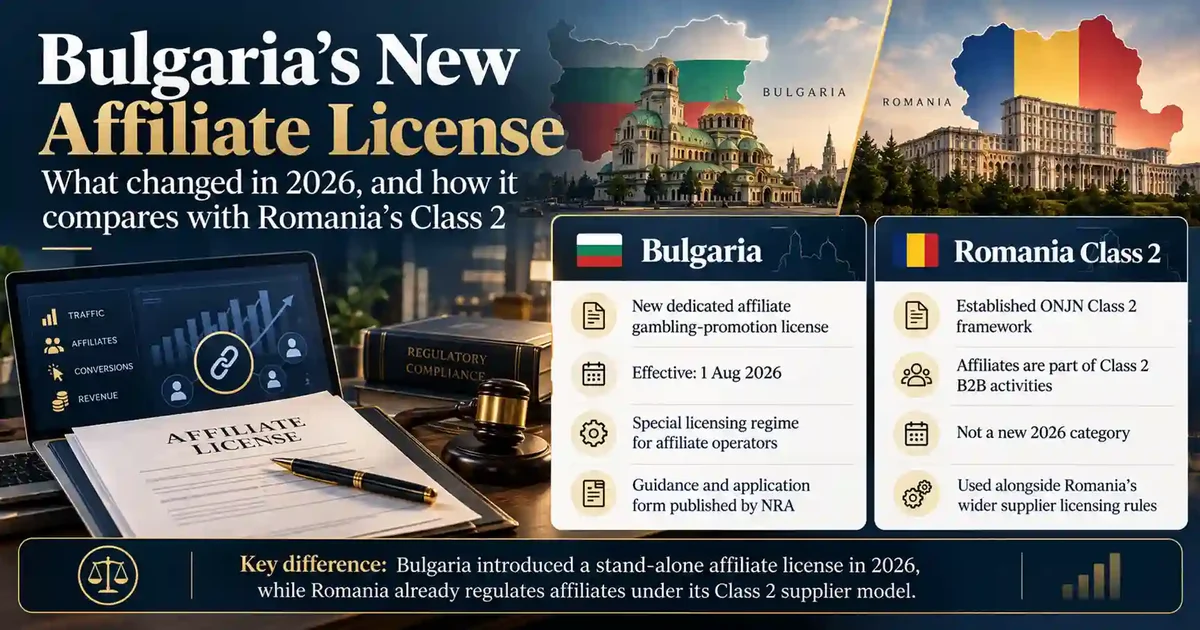
Since 1 August 2026, an affiliate paid on performance for promoting gambling to Bulgarian players needs its own license from the National Revenue Agency (NRA). It costs €6,000 a year plus 10% of every performance-based commission, which the operator withholds and pays over. Romania took a different route years earlier: its affiliates hold an ONJN Class 2 license at €35,000 a year, flat, with no levy on commission. The two regimes now sit side by side in neighboring EU markets, and an affiliate active in both has to price them very differently.
This analysis explains what Bulgaria changed, how the license works in practice, and how it compares with Romania’s Class 2 affiliate license, including where the break-even sits.
What Bulgaria changed, and why so fast
Bulgaria already restricted gambling advertising heavily in 2024, but affiliates themselves were outside the licensing system. That changed through the 2026 State Budget Act, which amended the Gambling Act. The National Assembly passed it on 24 July 2026, it was published in the State Gazette on 31 July and the affiliate rules took effect the next day.
The timetable was tight. Affiliates with active contracts on 1 August had until 15 August 2026 to apply and keep working under transitional rules. Anyone applying later has to stop promoting until the license is granted. Industry reports describe little or no consultation with affiliates before the announcement.
The motive is fiscal as much as regulatory. The finance ministry estimated untaxed affiliate commission at around 450–500 million leva a year (roughly €230–256 million), and the NRA expects the regime to raise about €100 million in 2026 and €150 million in 2027. The country’s budget deficit and AML concerns in the banking sector are part of the background.
Who needs the Bulgarian license
The test is how the affiliate is paid, not what it calls itself. The license covers remuneration tied to a measurable result:
- CPA per registered or depositing player;
- revenue share on net gaming revenue;
- hybrid deals combining both;
- sub-affiliate networks paid on downstream performance.
On the current wording, flat-fee brand placements with no performance metric, media sold directly by an operator and editorial coverage with no commercial link fall outside. A “flat fee” that in practice tracks deposits is likely to be treated by its substance, not its label.
How the license works
| Point | Bulgaria (NRA) |
|---|---|
| In force | 1 August 2026 |
| Holder | Bulgarian or foreign company, including sole traders |
| Foreign applicants | Representative in Bulgaria, empowered to sign |
| Fixed fee | €6,000 a year, due by 31 March of the following year |
| Variable levy | 10% of performance-based commission, withheld by the operator, remitted monthly |
| Disguised commission | Levy doubles to 20% of the hidden amount |
| Term | 5 years |
| Decision time | 7 days for a complete file; missing documents flagged within 3 days |
| Channels | Every website, app, social account and streaming channel declared and recorded in the license |
| Who you may promote | Only operators with a Bulgarian license |
| Sanctions | Reported fines of about €5,000–20,000, doubled for repeat breaches; confiscation of unlicensed income; NRA blocking orders against sites, apps and social or streaming profiles, applied by telecom providers within 24 hours |
Two practical points matter more than the table.
The operator is the gatekeeper. Licensed operators must check the public register and withhold payment until the affiliate is licensed and compliant. For an unlicensed affiliate, the first consequence is not a fine but unpaid invoices.
The 10% needs to be in the contract. Market practice is still settling on whether the levy comes off the agreed commission or is added on top. Where the contract is silent, the affiliate usually bears it. Published summaries of the budget act also indicate that commission on which the 10% has been paid sits outside the corporate income tax base, but the accounting treatment is not yet uniform; take local tax advice before you price a Bulgarian deal.
The same question in Romania
Romania has licensed affiliates as part of its gambling supply chain since the online regime started. Under OUG 77/2009, affiliate and performance-marketing activity aimed at Romanian players is a Class 2 activity, licensed by the National Gambling Office (ONJN). The full route is on our Romania Class 2 (B2B) license page.
| Point | Bulgaria (NRA) | Romania (ONJN Class 2) |
|---|---|---|
| Since | 1 August 2026 | Online regime from 2015; current fees since OUG 82/2023 |
| Who is covered | Performance-paid affiliates | Affiliate and performance marketing aimed at Romanian players |
| Entry cost | None beyond the annual fee | €10,500 one-off |
| Annual cost | €6,000 plus 10% of commission | €35,000 flat (€20,000 license fee plus €15,000 responsible-gambling contribution) |
| Year-one total | €6,000 plus 10% of commission | €45,500 |
| Term | 5 years | 10 years |
| Foreign holder | Yes, with a Bulgarian representative | EU/EEA company directly, with an authorized Romanian representative; others through a Romanian company |
| Time to license | 7 days for a complete file | About 2–3 months for a clean file |
| Operator duty | Pay only licensed affiliates; withhold the levy | Class 1 operators may only work with Class 2-licensed suppliers |
| Enforcement | Blocking of affiliate sites and channels; fines | ONJN blacklist, blocking, license revocation; reporting duties under Law 141/2025 |
The Romanian side also carries ongoing obligations: some Class 2 holders file reports to ONJN under Law 141/2025, explained in our guide to Class II reporting obligations.
Where the break-even sits
Ignoring corporate tax and professional fees, the statutory cost of each license is easy to compare:
- Bulgaria: €6,000 + 10% × commission.
- Romania: €35,000 a year (€45,500 in year one).
The two lines cross at about €290,000 of local commission a year (about €395,000 in Romania’s first year). Below that, Bulgaria is cheaper; above it, Romania’s flat fee wins, and the gap widens as revenue grows. An affiliate earning €100,000 a year from Bulgarian players pays €16,000; from Romanian players, €35,000. At €1 million, the Bulgarian bill rises to €106,000, while the Romanian one stays at €35,000.
The two models therefore filter differently. Bulgaria lets small affiliates in cheaply and taxes the large ones. Romania sets a high fixed threshold that keeps marginal affiliates out but rewards scale. Neither is “cheaper” in general; it depends on how much each market is worth to you.
What affiliates should do now
- Map your traffic by country. Bulgarian and Romanian players each need their own license; there is no EU passport.
- Classify your deals. In Bulgaria, list every CPA, revenue-share, hybrid and sub-affiliate deal. In Romania, any affiliate activity aimed at local players is in scope.
- Fix the 10% in writing. Agree with each Bulgarian operator whether the levy reduces the commission or is added on top, and how it is reported.
- Declare every channel. Bulgaria records your websites, apps and social and streaming accounts in the license; keep that list current. Romania expects the same discipline in the Class 2 file.
- Check every brand you promote. Both regimes prohibit promoting unlicensed operators, and both regulators can block the channels that do.
- Watch Bulgaria’s advertising bill. A near-total advertising ban tabled in late September 2026 was due for discussion by 23 October; if it passes, the business case for Bulgarian affiliation changes again.
Our view
Bulgaria’s regime is a fast, revenue-driven fix: cheap to enter, quick to grant, but with a tax on every euro of commission and rules that are still settling. Romania’s is older, slower and more expensive upfront, but predictable, valid for ten years and flat in cost. For a serious affiliate business in South-East Europe, the question is not which one to choose but how to hold both cleanly. If you are weighing Romania, our free Romania Gambling Market Report 2026 covers the wider market, and the Bulgaria license page sets out the operator side of the Bulgarian regime.
We hold the file for Romanian Class 2 affiliate licenses end to end and can coordinate Bulgarian filings with local counsel. Tell us where your traffic comes from and we will send a written first read within one business day.