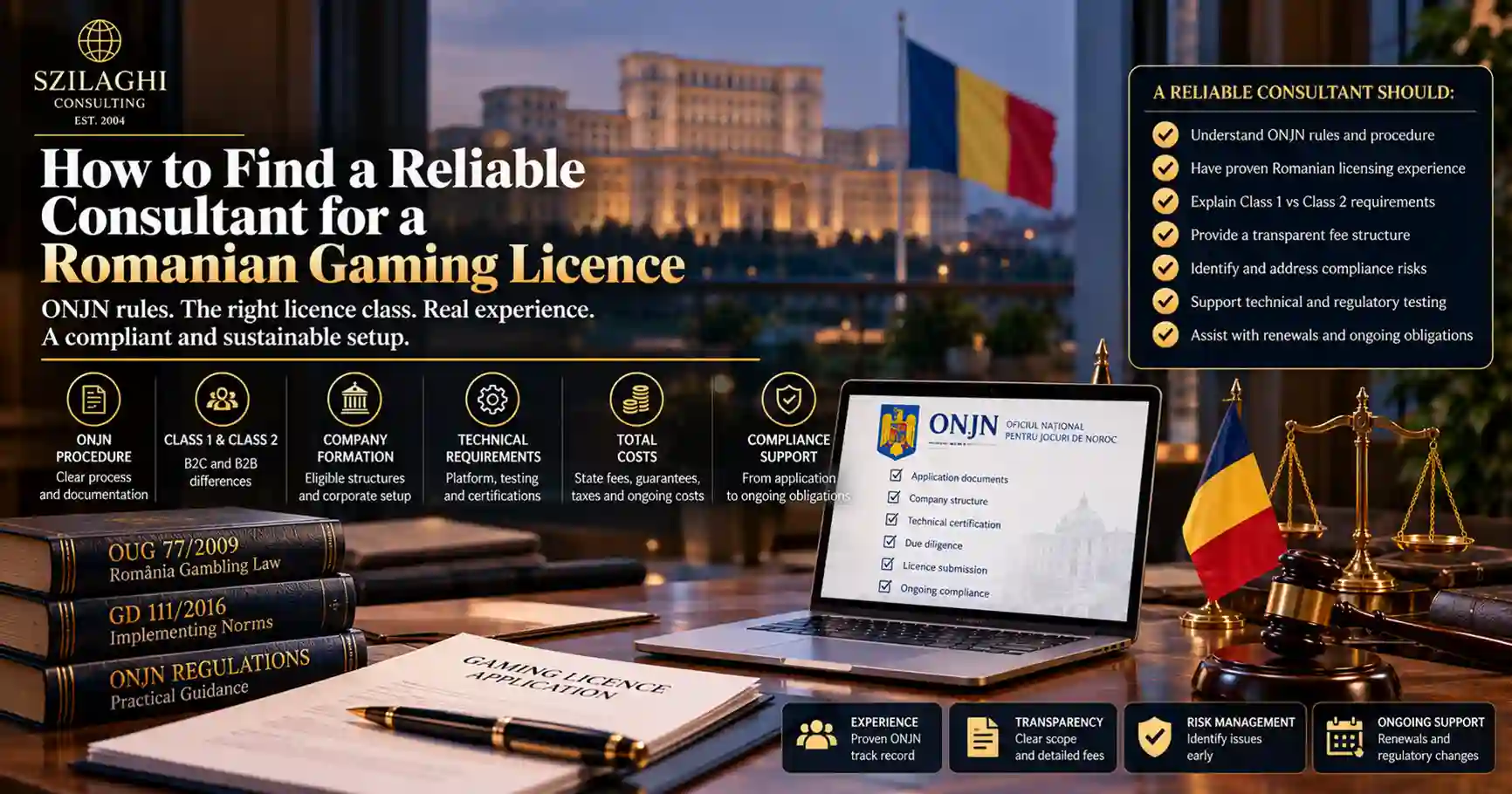
How do you find a reliable consultant for a Romanian gaming license? Choose an adviser who can identify the correct ONJN license category, verify your company’s eligibility, calculate the full first-year financial commitment, prepare an auditable application dossier and explain what could prevent approval. A credible consultant identifies material legal or financial obstacles before accepting a substantial licensing mandate.
Romania’s gambling licensing system is administered by the National Gambling Office (ONJN) under Government Emergency Ordinance No. 77/2009 and its implementing rules, Government Decision No. 111/2016. For the full framework, see our guide to Romania ONJN gambling licensing.
In 2026, licensing involves far more than filling in forms. Applicants must consider corporate structure, ownership checks, financial guarantees, technical certification, anti-money laundering obligations, responsible gambling, suppliers and ongoing supervision.
A consultant can organize the application and represent a client within an appropriate mandate. Only the competent authority can grant the approval. The right adviser makes the process understandable, documents the risks and gives management enough evidence to decide whether the project is commercially viable.
Romania ONJN licensing: what investors need to know first
Before comparing consultants, establish whether your business needs a Class I or a Class II license.
| Requirement | Class I — B2C operator | Class II — B2B supplier |
|---|---|---|
| Primary activity | Offering gambling directly to players | Providing specified regulated services to gambling businesses |
| Typical businesses | Online casinos, sportsbooks, poker and bingo operators | Software studios, platforms, certain payment providers, affiliates |
| License term | 10 years | 10 years |
| Separate operating authorization | Required for the relevant Class I activities | Not the Class I authorization regime |
| Annual license fee (remote) | €300,000 | €20,000 per licensed category |
| Annual responsible-gambling contribution | €500,000 | €15,000 |
| Authorization tax | 30% of relevant gaming revenue, minimum €480,000 a year (Law 141/2025) | No GGR-based authorization tax for a pure Class II supplier |
| Financial guarantee | €2 million, or €5 million for online casino | No equivalent gambling-specific guarantee under the standard regime |
| Recurring statutory baseline | At least €1,280,000 a year | €35,000 a year for one category |
Amounts reflect the 2026 framework for the activities described. One-off application and issuance charges, technical certification, company formation, taxes and professional fees are additional. A guarantee is a financial-security obligation, not a non-refundable government fee.
The difference is substantial. A company developing casino software should not be steered toward a Class I operator license if its activities fall solely within a Class II supplier category. Equally, a business that wants to accept bets from Romanian players cannot obtain operating rights by licensing a supplier entity.
For detailed costs, see Romania Class I licensing and costs and ONJN Class II supplier requirements.
1. Verify the consultant’s Romanian legal and regulatory expertise
A reliable adviser must understand both the ONJN application and the legal structure behind it. Romanian gambling licensing combines national gambling legislation, company law, tax rules and sector-specific requirements.
Before appointing a consultant, ask who is responsible for the legal analysis. A licensing engagement may involve lawyers, corporate advisers, accountants and technical specialists — related functions, but not interchangeable ones. Where legal advice or representation is provided by an avocat, verify the person’s professional status through the Romanian Bar records.
Ask for a written description of the team’s responsibilities. A credible provider should be able to say:
- who determines the appropriate license category;
- who advises on corporate eligibility;
- who prepares and checks the ONJN dossier;
- who handles technical certification and supplier coordination;
- who corresponds with ONJN, and under what authority;
- who answers regulatory questions after submission;
- who manages ongoing obligations after approval.
Experience in company incorporation alone is not evidence of competence in gambling regulation.
Red flag: the adviser claims that Romanian gambling licensing is simply a company-registration procedure.
2. Confirm the correct license class and applicant structure
The first deliverable should be a written assessment of what the applicant actually intends to do: the gambling products or B2B services, the intended customers, the entities involved and the jurisdictions where activities take place.
Class I — direct gambling operations
Class I applies to operators that organize games of chance and contract directly with players. For remote gambling, the license and the annual operating authorization must be considered separately. A Class I applicant generally needs an eligible Romanian entity or, where the law permits, a qualifying foreign entity with a Romanian permanent establishment, and its structure must satisfy gambling-specific requirements on capital, guarantees, suitability and operational controls.
Class II — regulated suppliers
Class II applies to specified suppliers of gambling-related products and services. An eligible EU/EEA supplier may have a direct licensing route without incorporating a Romanian subsidiary, using a local representative. Non-EU/EEA entities need a separate eligibility assessment and may need a Romanian corporate structure. Having a Romanian representative is not automatically the same as creating a permanent establishment for corporate tax purposes.
Why this decision matters
The wrong applicant structure creates substantial rework. Ownership documentation, contracts, banking and technical certificates may all need revising if the applicant entity changes mid-process. Our case studies show both routes in practice: EU studios licensed directly, and UK, US, Malaysian and Israeli groups that formed a Romanian company first.
Red flag: a consultant recommends incorporating a Romanian company before asking where your current company is established, what services it will supply and whether direct licensing is available.
3. Demand a complete and transparent licensing budget
A reliable consultant distinguishes statutory payments, financial guarantees, operating expenses and professional fees. An ONJN budget should not be one headline price with everything else labeled “miscellaneous”.
For Class I online operations, the recurring statutory baseline in 2026 is at least €1,280,000 a year, before any increase in the variable authorization tax above its minimum — and the financial guarantee comes on top. For standard Class II licensing of one activity category, the published statutory baseline is €45,500 in the first year and €35,000 a year after. Our gambling license cost guide compares these figures with other jurisdictions.
What should a written quotation show?
| Cost category | What the consultant should disclose |
|---|---|
| File analysis | Applicable official charge and payment timing |
| License issuance | Government issuance charge |
| Annual license fee | Amount, license category and payment schedule |
| Operating authorization | Whether it applies and how the fee is calculated |
| Responsible-gambling contribution | Statutory amount and payment obligation |
| Financial guarantee | Required amount, permitted instrument and collateral cost |
| Technical certification | Laboratory fees, audits and retesting assumptions |
| Corporate work | Incorporation, representation and registered-office charges |
| Tax | Corporate, indirect and other relevant obligations |
| Professional fees | Fixed or variable fees, and excluded services |
| Contingencies | Re-filings, additional documents and change requests |
A guarantee should not be presented as a fee the applicant permanently pays to the state, and a minimum authorization tax should not be presented as the maximum payable. For a Class I remote operator, the consultant must explain how the variable charge rises with relevant gambling revenue.
Test the financial assumptions
Ask for at least a conservative and a base-case scenario. The model should show the annual statutory obligations even if revenue falls well short of projections. For Class I operators, licensing economics can make a technically feasible project commercially unattractive.
Red flag: the consultant quotes only incorporation and application costs and avoids recurring taxes, guarantees and compliance spending.
4. Ask for a dossier you can inspect yourself
A well-prepared application is a traceable chain of evidence: every important statement made to ONJN is backed by an identifiable document. Depending on the license category and the applicant, the file may include:
- corporate registration and constitutional documents;
- shareholder and beneficial ownership records;
- management and identity information;
- financial statements and source-of-funds evidence;
- business plans and operating forecasts;
- supplier agreements;
- technical certificates and system documentation;
- AML/CFT and responsible gambling procedures;
- licensing declarations;
- evidence of payments and guarantees.
A B2B affiliate will not need the same technical dossier as an online casino.
How should the file be organized? Every significant document should have an owner, a date, a version and a purpose. The adviser should keep a checklist showing whether each requirement is complete, awaiting confirmation or subject to a regulator question, and should be able to explain how material from laboratories or accountants fits into the application.
Red flag: the adviser insists that the applicant does not need to see or understand its own application dossier.
5. Test the consultant’s compliance and technical understanding
Licensing and compliance are not separate projects: compliance readiness affects both the quality of the license file and the launch date.
For a Class I operator, the relevant areas include identity verification, AML, responsible gambling, player-account controls, regulatory reporting and technical certification. For a Class II supplier, obligations depend on the activity. The 2025–2026 amendments to OUG 77/2009 restrict services to unauthorized operators, and specified technical supplier categories — gambling software, platform management and hosting, and payment processing — now carry player-location, blocking and reporting duties. See ONJN technical reporting obligations. These duties should not be attributed automatically to every affiliate or other supplier.
Questions to ask the adviser:
- How will the business verify the licensing status of its gambling partners?
- What information must the technical platform retain?
- Which system changes need further assessment?
- How are complaints, compliance incidents and ONJN requests handled?
- What happens if a partner loses its license or a domain becomes unauthorized?
- Which requirements must be met before the product goes live?
A reliable consultant explains where specialist laboratory testing, IT expertise or legal review is needed.
Red flag: the adviser promises that a generic compliance manual bought online will satisfy every ONJN requirement.
6. Require a written plan for refusal, delay and unexpected costs
An adviser’s quality shows most clearly when a problem appears. A responsible consultant identifies foreseeable failure points before submission, such as:
- ineligible shareholders or directors;
- unclear ultimate beneficial ownership;
- insufficient evidence of the lawful source of funds;
- inadequate capital or guarantee arrangements;
- incorrectly classified activities;
- technical certificates that do not match the proposed platform;
- defective supplier agreements;
- changes in legislation or regulatory interpretation.
What should the engagement contract provide? It should say who answers regulator information requests, how additional work is priced, what happens if the business model changes and whether assistance continues after an unfavorable decision. It should also separate the adviser’s contractual services from the regulator’s decision.
No legitimate consultant can guarantee that ONJN will grant a license. An adviser can prepare a complete file, identify risks and represent the applicant within the mandate; the statutory decision remains with the authority. For realistic planning times, see how long a gaming license takes.
Red flag: the consultant advertises guaranteed approval, guaranteed timing or a way to bypass normal suitability requirements.
7. Verify post-licensing support before signing
The ONJN license starts a regulated operating relationship; it does not end the compliance project. A compliance calendar may include annual fees, authorization renewals, regulatory reporting, audits, technical certificate reviews, changes of control and supplier due diligence.
Obligations differ by category. Certain technical Class II suppliers must file a monthly report by the tenth day of the following month under the amended OUG 77/2009; other Class II activities are not subject to that report.
Build a 12-month compliance calendar that lists each obligation, its legal source, deadline, responsible person, required evidence and escalation route. Update it whenever ownership, licensed activities, technology, domains, key suppliers or territories change. For practical detail, see post-licensing compliance for Class II suppliers and the deadlines and taxes that keep a Romanian license alive.
Red flag: the adviser’s contract ends at license issuance and does not say who manages the obligations that follow.
How to compare Romanian gaming license consultants
A simple scoring framework helps management compare proposals objectively.
| Selection criterion | Suggested weight |
|---|---|
| Romanian legal and ONJN expertise | 20% |
| Accurate Class I / Class II classification | 20% |
| Transparent statutory and commercial budget | 20% |
| Documentation and audit-trail quality | 15% |
| Technical and compliance coordination | 10% |
| Regulator communication and problem management | 10% |
| Post-licensing support | 5% |
| Total | 100% |
This is an editorial evaluation model, not an ONJN qualification standard.
A low advisory fee is attractive, but it should not outweigh concerns about eligibility, legal accuracy or undisclosed costs. The best consultant for an international operator may differ from the best adviser for a small specialized B2B supplier — choose the team for the work actually required.
Questions to ask before paying a gaming license consultant
Request written answers to these:
- Which legal entity should apply, and why?
- Which exact ONJN license or authorization is required?
- Which specialists will handle the legal, technical and financial work?
- What could cause this application to fail?
- What are the complete first-year and annual financial commitments?
- Which government payments are separate from advisory fees?
- What documents and approvals will I receive or control?
- Who will respond to ONJN information requests?
- What happens if the regulator requests substantial changes?
- Who will manage compliance after the license is granted?
These answers tell you more than asking only how quickly a consultant can obtain the license.
Should you pay government fees into a consultant’s private account?
Government payments should follow verified official payee instructions, supported by records. If an adviser proposes to collect or forward regulatory payments for the applicant, the arrangement should be authorized in writing, documented and independently verified. The applicant should know who legally owes the charge, who receives the money, whether it is refundable and what proof of payment it will receive.
Private payment instructions that cannot be reconciled with the engagement contract and the official requirements deserve extra scrutiny. An adviser should never ask a client to disguise the commercial purpose of a payment.
How long does a Romanian gaming license take?
It depends on the license class, eligibility and readiness. A straightforward Class II application can be planned over about two to three months, subject to document completeness and regulatory review. Launching a new Class I online operation is a larger project — licensing, operating authorization, technical preparation, guarantees, contracts and launch controls — and several months is a more realistic planning horizon than the regulator’s decision window alone. No consultant can guarantee that a complex project will finish within an advertised number of days.
How can foreign investors choose the right Romanian structure?
Establish the licensing route before incorporating a company or committing to major technical integrations. Class I operators and Class II suppliers face different rules on eligible entities and Romanian presence:
- A qualifying EU/EEA supplier may seek Class II licensing directly, without creating a Romanian subsidiary solely for licensing purposes.
- A Class I operator must assess a Romanian company or an eligible foreign-entity arrangement, including permanent-establishment obligations.
The choice also affects tax, banking, staffing, ownership documentation and contracts. For specialist guidance, see company formation for Class I and company formation for Class II.
What makes a licensing application defensible?
A defensible ONJN application lets a reviewer follow the evidence. The incorporation records identify the applicant; the shareholder register explains ownership; beneficial ownership records identify who ultimately controls it; financial documents support the origin and availability of funds; commercial contracts explain the planned business; technical and compliance documents show how systems and safeguards will work.
Each part must match the others. A sophisticated business plan does not compensate for inconsistent ownership records, and a complete corporate file does not replace a required technical approval or guarantee. The goal is an accurate, verifiable regulatory position — not a large pile of documents.
Conclusion: choose the adviser who finds the problems before ONJN does
A Romanian gambling license can be a substantial commercial investment, and in 2026 the difference between Class I and Class II goes far beyond terminology. The licensing route determines corporate eligibility, financial commitments, technical obligations, reporting and the requirements that continue after approval. A reliable consultant identifies these issues early and explains them in writing.
Do not choose an adviser for the lowest initial price or the shortest promised timetable. Choose the team that can demonstrate competence, provide a transparent budget, prepare an auditable dossier and stay accountable when the project hits difficulties. The strongest application is not the one that reaches ONJN first; it is the one that arrives with the right structure, credible evidence and working compliance controls.
Romanian gaming licensing advisory — Szilaghi Consulting
Szilaghi Consulting assists gaming operators and B2B suppliers with Romanian licensing, corporate structuring, documentation, technical coordination and regulatory compliance, with in-house Romanian lawyers (avocați) practicing under Law no. 51/1995. Our gambling consulting and licensing services include preliminary eligibility reviews, Class I and Class II applications, company formation, representation and post-licensing compliance.
For businesses evaluating Romanian market entry, we recommend starting with a written feasibility assessment covering the license category, applicant structure, statutory costs and principal regulatory risks. Send us your proposed activity, applicant company, target markets and launch timetable to request an ONJN licensing feasibility review.
Regulatory and editorial review: 17 October 2026. This guide provides general information and is not an individual legal opinion. Confirm the license category, applicant eligibility, fees and technical requirements for your specific project before filing. The featured image is an editorial illustration; its graphics do not represent an ONJN certificate, authorization or approval.