Editorial analysis and opinion. Data cut-off: ONJN figures as reported by Econocast on October 7, 2026.
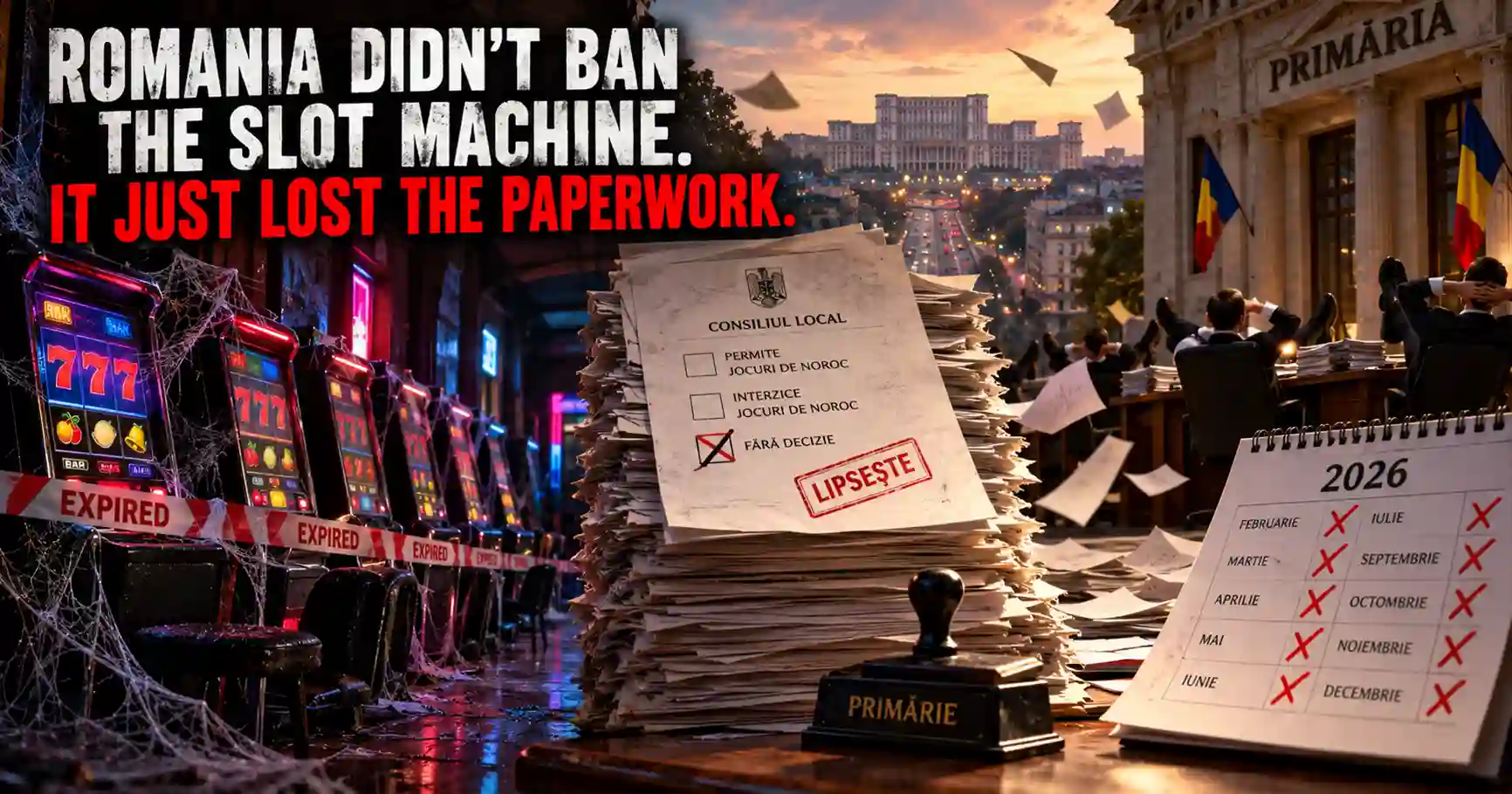
The short answer: Romania has not introduced a blanket nationwide ban on slot machines. Emergency Ordinance 7/2026 introduced a local authorization requirement for physical gambling venues, making slot operations dependent on municipal decisions. According to figures reported by Econocast from Romania’s National Gambling Office (ONJN), slot machine authorizations issued fell from 45,659 in 2025 to 9,138 so far in 2026. Of 3,181 local administrative units, ONJN had received only 74 council decisions: 41 permitting gambling and 33 prohibiting it. The absence of a decision on ONJN’s file does not necessarily mean a council never voted.
Romanian politicians spent years promising to crush the gambling industry. It turns out all it took was a council resolution most of the country never sent: thousands of local administrations doing what they do best, sitting on their hands, dodging responsibility and letting an entire industry bleed out in bureaucratic silence.
Forget police raids. Forget dramatic prohibition laws. Forget righteous politicians pounding their fists on television about saving Romanian families from the evil păcănele.
Romania has apparently discovered a far cheaper, cleaner and infinitely more ridiculous way to wipe out a nationwide industry: don’t decide anything, and let the calendar do the rest.
The numbers come straight from ONJN, in a reply to a press request from Econocast signed by the regulator’s president, Valentin-Ioan Tomescu. In 2025, ONJN granted 45,659 slot machine authorizations. In 2026, up to the date of the reply, it granted 9,138. That is an 80% collapse on the year-to-date figure. Today, 20,810 machines nationwide still hold a valid authorization, and that number falls every month.
Politicians are already measuring the podium for a public-health victory lap. They might want to check who actually ran the race.
The rule: no council resolution, no machine
Since February, Emergency Ordinance No. 7/2026 has chained the regulator to city hall. ONJN will authorize machines in a venue only if the venue holds a municipal operating permit, and the town hall can issue that permit only if the local council has voted to allow gambling. It is a new layer on top of Romania’s ONJN licensing requirements, not a replacement for them.
Machines authorized before the ordinance can run until their authorization expires. A slot machine authorization lasts one year. Do the arithmetic: absent a council resolution, every machine in the country carries an expiry date, and the clock started in February.
Nobody had to shut anything down. They just had to let the calendar do it.
3,181 municipalities. 74 answers. One very confused regulator.
Here is what ONJN has on file:
| Council decisions communicated to ONJN (3,181 UATs) | Share | Count |
|---|---|---|
| No decision on file at ONJN | 97.7% | 3,107 |
| Allow gambling | 1.3% | 41 |
| Ban gambling | 1.0% | 33 |
Before anyone mocks three thousand villages, consider the fine print. Since 2024, localities with fewer than 15,000 residents cannot host slot machines at all; they can only decide on betting. Only about 130 of the largest municipalities are even allowed to permit slots, casinos and poker. Most of that 97.7% is made up of communes that never had the power to save a slot hall in the first place.
So the real scandal isn’t the villages. It’s the plumbing.
The 74 figure counts only resolutions that actually reached ONJN. Cluj-Napoca, Iași, Timișoara and Constanța have reportedly adopted resolutions, and the regulator’s tally doesn’t capture them. Romania has built a gambling regime in which a machine’s legality depends on a council vote, and the agency issuing the authorizations doesn’t have a reliable list of the votes.
It’s a licensing system where the regulator has to find out from journalists whether a town said yes.
The figures at a glance
| Reported indicator | Figure |
|---|---|
| Authorizations issued in 2025 (full year) | 45,659 |
| Authorizations issued in 2026 (to the date of ONJN’s reply) | 9,138 |
| Decline in authorizations issued | 80.0% |
| Valid slot machine authorizations reported | 20,810 |
| Local administrative units | 3,181 |
| Council decisions received by ONJN | 74 |
| Units without a decision on file at ONJN | 3,107 |
| Bucharest venues, March 2026 | 829 |
| Bucharest venues, October 2026 | 231 |
| Bucharest venues, February 2027 | 68 (projected) |
Source: figures reported by Econocast from ONJN information, published 7 October 2026. The February 2027 figure is a projection, not an observed count. The 2025 and 2026 figures are authorizations issued, not necessarily unique venues or currently operating machines.
Don’t take our word for it. Take the map’s.
In fairness to ONJN, it is admirably transparent about everything except the council votes. Anyone can see how many machines are still authorized and exactly where they sit in the Public Register of Gaming Equipment, an interactive map you can filter by county, locality and operator: registru.onjn.gov.ro.
It’s worth a look, if only to watch the map empty out in real time. Pick your town, check the slot hall on the corner, and see whether it still has authorized machines or is just living on borrowed months. It is, oddly, the most accountable document in the whole saga: the state can tell you, machine by machine, what is still legal. It just can’t tell you which councils decided.
Bucharest: silence at scale
If you want a pure laboratory case of governing by abstention, look at the capital. The Bucharest General Council has adopted no resolution on gambling. Not yes, not no. The venue count is following the expiry calendar like a train timetable:
| Period | Slot venues in Bucharest |
|---|---|
| March 2026 | 829 |
| October 2026 | 231 |
| February 2027 (projected) | 68 |
That’s a 72% decline so far and, on the projection, more than 90% by early next year. One of the European Union’s capital cities is about to lose nearly its entire land-based slot sector, and there is no vote to point to, no debate to quote and no politician to praise or blame. The council couldn’t find the courage to ban or the courage to allow, so it chose the third option the ordinance accidentally created: let it expire and say nothing.
As political risk management, it’s flawless. A yes vote puts a councilor’s name next to “gambling.” A no vote kills businesses, empties ground-floor rentals and costs local revenue. Silence costs the people who choose it nothing, because the outcome is automatic and the operator’s argument is with ONJN.
Demand doesn’t expire
Here’s the part nobody will put in a press release. Pulling an authorization removes a machine. It doesn’t remove a player.
The licensed slot hall was, for all its neon vulgarity, the most supervised gambling a Romanian could walk into. It verified IDs, it honored self-exclusion, it kept records and paid taxes, and an inspector could shut it down. When it closes, demand goes looking for the nearest door that doesn’t check anything.
One door leads to illegal land-based machines in back rooms and “internet cafés.” The other, much wider, leads to unlicensed online casinos operating from offshore jurisdictions. They’re on the ordinary web, often a search result away, with no Romanian age checks, no deposit limits, no ONJN oversight and no tax paid to the municipalities that couldn’t bring themselves to vote.
To be precise about it: the closures alone do not prove that unlicensed play is rising. Measuring that takes player, enforcement and market data that nobody has yet published. But the risk is obvious enough that a policy built on silence should at least have considered it. Romania may not have shrunk its gambling market; it has certainly shrunk the part of the market it can actually see.
The verdict nobody signed
An 80% drop in authorizations looks like policy. It isn’t. Policy is a choice someone makes, defends and answers for. What Romania got instead was an ordinance that made legality contingent on local votes, a capital that declined to cast one, and a regulator counting resolutions it can’t reliably collect. For operators, that is regulatory risk of the least predictable kind: a license that depends on a vote nobody is obliged to hold.
Romania didn’t ban the slot machine. It lost the paperwork, and the authorizations are running out on schedule.
For the wider picture, see our Romania gambling market report 2026 and our explainer on OUG 7/2026 and local authorization.