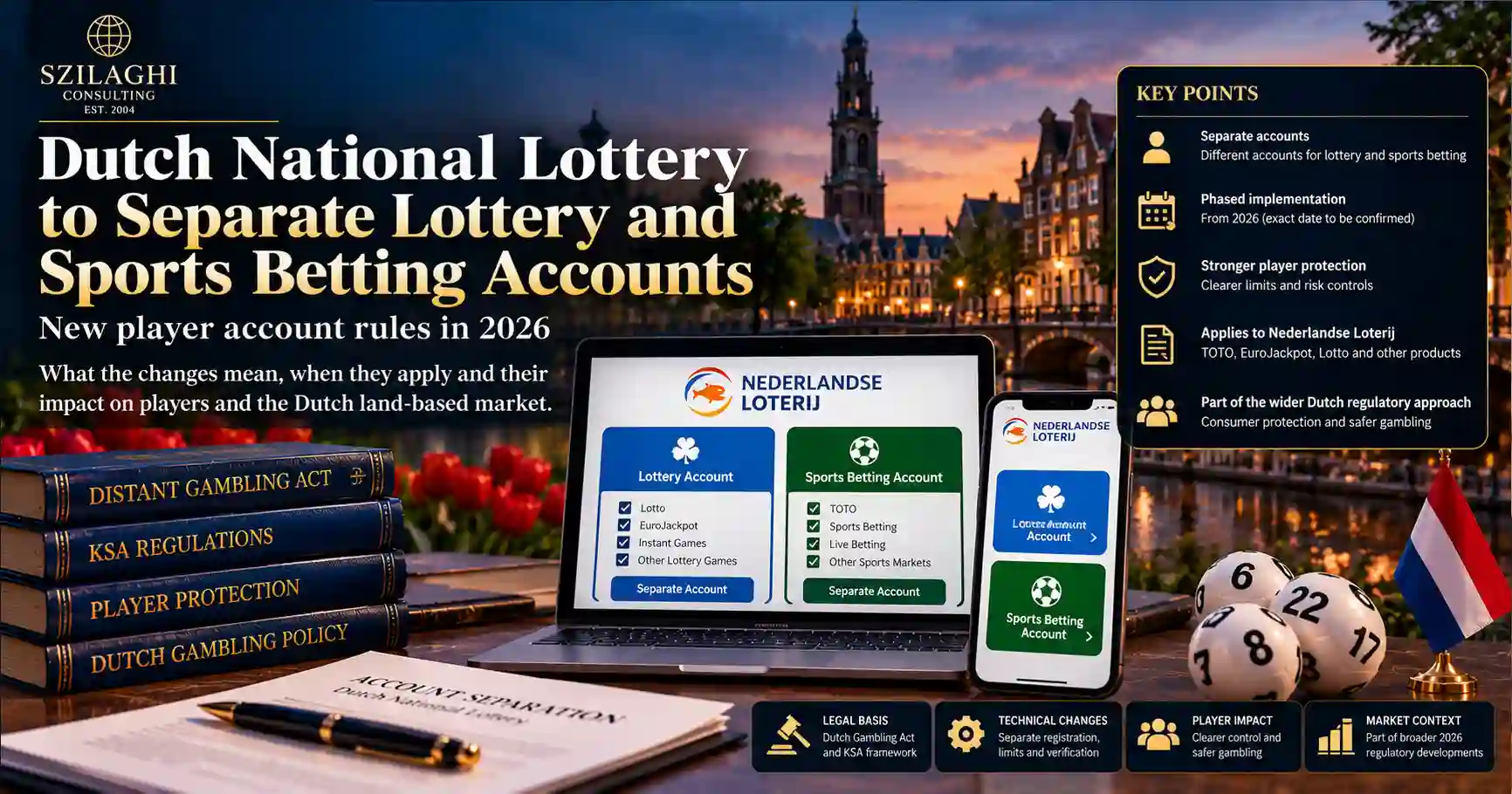
Why are Dutch National Lottery and TOTO accounts separate in 2026? Because lottery products and licensed remote gambling operate under different regulatory and operational arrangements in the Netherlands. Nederlandse Loterij keeps a dedicated account and wallet for its lottery products, while TOTO uses a separate account system for sports betting and online casino.
This is not a new 2026 measure. The operator began splitting customer accounts in November 2020, ahead of the regulated remote gambling market opening on 1 October 2021 — see how the Dutch online market launched. Five years on, the arrangement still matters to operators, investors and compliance teams because it illustrates a basic principle:
Businesses in the same gambling group cannot assume that different licensed products may share one customer wallet, registration system or operating authorization.
It also opens a wider discussion of Dutch player protection, account verification, safeguarding of customer funds and anti-money laundering controls.
Dutch National Lottery vs TOTO: the 2026 account structure
| Feature | Nederlandse Loterij account | TOTO account |
|---|---|---|
| Main products | Staatsloterij, Lotto, Eurojackpot, Miljoenenspel, Lucky Day, scratch cards | TOTO Sport, TOTO Casino and related products |
| Account | Separate lottery customer account | Separate TOTO customer account |
| Wallet | Lottery wallet | TOTO account balance |
| One account for both? | No | No |
| Legal entities | The group’s lottery companies | TOTO Online B.V. for licensed online gambling |
| Regulatory context | Dutch lottery permissions | Remote gambling license (KOA framework) |
| Player controls | Lottery-specific verification and controls | Remote-gambling identity, monitoring and responsible-gambling controls |
The group’s customer guidance confirms that personal details and account information are kept separately and may need updating in both systems.
1. When did Nederlandse Loterij separate the accounts?
On 16 November 2020, Nederlandse Loterij announced that it had begun separating lottery accounts from TOTO sports betting accounts, because the products would operate under different legal frameworks. The announcement expected remote gambling legislation in March 2021; the timetable then slipped, and the regulated market opened on 1 October 2021. Descriptions of the separation as an upcoming March 2021 change are therefore out of date.
Is the separation still active in 2026? Yes. Nederlandse Loterij’s current customer support pages distinguish the lottery account from the TOTO account. Customers cannot use the lottery account for TOTO products or the TOTO account for lottery products, and certain personal details must be changed in both. It is an implemented operating arrangement, not a pending reform.
2. Why do lottery and remote gambling need different arrangements?
The issue is the distinction between licensing regimes, operating entities and customer protections. The Wet op de kansspelen (Betting and Gaming Act) is the foundation of Dutch gambling regulation; the Wet kansspelen op afstand (Remote Gambling Act, KOA) added the framework for licensed online gambling. Different products can sit under different permissions and legal entities, which affects:
- which entity contracts with the customer;
- which products the account can access;
- how player funds are recorded;
- which identity checks apply;
- how responsible-gambling limits work;
- which records must be available to the regulator;
- how complaints and reporting are handled.
A shared parent company does not remove these distinctions.
Does Dutch law require separate accounts for every product? That would be too broad. The Nederlandse Loterij–TOTO separation reflects the specific products, entities and licenses involved; it is not a universal rule that every Dutch operator needs a separate account per game or brand. The requirements depend on the authorizations and the operating model.
3. Which companies operate the lottery and TOTO products?
Nederlandse Loterij’s participant rules identify distinct operating entities. Staatsloterij B.V. is associated with Staatsloterij and Miljoenenspel; Lotto B.V. organizes various lottery products; TOTO Online B.V. is the licensed entity behind TOTO Sport, TOTO Casino and Winnitt. The consumer-facing brand is not always the legal entity responsible for a product.
TOTO’s license in 2026. TOTO states that the Kansspelautoriteit (KSA) first granted TOTO Online B.V. its remote gambling license on 29 September 2021, under license number 1601, and it now publishes authorization information covering 2026–2031 for TOTO Sport and TOTO Casino. Investors should distinguish the original 2021 decision from the authorization currently in force — a historical license announcement does not replace checking the KSA register.
4. Why separate player wallets matter
A player wallet is not just a payment interface: it is part of the system that records customer funds, transactions and balances. The lottery account lets eligible users fund a wallet for Nederlandse Loterij products; the TOTO system keeps its own account and gambling balance.
Separate arrangements help a group keep identifiable product-level records and manage different legal obligations, contracts, restrictions and compliance responsibilities. They are not, by themselves, evidence that every consumer risk has been eliminated — that depends on the actual systems, processes and supervision.
Can players move funds freely between the accounts? Players should not assume a lottery balance is interchangeable with a TOTO balance. The two systems are separate, and any deposit, withdrawal or payment must follow the rules of the account concerned.
5. What changed in Dutch player protection by 2026?
The remote gambling framework has developed considerably since October 2021, with heavy emphasis on verification, deposit limits, monitoring of gambling behavior and preventing harm.
Age and identity verification. Licensed online operators must verify age and identity; TOTO describes registration checks involving identity documents and bank details. In April 2026 the KSA reported that participation by minors at licensed online providers was generally difficult, but identified ways controls could be circumvented, including use of adults’ accounts — so initial verification and ongoing account security both matter.
Deposit limits and affordability checks. Players must set deposit limits, and since October 2024 the Remote Gambling Regulation gives new players a default monthly deposit limit of €350, or €150 for those under 24. Separately, the KSA’s responsible-gambling guidance (Responsible Gambling Policy Rule 2024) uses monthly net-deposit thresholds of €700 for adults aged 24 or older and €300 for younger adults as triggers for operator checks. Those thresholds are guidance, not a statutory ceiling on every deposit.
Why this matters for account architecture. An operator must know which system records limits, monitors activity and responds to risky behavior. Where entities or platforms are separate, management must establish which obligations apply to each and keep the evidence. Two accounts do not justify gaps in risk monitoring.
6. TOTO’s 2025 AML instruction: a lesson for 2026
Separate account systems are only one part of compliance. On 24 December 2025, the KSA published a formal instruction (aanwijzing) to TOTO Online B.V. under the Wwft, the Dutch anti-money laundering and counter-terrorist financing act. It found shortcomings in the ongoing monitoring of business relationships and transactions, in documenting why new facts did or did not change customers’ risk classifications, and in investigating the source of players’ funds. TOTO Online was given six months to end the violations, after which the KSA will re-check; the regulator noted that TOTO cooperated and that some violations had already ended.
What other operators should take from it: an active license does not remove the duty to demonstrate continuing compliance. Regulators examine whether policies are applied in individual customer files, not only whether they exist. Defensible records explain:
- how customer risk classifications are set;
- when they are reviewed;
- what triggers further investigation;
- how transactions are monitored;
- why particular actions were taken;
- what evidence supports source-of-funds decisions.
Account design, risk monitoring and record keeping have to work together.
7. Player-fund protection: an important 2026 change
The KSA’s guidance for applications and renewals states that, from 1 January 2026, new license applications can no longer rely on a traditional third-party client-money account or a bank guarantee as the player-fund segregation arrangement, because those mechanisms caused practical problems.
This does not mean player balances no longer need protection. The obligation remains; what changed is which methods the KSA accepts. Operators renewing their licenses must check the current requirements and the transitional treatment of existing arrangements. Wallet architecture is a legal question as much as a technical one: a payment set-up approved when the market opened may need changes at renewal.
8. What about the Netherlands’ proposed gambling reforms?
In June 2026, the Dutch government proposed further restrictions on gambling advertising, promotional incentives, player protection and enforcement — see our analysis of the proposed reform of Dutch online gambling regulation. These proposals are commercially significant, but a proposal is not enacted law. Operators should distinguish:
- requirements already in force;
- KSA guidance currently applied;
- published legislative proposals;
- obligations enacted but not yet in effect.
The distinction matters when evaluating marketing contracts, product changes or platform development. Advertising rules are a separate layer again — compare the KSA’s advertising guide with Belgium’s 2026 advertising rules.
9. What other operators can learn from Nederlandse Loterij
International gaming groups often run different products through several licensed entities that share shareholders, management, technology or brands, yet face different legal requirements.
Five practical lessons:
- Start with the license holder. Identify which legal entity may offer each product.
- Map customer relationships. Determine who registers users and who contracts with them.
- Design wallets around regulatory obligations. Balances, transaction records and fund protection must match the applicable rules.
- Assign AML and player-protection responsibility. Shared group resources do not remove entity-level accountability.
- Plan for renewals and legislative change. A system that was compliant in 2021 cannot be assumed compliant in 2026.
A group brand strategy must not obscure the structure regulators supervise. The same logic applies wherever groups combine licenses — see how to compare gambling license jurisdictions.
10. Compliance checklist for multi-product gambling groups
| Question | Evidence to keep |
|---|---|
| Which entity holds each license? | Current authorization and regulator register |
| Which products are covered? | License scope, conditions and approved brands |
| Who contracts with the player? | Terms and conditions, contracting entity |
| Are wallets correctly structured? | Account architecture and reconciliations |
| How is age verified? | Registration and verification procedures |
| Where are limits monitored? | Product-level controls and documented rules |
| Who assesses AML risk? | Due-diligence and monitoring records |
| How are customer funds protected? | Current safeguarding arrangements |
| What happens when information changes? | Change-management and escalation procedures |
| When is renewal due? | Compliance calendar and renewal file |
The checklist does not prescribe one technical design; it makes sure the actual design can be explained, verified and maintained under the license conditions.
Conclusion: separate accounts reflect separate regulatory responsibilities
The Nederlandse Loterij–TOTO account separation began in 2020, before the Dutch remote market opened in October 2021, and remains in place in 2026. It shows why licensed entities, products, player accounts and wallet responsibilities must be identified correctly. The wider story has moved on: TOTO’s license information now covers 2026–2031, Dutch player protection is more demanding, player-fund safeguarding rules changed in 2026, and the KSA’s 2025 AML instruction shows the scrutiny applied to ongoing compliance.
The principle is simple: a shared group brand does not erase the legal boundaries between licensed activities. A business must be able to explain who holds each authorization, who controls customer funds, how player risks are monitored and what evidence supports compliance.
Regulatory and corporate advisory — Szilaghi Consulting
Szilaghi Consulting, led by a founder advising gambling businesses since 2004, works with operators, B2B suppliers and investors on international licensing, corporate structuring and regulatory compliance. We assess license-holding entities, operating models, contractual responsibilities, compliance frameworks and cross-border market entry. If your group runs several gambling products, platforms or entities, regulatory structuring should come before customer accounts and payment systems are integrated — contact Szilaghi Consulting.
Regulatory review: 18 October 2026. This article describes the publicly documented position and is not legal advice on any operator’s license, account architecture or compliance obligations.