Choosing the cheapest gambling license in 2026 is not simply a matter of finding the lowest government fee. An online casino or sportsbook also needs access to payment providers, suitable banking arrangements, compliant technology and permission to serve its intended markets. For startups, these requirements decide whether a low-cost license is commercially useful.
The short answer: Anjouan has the lowest confirmed fixed government fee in our comparison at €17,828, with an indicative processing time of about 2–4 weeks. Nevis costs €28,000, while Curaçao offers a more extensive offshore regulatory framework at €52,042 in first-year B2C government charges. Malta and the Isle of Man are the alternatives for operators that put established financial relationships first. The right choice depends on the business model, available capital and intended players.
The cheapest gambling licenses for startups in 2026
Our comparison uses the year-one government costs in the Szilaghi Consulting jurisdiction register, which covers 25 licensing regimes. The five options below are relevant starting points for a B2C online gambling business. They are ordered by government cost, not ranked by quality.
| Gambling license | Year-one government cost | Year two | Time to license | Banking tier |
|---|---|---|---|---|
| Anjouan | €17,828 | €17,828 | About 2–4 weeks (no official timeline) | Entry |
| Nevis | €28,000 | €28,000 | 8–12 weeks | Entry |
| Malta Type 1 | From €45,000 | From €40,000 | 4–6 months (typical practice) | Tier 1 |
| Isle of Man | £42,000 (≈ €50,300) | £36,750 (≈ €44,000) | 10–12 weeks | Tier 1 |
| Curaçao B2C | €52,042 | €47,450 | 22–30 weeks (statutory stages) | Tier 2 |
Figures exclude professional fees, local operations, company formation, audits, capital requirements and financial guarantees. Processing times are indicative. Banking tiers reflect general market acceptance, not guaranteed onboarding. Sterling is converted at the ECB reference rate of 10 November 2026 (€1 = £0.83545).
The lowest reported estimate across the wider register is Tuvalu, at approximately €14,100 (US$15,850). That figure is derived from commercial sources and has not been confirmed against a primary regulator fee schedule, so we do not treat it as an established startup budget.
To model these numbers against your own GGR, product and target markets, use the gambling license cost calculator, which applies each regime’s fees, GGR charges and locked capital line by line.
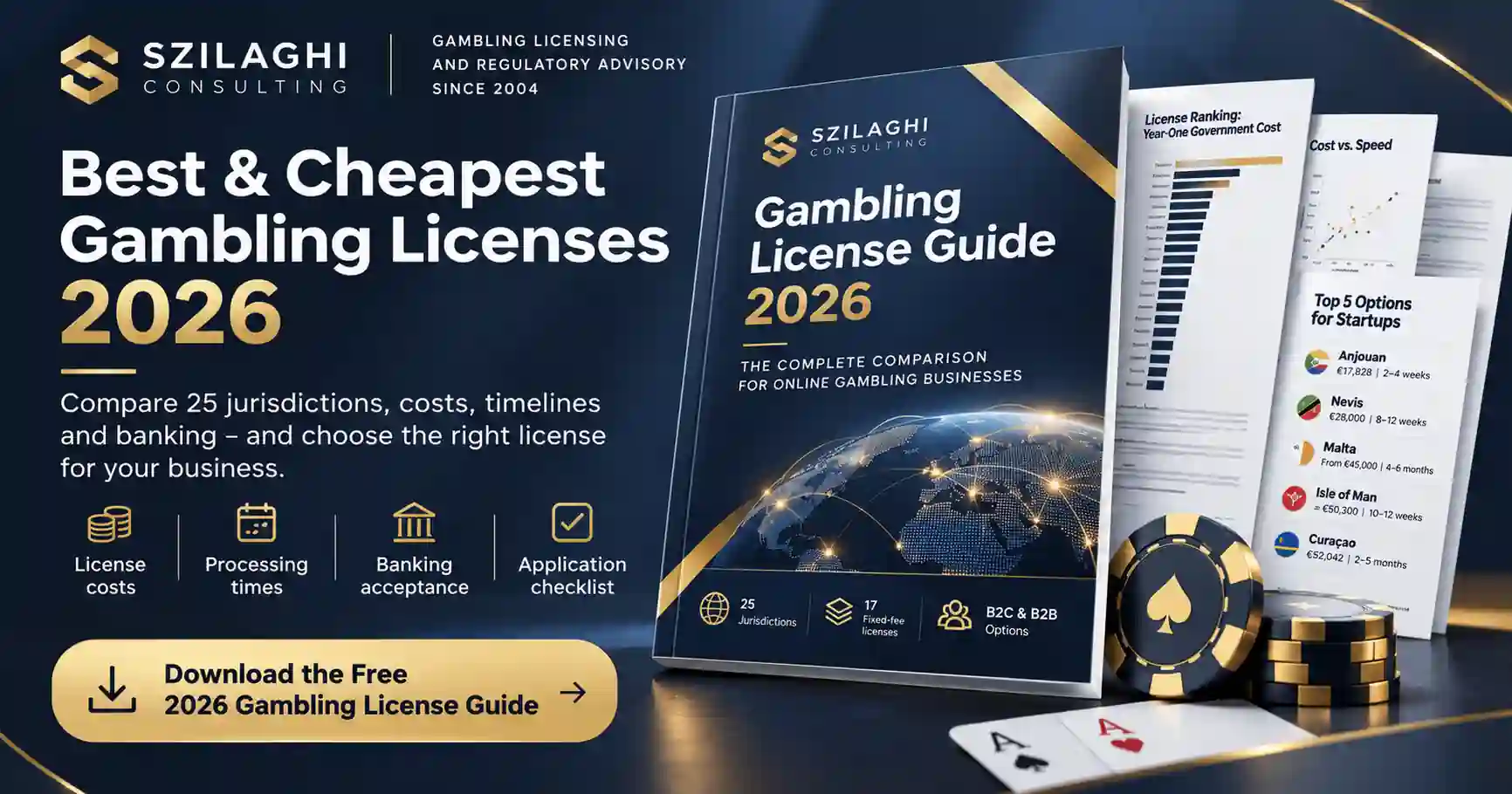
Free PDF: Best & Cheapest Gambling Licenses 2026. Our 13-page Gambling License Guide 2026 covers 25 regimes, including 17 fixed-fee license variants, with government costs, processing times, banking acceptance, visual comparisons and an application checklist. Download the free 2026 Gambling License Guide (PDF)
1. Anjouan: best for a low-budget, fast launch
- Government cost: €17,828 a year
- Processing time: about 2–4 weeks on a complete file; Anjouan publishes no official timeline
- Banking acceptance: Entry
Anjouan remains a low-cost option for startups developing an online casino, sportsbook or other remote gaming product. It licenses B2C operators and B2B suppliers through the Anjouan Offshore Financial Authority (AOFA), administered by Anjouan Licensing Services Inc. The published license fee is €17,828, with annual renewal at the same amount. The first Key Person authorization and one domain are included; each additional Key Person costs €2,000 a year and each additional B2C domain €500. There is no GGR tax.
Why consider Anjouan? Its government charges are comparatively low, the procedure is short and it does not impose the local operating presence some other jurisdictions require. For a startup testing a commercial model in legally accessible markets, a shorter licensing process shortens the time to launch and preserves capital for software, customer acquisition and compliance. Anjouan may also suit crypto-focused businesses, although accepting cryptocurrency does not remove AML, KYC or other regulatory obligations.
What is the catch? Payments and market access. Anjouan is classified as Entry in our banking comparison: some banks, electronic money institutions and payment processors will not onboard operators holding this license. It also does not authorize gambling in markets that require their own national license. A founder who obtains an inexpensive license but cannot establish banking or payment processing may have to rebuild the operating structure.
Our assessment: consider Anjouan where the budget is limited, speed matters and the payment arrangements and player markets have already been checked. Read the complete Anjouan gambling license guide, compare it directly in Anjouan vs Curaçao, or follow the Anjouan application step by step.
2. Nevis: a lower-cost alternative with additional compliance requirements
- Government cost: €28,000 a year
- Processing time: 8–12 weeks
- Banking acceptance: Entry
Nevis introduced its dedicated online gaming framework with the Nevis Online Gaming Ordinance 2025, creating an alternative for operators and suppliers looking beyond the longer-established offshore regimes. The Nevis Online Gaming Authority (NOGA) licenses both B2C businesses and B2B suppliers. The flat €28,000 fee is the same for both and covers processing, two domains, the NOGA seal and the register listing. Applicants must set up an eligible Nevis company and meet the ownership and compliance requirements.
Why consider Nevis? It offers a defined gambling licensing framework without some of the physical-presence requirements found in Curaçao or the Isle of Man, and its licensing process is short compared with most European options.
What is the catch? The €28,000 fee is not the whole operating budget. B2C licensees must appoint a Nevis-resident, FSRC-registered Reporting Officer and an independent Compliance Officer. Our Nevis guide estimates about €34,200–35,900 in first-year B2C costs before key-person due diligence, certification and professional charges. Payment acceptance must be assessed separately.
Our assessment: Nevis is worth comparing with Anjouan for startups that can support the extra compliance appointments and want a different offshore regulatory structure. Read the complete Nevis gambling license guide.
3. Malta: best for startups prioritizing established banking relationships
- Year-one government cost: from €45,000
- Processing time: 4–6 months for application review (typical practice; the MGA sets no timeline)
- Banking acceptance: Tier 1
Malta is not the cheapest licensing jurisdiction, but it can be a stronger starting point for operators that need an established European regulatory framework. The Malta Gaming Authority (MGA) licenses online gambling under the Gaming Act (Cap. 583). For a Type 1 B2C casino license, the minimum year-one government cost is a €5,000 application fee, a €25,000 annual license fee and a minimum €15,000 compliance contribution. The contribution rises with revenue, and from October 2026 gaming tax on players in Malta is 15% for Type 1 and 10% for Types 2–4.
Why consider Malta? An MGA license helps when a startup needs to work with international game suppliers, acquiring banks, electronic money institutions and investors. It brings a developed framework covering player protection, technical systems, governance and compliance.
What is the catch? Malta requires far more preparation than the cheapest offshore regimes. Applicants must meet capital requirements, appoint key-function holders, pass due diligence and complete technical implementation and audit stages. For Type 1 operators, paid-up share capital of €100,000 is required on top of the licensing charges. An MGA license is also not a gambling passport across the European Union: countries with their own licensing systems require separate authorization.
Our assessment: evaluate Malta when financial counterparties, long-term compliance and regulatory positioning matter more than the lowest immediate cost. Read the complete Malta gambling license guide, and see Curaçao vs Malta for the offshore alternative.
4. Isle of Man: an established alternative for operators with a larger budget
- Year-one government cost: £42,000 (≈ €50,300)
- Processing time: 10–12 weeks
- Banking acceptance: Tier 1
The Isle of Man runs its own online gambling licensing regime through the Gambling Supervision Commission (GSC). A full license carries a £5,250 application charge and a £36,750 annual license fee. The regime suits operators that want a recognized regulatory setting outside the European Union.
Why consider the Isle of Man? It combines an established licensing framework with a stated timeline shorter than several European alternatives, and banking, technology and commercial partners often prefer jurisdictions with a long record of gambling supervision.
What is the catch? Local substance raises operating costs materially. A full license normally requires an Isle of Man company, two resident directors, a Designated Official and local technical arrangements. Gambling duty of 0.1–1.5% is charged separately on gross gaming yield.
Our assessment: the Isle of Man suits a well-capitalized startup with a developed business plan better than a founder seeking the smallest possible launch budget. Read the complete Isle of Man gambling license guide.
5. Curaçao: a practical offshore option for operators prepared to establish local operations
- Year-one B2C government cost: €52,042
- Processing time: 22–30 weeks across the statutory review stages
- Banking acceptance: Tier 2
Curaçao remains a significant jurisdiction in international online gambling. Under the National Ordinance on Games of Chance (LOK), in force since 24 December 2024, the Curaçao Gaming Authority (CGA) licenses applicants directly; the former master-license and sublicensing system is gone. For B2C operators, annual government charges total €47,450, plus the €4,592 application fee in year one.
Why consider Curaçao? It has a more extensive formal regulatory and supervisory structure than the lower-cost offshore alternatives. It can suit operators targeting international markets where their business model is lawful and where financial providers accept a Curaçao license. It also has a separate B2B license category for critical suppliers.
What is the catch? The LOK requires genuine local presence: a local company, a resident managing director, real premises, compliance arrangements and approved key personnel. Virtual set-ups do not meet the CGA’s substance policy, and these costs can push the launch budget well above the statutory figure. Curaçao is Tier 2 in our banking comparison; payment providers still assess each applicant, and the license does not open restricted or separately regulated markets.
Our assessment: consider Curaçao when a startup has the capital for local substance and wants a defined offshore supervisory regime. Read the complete Curaçao gambling license guide and, for the local entity, company formation for gambling licenses.
What about B2B gambling licenses?
A software studio, platform developer, game aggregator or other gambling supplier should not automatically apply for a B2C operator license. The right authorization depends on the services provided and the markets in which the supplier’s customers operate. In the 2026 comparison:
| B2B license | Year one | Year two | Banking tier |
|---|---|---|---|
| Anjouan B2B | €17,828 | €17,828 | Entry |
| Curaçao B2B | €29,082 | €24,490 | Tier 2 |
| Romania Class 2 | €45,500 | €35,000 | Tier 1 |
Romania Class 2 is particularly relevant to suppliers serving the regulated Romanian market and is licensed by an EU regulator, the ONJN. It carries no GGR-based tax and no financial guarantee, although continuing regulatory and reporting duties apply, including geolocation and a monthly report under Law 141/2025. Read the Romania Class 2 B2B license guide or the step-by-step article on how to obtain a gambling B2B license in Romania.
Why the cheapest gambling license may cost more in practice
A startup should compare the amount needed to start operating, not just the government invoice. Take an operator choosing between Anjouan at €17,828 and Curaçao B2C at €52,042 in first-year statutory charges: the difference in government fees is €34,214. That saving is useful only if the cheaper license supports the operator’s intended markets, suppliers and payment arrangements.
A complete first-year budget includes:
- Government charges: application, issuance, annual licensing and contributions.
- Capital and guarantees: funds held or committed, not spent fees, but cash the business must have.
- Local substance: offices, directors, representatives, MLRO and key functions.
- Technology and testing: platform audit, RNG and technical certification, hosting.
- Formation and operations: entity incorporation, corporate administration, policies and accounts. See company formation for gambling licenses.
- Payments and compliance: PSP reserves, KYC, screening, AML and reporting workflows.
Cyprus shows how large the hidden difference can be: its €30,000 one-year betting license carries a separate €550,000 bank guarantee. The lowest licensing fee is not necessarily the lowest viable launch cost.
Banking acceptance: the factor startups should check early
A gambling license does not guarantee a business bank account, merchant account or card-processing service. Our jurisdiction comparison groups acceptance into three tiers:
- Tier 1: comparatively established acceptance among financial and commercial counterparties, including Malta, the Isle of Man, Ontario and Romania.
- Tier 2: jurisdictions such as Curaçao, where specialist gambling payment providers may be available but institutions can impose restrictions.
- Entry: regimes such as Anjouan and Nevis, where onboarding options are often more limited and need careful verification.
These tiers are comparative indicators, not guarantees. Before applying, ask prospective financial providers whether they support the license, the target countries, the ownership structure, the payment methods and the expected volumes. This screening should happen before a startup commits to a jurisdiction. For the account itself, see bank account vs EMI account: which one to select.
Is a cheap gambling license enough to operate internationally?
No. A gambling license gives rights under the issuing jurisdiction’s law. It does not authorize gambling services in every country where a website can be reached. Operators targeting the United Kingdom, Romania or other locally regulated markets must meet those national requirements, and a Malta license does not open every EU gambling market.
Two alternatives are often misunderstood:
- Costa Rica does not issue a comparable iGaming license. A company registration or commercial permit should not be presented as a gambling license.
- Cyprus offers a €30,000 one-year betting license, but it is not a general online casino license and requires a separate €550,000 financial guarantee.
Define the gambling activity and the countries you intend to serve first; only then can licensing options be compared meaningfully.
Download the full 2026 gambling license comparison
This article covers five starting points for online gambling startups. The full Best & Cheapest Gambling Licenses 2026 PDF from Szilaghi Consulting covers a much wider range:
- government and statutory costs across 25 jurisdictions, including 17 ranked fixed-fee license variants, among them Kunaisa, Tobique, Kahnawà:ke, Estonia, Ontario and Alberta;
- processing timelines and banking acceptance categories;
- cost-versus-speed and year-one cost charts;
- B2C and B2B licensing considerations, capital requirements and an application-readiness checklist;
- revenue-dependent regimes (United Kingdom, Gibraltar, Bulgaria, Peru, Colombia) and regimes not currently open for licensing.
The guide is free and can be used to prepare an initial licensing budget. Download the free Gambling License Guide 2026 (PDF)
For costs per regime in more depth, see gambling license costs in 2026 and, if you are planning a launch next year, starting an online casino in 2027.
Which gambling license should your startup choose?
The right jurisdiction depends on what the business will offer, where its customers are, how it will process payments and how much capital is available. Anjouan and Nevis deserve consideration for lower-budget projects. Curaçao is an offshore regime with more extensive local requirements. Malta and the Isle of Man suit businesses for which established financial relationships and regulatory positioning come first. For suppliers the comparison changes again, with separate B2B options in Anjouan, Curaçao and Romania.
Szilaghi Consulting assists gambling businesses with jurisdiction selection, corporate structuring, licensing applications and ongoing compliance. The team has obtained over 580 licenses in multiple jurisdictions, with licensing experience dating back to 2004.
Not sure which fits your business? Book a free 20-minute fit call.
Figures are government and statutory charges from the Szilaghi jurisdiction register and the 10 November 2026 guide snapshot; they exclude professional fees. Government costs and timelines change. General information, not legal advice.