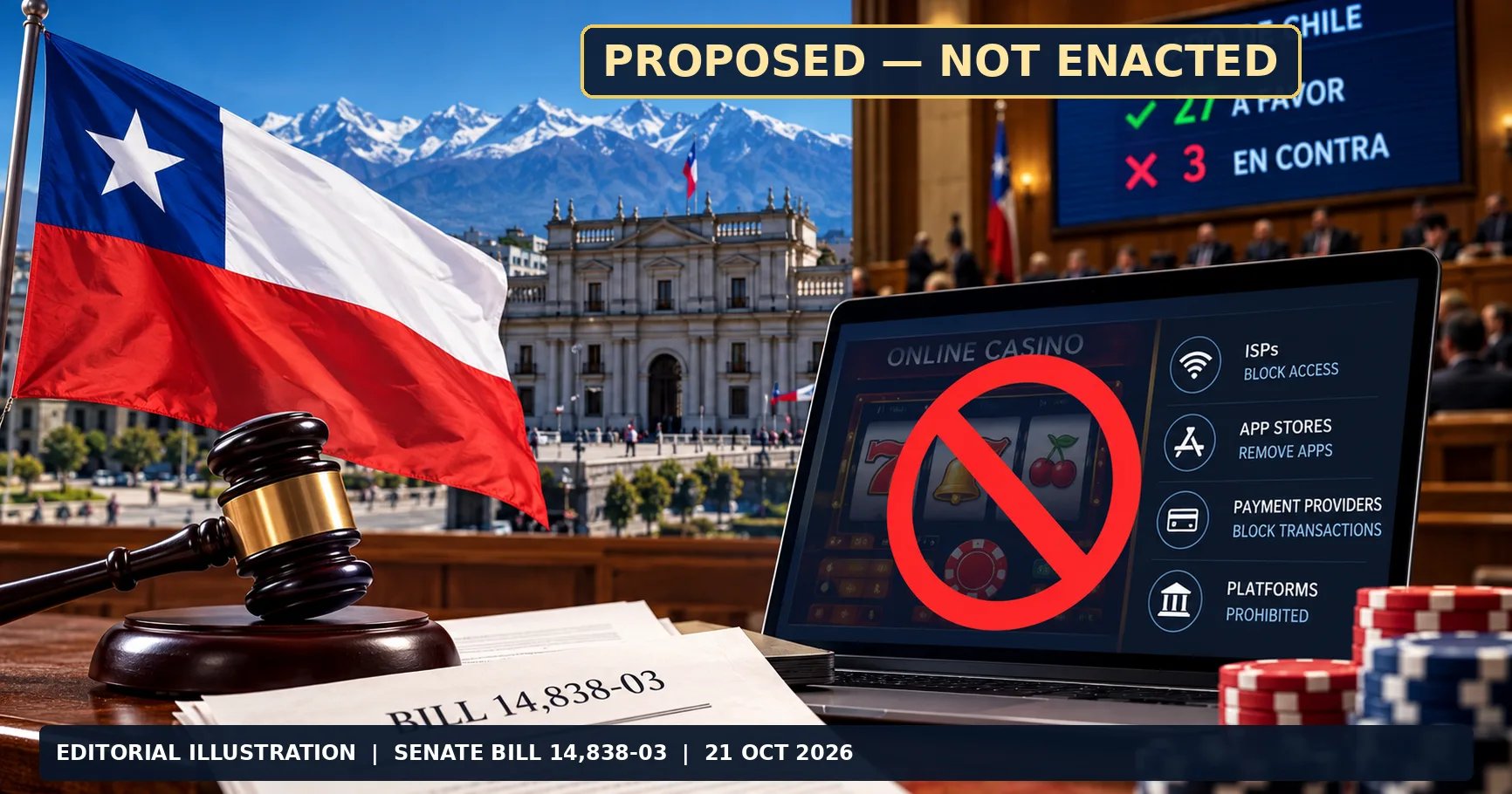
Is Chile banning private online gambling in 2026? Not yet. Bill 14.838-03 was approved in general by the Senate on 13 August 2025, by 27 votes to 3 with five abstentions, as a bill to license online betting. It has not been enacted, and Chile still has no general license for private online gambling. On 16 October 2026, Senators Gastón Saavedra and Paulina Núñez filed substitute amendments that would prohibit private platforms instead. Those amendments are proposals, not law.
The choice matters. Chile can build a regulated market in which private operators meet licensing, tax, age-verification and responsible-gambling standards. Or it can adopt a restrictive model built around existing authorized entities and tougher enforcement against everyone else. Neither can be judged on slogans. The test is which one reduces gambling harm, channels existing demand into controlled environments and survives practical enforcement.
Our view: Protecting consumers is a legitimate priority, and prohibition can be a legitimate policy choice. But a ban without credible enforcement and consumer-protection alternatives risks pushing players toward offshore providers that are harder to monitor, tax or hold to account.
For the current legal position in one place, see our Chile online gambling licensing status page.
Chile online gambling legislation: where matters stand
| Question | Position on 21 October 2026 |
|---|---|
| Bill | 14.838-03, regulating online betting platforms |
| Senate general vote | 27 in favor, 3 against, 5 abstentions on 13 August 2025: approval in general, not enactment |
| Original direction | Competitive licensing with taxation, supervision and player safeguards |
| Current stage | Second constitutional stage; amendments before the Senate Economy Committee |
| General private online gambling license | None available |
| Amendment deadline | Extended to 26 October 2026, 12:00 |
| Restrictive amendments filed | Saavedra (prohibition of private platforms, with exceptions) and Núñez (criminal penalties and permanent blocking), both 16 October 2026 |
| Existing enforcement | Supreme Court blocking order (30 September 2025); Subtel DNS-blocking instructions for 42 addresses (1 September 2026) |
This page separates the law in force from proposed amendments. We will update it when amendments are voted on.
1. From a licensing vote to a fight over market structure
In August 2025 the Senate approved the bill in general. Its stated aims were regulated competition, player protection, financial transparency and effective oversight of digital betting. The vote endorsed legislating; it did not approve every clause or authorize any private operator.
The debate has since turned. According to Chilean press reports of 16 October 2026, Economy Committee chair Gastón Saavedra (PS) filed a substitute amendment that would prohibit online gambling platforms, with exceptions for Polla Chilena de Beneficencia, Lotería de Concepción, authorized racetracks and casinos. It would require internet service providers, app platforms and payment processors to block prohibited services, and would give platforms registered with the tax authority (SII) a transition of up to 24 months.
That would be a sharp break from the competitive model debated so far. The exact scope of the exceptions and the transition will only be clear from the text as finally voted.
A committee amendment is not a national ban. The Senate, the executive and the remaining legislative stages can still change the outcome.
2. Does prohibiting private operators protect players?
The strongest case for prohibition is simple: a state may decide that gambling harms justify restricting supply, especially where advertising, debt or access by minors have become hard to control.
The counterargument is channelization: where do consumers go when they cannot reach authorized, supervised online products?
A licensing regime can compel operators to verify identity and age, offer responsible-gambling tools, run audited games, monitor payments and follow approved advertising rules. It also produces the regulatory data needed to measure harm and enforce sanctions.
Prohibition can reduce exposure if access, advertising and payments are effectively restricted. But if players move to offshore sites, the state loses direct oversight of deposits, withdrawals, complaints and data. How large that migration would be in Chile cannot be asserted without reliable measurement.
So the policy question is not whether gambling should be unregulated. It should not. It is which arrangement produces the best observable public-health and enforcement outcomes.
3. Protecting incumbents needs a consumer-benefit case
The Saavedra amendment would leave selected existing institutions in a privileged position while excluding new private online entrants.
That raises competition and proportionality questions; it is not proof of improper motives. Existing entities operate under different statutes, controls and public-interest obligations. The legislature should explain why those differences justify treating comparable products differently. A sound legislative record should address:
- which harms the prohibition aims to reduce;
- why licensing, technical standards and sanctions would not be enough;
- which existing institutions may offer equivalent digital services, and on what terms;
- whether consumers would have effective complaint and fund-protection mechanisms;
- how market concentration, tax revenue and illegal supply would be monitored.
Regulation should be measured by results for consumers, not by the number of companies excluded.
4. ISP, payment and app-store blocking: enforcement has costs
Both amendments lean on intermediaries. Saavedra’s would oblige ISPs, app platforms and payment processors to block prohibited services. Núñez’s would create a court procedure, before a judge of the San Miguel Court of Appeals, to block sites and apps permanently while the grounds persist, extend blocks to new domains of the same operation after judicial verification, restrict payment and advertising services, and give providers 48 hours to comply.
These measures could disrupt unauthorized supply, but they need precise design: a competent decision-maker, clear targets, notice, review rights, proportionality and remedies for mistaken blocks.
Chile already has enforcement on the books. The Supreme Court ordered blocking of the unauthorized platforms before it on 30 September 2025, and Subtel issued DNS-blocking instructions for 42 web addresses on 1 September 2026. Blocking alone does not remove demand, and overly broad orders cause collateral damage.
5. The proposed penalties are not current law
Senate President Paulina Núñez (RN) has proposed prison terms of up to 15 years in aggravated cases, fines of up to 10,000 monthly tax units (UTM) and criminal liability for legal entities. Aggravating factors include targeting minors, continuing to operate in breach of a court order, links to organized crime, and false identities or shell companies hiding the real controllers. Her amendment would reserve digital gambling for legally authorized entities without creating a new licensing market for private operators.
These are draft penalties. The offense definitions, maximums and their final form depend on the text Congress actually passes. The same applies to Saavedra’s 24-month transition for SII-registered platforms: its scope and conditions cannot be assumed until enacted.
For investors and operators, a draft sanction is a material risk indicator, not an obligation that applies today.
6. Tax compliance is not a gambling license
SII Resolution 69 of 2 June 2026 set up VAT registration, filing and payment for certain non-resident digital gambling and betting providers. In June 2026 the Senate Economy Committee heard from the SII director on the tension between collecting VAT and the illegality of unauthorized online gambling.
The distinction is essential: paying tax does not legalize an unauthorized product. SII registration should never be presented to banks, affiliates or customers as a Chilean gaming license, and it does not necessarily create a right to keep operating during any future transition.
7. What operators and suppliers should do before 26 October
The amendment deadline is 26 October 2026 at 12:00. Plan for competing scenarios instead of betting on one.
| Workstream | Planning action |
|---|---|
| Market-entry strategy | Do not market a pending bill as an available Chilean license |
| Corporate structure | Model a future licensed Chilean entity only as a contingent option |
| Compliance | Prepare age verification, AML, player safeguards and technical controls for a possible regulated model |
| Current activity | Assess exposure from serving Chilean users under existing prohibitions and blocking orders |
| Tax | Keep SII obligations separate from gaming authorization |
| Commercial contracts | Add legislative-change, suspension and exit clauses |
| B2B and affiliates | Check advertising and supplier exposure before supporting Chile-facing campaigns |
| Monitoring | Track the filed amendments, committee reports and final votes |
An operator already exposed to Chile needs advice based on its actual sites, entities, payment flows and marketing. A general offshore license does not create Chilean market access. If a Chilean entity becomes relevant, see Chile company formation for iGaming; affiliates should note the same verify-the-operator discipline we describe for regulated affiliate programs.
8. What a workable Chilean model would contain
If Chile chooses regulated private competition, it needs real eligibility checks, capital and financial-security rules, age and identity verification, AML controls, exclusion tools, transparent advertising limits, technical certification, complaint resolution and enforceable penalties for unlicensed supply.
If it chooses prohibition, the framework must answer how players are protected when unlawful services remain reachable, how intermediaries can comply with blocking orders and how success will be measured.
Both models need evidence and accountable implementation. A licensing regime that exists only on paper fails; so does a prohibition that pushes players to providers nobody can reach.
9. Outlook for late 2026 and 2027
Three outcomes remain possible: Chile revives competitive licensing; it adopts a restrictive framework that excludes private platforms; or it keeps revising the bill and the uncertainty continues. These are scenarios, not predictions.
Chile is not alone. Brazil, which opened a licensed market in 2025, has prohibited fixed-odds betting under Provisional Measure 1.394/2026 since 25 September 2026, pending Congress; see our Brazil licensing status page. Investors should not publish assumed fee schedules, launch dates or eligibility rules for Chile while the bill is pending. The next meaningful event is the committee’s treatment of the amendments filed by 26 October. To compare Chile with markets that do license today, see our jurisdictions register, including Peru and Colombia, or our map of where online gambling is legal.
Conclusion: a consumer-protection argument must survive the real market
Chile is entitled to choose a restrictive policy. But lawmakers should compare the actual consumer outcomes of restriction against those of supervised competition, rather than assume that removing licensed private supply removes online demand.
A durable framework must cover player protection, technical enforceability, financial transparency, lawful competition and appeal rights. It should also avoid contradictory signals, such as treating an activity as unauthorized while collecting VAT from the same providers.
The question is not whether gambling should be controlled. It is whether Chile’s controls will reach the players and transactions that need protecting.
Chile market-entry advice from Szilaghi Consulting
Szilaghi Consulting advises international operators and B2B suppliers on regulatory feasibility, corporate structure, compliance and market-entry planning. Chile’s pending bill makes advance analysis valuable, but no general online license can be applied for there today. See our international gambling licensing advisory and compliance and corporate structuring services.
Request a Chile market-entry feasibility assessment.
Reviewed 21 October 2026. Descriptions of the Saavedra and Núñez amendments are based on Chilean press reports of the filed amendments and will be checked against the committee text. Legislative status can change quickly. This is legal and commercial commentary, not individual legal advice.