Is Latvia raising its gambling age to 21 in 2026? Not yet. On 21 October 2026 the Saeima’s Budget and Finance (Taxation) Committee supported, in first reading, the Finance Ministry’s amendments to the Gambling and Lotteries Law. The measures are not law: the committee left the final decision to the incoming 15th Saeima. Until then, the minimum gambling age stays at 18 and licensed operators follow the rules already in force.
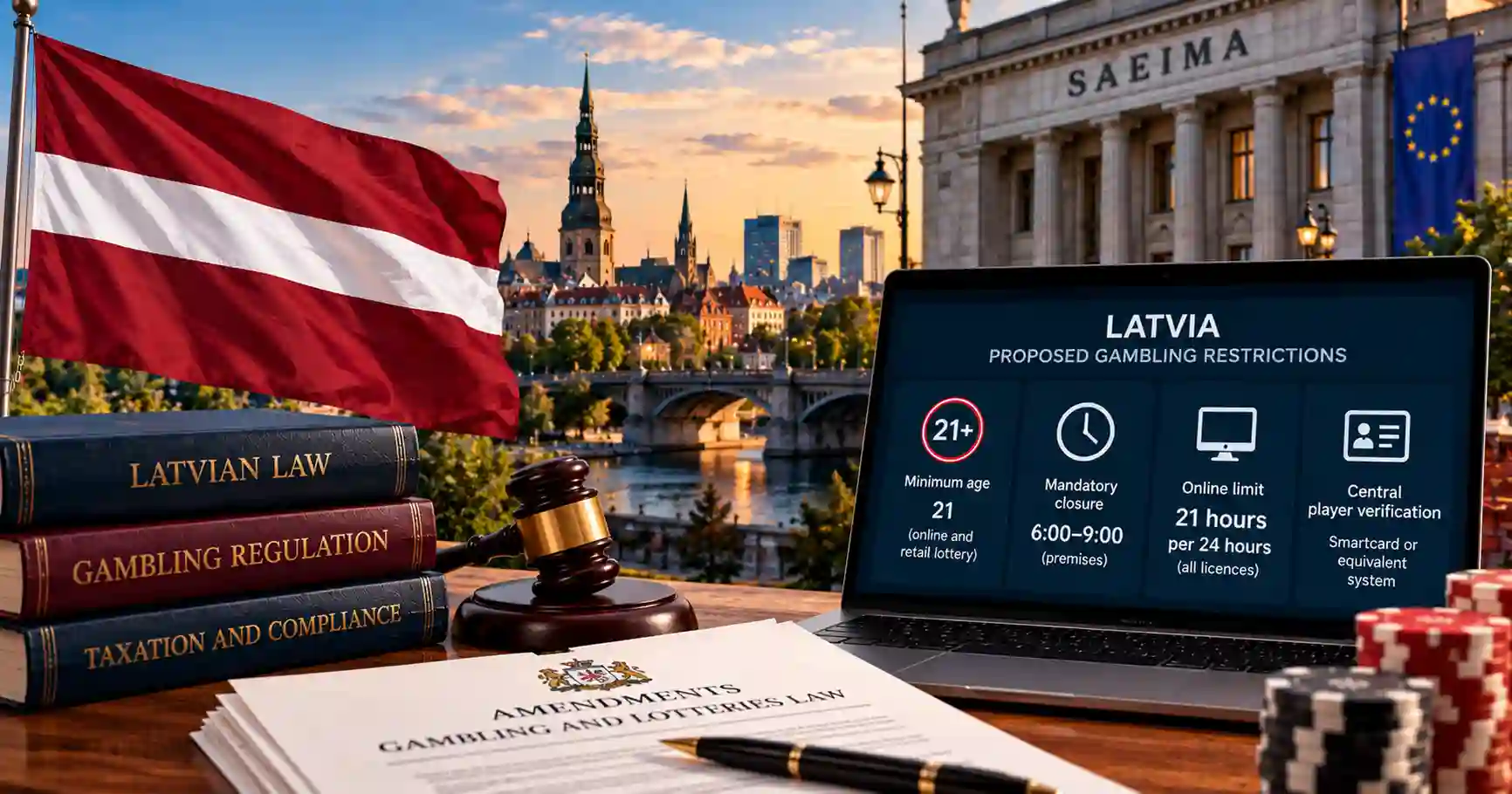
The draft would raise the gambling age to 21, close gambling venues between 06:00 and 09:00, cap online play at 21 hours in any 24-hour period, introduce personalized player cards, and lift the minimum number of gaming machines per hall from 20 to 25.
Keep proposals and enacted law apart. Latvia has already raised its gambling taxes and moved licensing and supervision to the State Revenue Service (VID) in 2026; those changes apply now. The player-protection package still needs parliamentary approval. For Latvia’s neighbors, see our guides to the Estonia gambling license and the Finland gambling license.
Latvia gambling reform at a glance
| Issue | Position on 22 October 2026 | Practical consequence |
|---|---|---|
| Minimum gambling age | 18 today; 21 proposed | Review age-verification logic; do not present 21 as law |
| Lotteries | Participation limited to adults proposed | Depends on final wording and transition |
| Gambling venues | Closure 06:00–09:00 proposed; totalizators and betting exempt | Shift planning and venue revenue |
| Online gambling | Maximum 21 hours in any 24-hour period proposed | Needs shared monitoring and precise counting rules |
| Player identification | Personalized player card or equivalent system proposed | Integration, data-protection and governance work |
| Gaming machines per hall | At least 20 today; 25 proposed | Floor space and capital for smaller halls |
| Video surveillance | Retention from 7 to at least 30 days proposed | Storage cost and GDPR assessment |
| Facades and signage | Uniform requirements proposed | Possible refits |
| Regulator | State Revenue Service (VID) since 1 April 2026 | Already in force |
| Interactive gambling tax | 15% of revenue from organizing the game | Already in force |
Proposed measures as reported from the 21 October 2026 committee meeting; tax rates from the Latvian Ministry of Finance. Final wording, exceptions and commencement dates can only be confirmed once the bill passes.
1. A committee vote, not a new law
The Budget and Finance (Taxation) Committee gave conceptual support to the Finance Ministry’s draft in first reading on 21 October. Work on these amendments began in 2019, and the Saeima referred the bill to the committee on 26 September 2024. The committee chair, Aiva Vīksna, urged the next parliament to continue the work rather than start over; whether the 15th Saeima, elected on 3 October 2026, will do so, and in what form, is open.
The bill comes from the government formed before the election: the Saeima approved Prime Minister Andris Kulbergs’s cabinet on 28 May 2026, with Māris Kučinskis as Minister of Finance. The Finance Ministry’s representative, Jana Salmiņa, described the draft as a compromise and noted that some earlier planned measures, such as the ban on free alcohol in venues, are already in force.
The debate runs both ways. The association of licensed operators, represented by Emīls Jonins, wants the bill reworked because it does little against illegal online gambling: it puts last year’s licensed online market at about €170 million and the illegal market at about €62 million. The party Kustība Par! argued the opposite, calling the draft too lenient and proposing a ban on venues in residential buildings and sports facilities and a minimum of 40 machines per hall.
2. A 21+ age limit would reach every channel
The core proposal raises the minimum gambling age from 18 to 21 and limits lottery participation to adults. For licensed operators this touches registration and identity checks, payment access, customer databases, venue admission and marketing audiences.
The draft does not yet answer the transition questions: what happens to verified customers aged 18–20, whether existing accounts must be closed or frozen, and how much lead time operators get. There is no effective date. Operators should prepare a conditional plan rather than deactivate lawful accounts on the strength of a draft.
3. A 21-hour online cap is a cross-operator technology question
The proposed ceiling of 21 hours of online play in any 24-hour period only works if it is measured across licensed operators. A cap that each site applies on its own can be avoided by switching to another licensed brand.
That is why the draft pairs it with player identification. The open design points are whether the 24-hour period is rolling or calendar-based, how an active session and idle time are defined, what happens during outages, and which body runs the shared system. Data protection, cybersecurity, retention and access rights all need rules of their own. Until the law and its technical regulations are adopted, there is no operative 21-hour limit.
4. Player cards and unified monitoring
The draft provides for personalized player cards, or an equivalent system, recording time spent, deposits and winnings so that operators can identify addiction risk. Such a system could show repeated play across venues and online brands, subject to a legal basis for sharing the data.
The risk is not only technical. A central record of gambling activity, spending and vulnerability indicators needs a clear controller, defined purposes, access rules, security, retention limits and a way to correct errors. For operators, the useful step now is a gap assessment: list the identity checks, self-exclusion controls and session monitoring already in place, and document what would change if a shared system became compulsory.
5. Land-based venues face cost and closure pressure
Venues would close between 06:00 and 09:00, with totalizators and betting exempt. The minimum size of a gaming hall would rise from 20 to 25 machines, CCTV recordings would be kept for at least 30 days instead of 7, and facades and signage would follow uniform rules.
Smaller halls carry most of that burden. The licensed industry association estimates that the 25-machine rule could close about 30 venues, cost about 240 jobs and reduce gambling tax revenue by about €4.46 million a year. These are industry figures, not official impact estimates. Whether a given hall can comply will depend on the final definitions, transition periods and any grandfathering, so operators should model each location rather than assume every hall can expand.
6. What has already changed in Latvia in 2026
Two changes are already law.
Higher gambling taxes from 1 January 2026. The Ministry of Finance lists these rates:
| Gambling category | Tax base | 2026 rate |
|---|---|---|
| Interactive gambling (any game type) | Revenue from organizing the game | 15% |
| Betting and wagering | Revenue from organizing the game | 18% |
| Telephone games | Revenue from organizing the game | 18% |
| Bingo | Revenue from organizing the game | 12% |
| Gaming machines | Each playing position, per calendar year | €7,440 |
| Roulette, card and dice tables | Each table, per calendar year | €40,440 |
The interactive rate rose from 12% to 15%, and the state duty for an interactive gambling license remains €200,000. The base is the revenue from organizing the game as defined in the tax law, not player deposits or turnover.
Supervision moved to the State Revenue Service on 1 April 2026. The Lotteries and Gambling Supervisory Inspection no longer operates as a separate authority. VID now licenses gambling and lottery operators, supervises them and keeps the self-exclusion register. The same amendments to the Gambling and Lotteries Law introduced a narrow exception to the advertising ban, letting licensed betting operators’ registered figurative trademarks appear in adult sport, subject to conditions and excluding youth sport.
The merger does not remove any licensing requirement or soften existing obligations; it changes which authority enforces them.
7. What to watch in the 15th Saeima
Five questions will decide the commercial impact:
- Age and transition: does the 21+ rule apply immediately, and what happens to existing customers aged 18–20?
- Cross-operator limits: how is the 21-hour cap measured, and who runs the shared system?
- Privacy and system ownership: who holds player identity and risk data, on what legal basis?
- Retail feasibility: how long do halls get to move from 20 to 25 machines, and is there grandfathering?
- Channelization: will enforcement against unlicensed online operators keep pace with tighter rules for licensees?
Follow the parliamentary readings, the consolidated law on likumi.lv and VID guidance rather than political statements or draft summaries.
8. Compliance checklist for operators and suppliers in Latvia
Separate what applies now from what might apply later.
Now: confirm the 2026 tax rates are reflected in finance and reporting systems, align reporting with VID as the new supervisor, and keep evidence of the licenses and controls already in use.
For the draft: prepare change-impact plans for age-verification logic, player time monitoring, identity and player-card integrations, CCTV retention, venue sizing, supplier contracts and information security, with costs, dependencies and realistic lead times.
Do not change public terms, refuse eligible customers or alter statutory declarations on the basis of provisions that have not passed.
Outlook: protection depends on workable implementation
Latvia is tightening oversight on top of higher 2026 taxes and a regulator now housed in the tax administration. Central player monitoring could help identify harm if it is well designed and governed. Costly technical requirements or a badly calibrated cap could also push players toward unlicensed sites, which is the industry’s main objection. A sound impact assessment has to weigh both effects.
The short version: Latvia’s 2026 tax increases and the move to VID supervision are law today; the 21+ age limit, the 21-hour online cap and the 25-machine minimum are still proposals.
For a wider view of where online gambling is licensed, see where online gambling is legal in 2026 and our country-by-country European gambling regulation overview.
EU market-entry advice from Szilaghi Consulting
Founded by Alex Szilaghi, licensing gambling businesses since 2004, Szilaghi Consulting helps operators and suppliers assess EU markets, plan license applications and track regulatory change. To compare Latvia’s neighbors and other EU options, compare gambling license jurisdictions, see our licensing and compliance services, or book a free fit call to review your Latvian exposure.
Regulatory review: 22 October 2026. The proposed measures rely on reporting of the 21 October 2026 committee meeting; tax rates and the supervisory change are from Latvian government and legal sources. Draft measures may change. This is general business analysis, not a legal opinion for a particular operator.