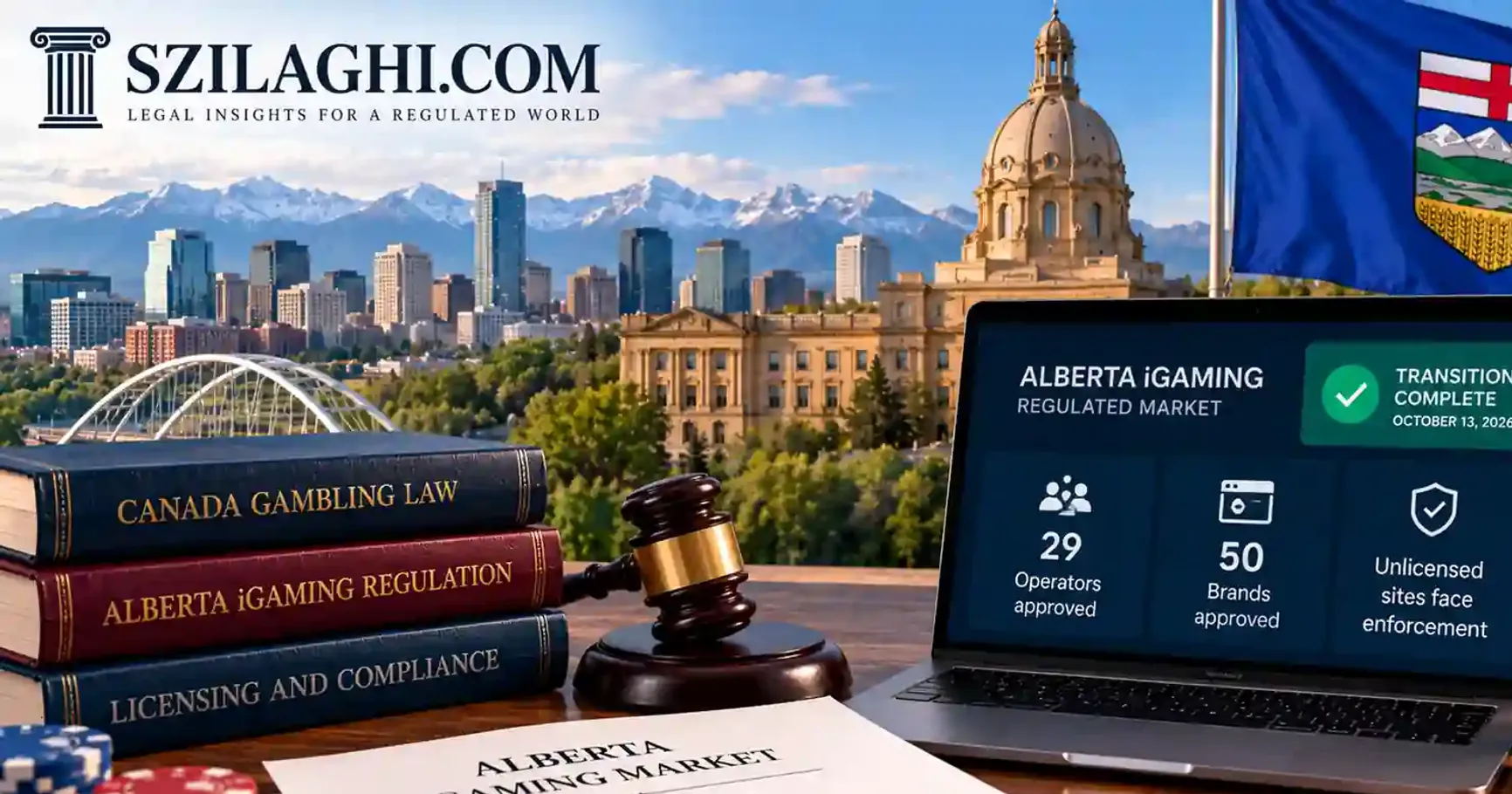
Has Alberta closed its transition period for private online gambling? Yes. Alberta’s competitive regulated iGaming market opened on 13 July 2026, and the three-month transition for formerly unregulated operators ended on 13 October 2026. Operators still serving Albertans without full provincial approval now risk enforcement, even if their application is pending.
At the deadline, 29 operators and 50 brands had been approved, according to figures from Alberta Gaming, Liquor and Cannabis (AGLC) and the Alberta iGaming Corporation (AiGC) reported on 14 October. The roster kept moving: by the morning of 15 October, reporting counted 30 operators running 51 sites, and an AiGC spokesperson said the number could change again that day. These are dated snapshots, not a limit on licenses.
The deadline changes the business case. An operator can no longer serve Alberta from an offshore license while an application works its way through. For the fees and the two-step entry process, see our Alberta iGaming license guide.
Alberta’s 2026 iGaming transition: key dates
| Date | Development | What it means for operators |
|---|---|---|
| 13 July 2026 | Competitive regulated market opens | Approved sites can offer gambling under provincial oversight; the three-month transition starts |
| 13 October 2026 | Transition ends | Operators without full approval must stop serving Albertans |
| 14 October 2026 | 29 operators and 50 brands reported approved | A dated count, not a ceiling |
| 15 October 2026 | 30 operators and 51 sites reported live | Check the AiGC directory before any launch or listing |
Check authorization on the AiGC registered sites directory and against the AGLC iGaming framework, not on press counts.
1. What changed on 13 October
Alberta gave businesses already serving Albertans a three-month window to move into the regulated system. That window has closed. Operators that did not finish the process, including those still waiting for a decision, must stop taking bets from Albertans until they are approved.
The deadline does not stop anyone from applying later; it stops them from operating before approval. A registration in progress, an Ontario registration or an offshore license does not authorize a particular casino or sportsbook site in Alberta.
2. AGLC registration and the AiGC agreement: two separate checkpoints
Entry needs both a regulatory and a commercial approval. The provincial framework sets out registration and due diligence with AGLC, a commercial agreement with AiGC, and confirmation that the operator may begin.
| Authority | Main role | The question it answers |
|---|---|---|
| AGLC | Registration, due diligence, supervision and enforcement | Is the company registered and compliant? |
| AiGC | Commercial agreement, market operation and approved-site directory | Is this specific site approved to take bets? |
The Alberta iGaming strategy draws the same line. A brand should not be marketed to Albertans just because its parent company appears in a register.
3. Why “29 operators” and “50 brands” are different numbers
One registered operator may run several casino or sportsbook brands; one approved group may hold separate entries for its casino and its sportsbook. Counting companies and counting sites measure different things, which is why some reports gave 50 and others 48 or 51 in the same week. Any statement about the Alberta market should give both the date and the unit.
For legal purposes, the question is whether the exact site appears in AiGC’s current directory.
4. What happens to offshore and formerly unregulated operators
The deadline is an enforcement line, not a marketing milestone. AGLC has said it will monitor compliance and act against operators still serving Albertans without approval, including those awaiting authorization; its spokesperson said the agency has “several investigative options available” without describing them. Alberta’s framework largely follows Ontario’s, where the AGCO has fined registered businesses for compliance breaches, and commentators expect Alberta to take a similar line.
The provincial government has estimated that about 70% of iGaming activity in Alberta took place with operators not regulated in the province, which shows the scale of the channel the transition is meant to close.
An operator still awaiting approval should stop Alberta-facing wagering and review customer balances, account access, advertising and affiliate arrangements. Groups active elsewhere also need to check whether their domains, payment flows and affiliate campaigns still reach Albertans with unapproved offers. Continuing to take bets in the hope that approval arrives soon is not a compliance strategy.
5. Player protection is a licensing condition, not a footer link
Alberta requires approved operators to identify and respond to potentially harmful play, offer deposit, spending and time limits, give players access to their account activity, connect to the centralized self-exclusion system and apply other consumer safeguards.
That means platform functionality, documented governance, staff training and reliable monitoring. A responsible-gambling badge or a generic policy does not meet the requirement if the live customer journey cannot deliver the controls.
Marketing teams and affiliates need a list of approved sites too. An ad accepted by an advertising platform does not prove the promoted site is approved in the province.
6. How Alberta compares with Ontario
Ontario opened its private regulated market in April 2022, with AGCO registration and an iGaming Ontario operating agreement. Alberta followed in July 2026 on a similar two-step model, but with its own agencies, documents, reporting and fees. See our Ontario iGaming licensing guide for the comparison.
The revenue model also differs. Under Alberta’s framework, 3% of gross gaming revenue is first set aside (2% for First Nations initiatives and 1% for social responsibility programs); of the remaining net revenue, the operator keeps 80% and the province takes 20%. That is a revenue-sharing arrangement under the AiGC agreement, not a flat 20% tax on gross gaming revenue.
A business already approved in Ontario should treat Alberta as a separate market-entry project, not a license extension. The same applies across Canada: New Brunswick is only now reviewing whether to regulate private online operators, and the Canadian province-by-province picture has no national passport.
7. What early BetMGM figures do and do not show
BetMGM, which launched in Alberta on 13 July, said its per-player metrics are trending above its Ontario launch, and its CFO was reported as saying that Alberta accounted for about 20% of the new players it acquired in the third quarter. These are one company’s management comments, not audited market data, and they say nothing about the returns a new entrant should expect.
A real business case starts from the cost of approval, platform adaptation, payments, responsible-gambling compliance, marketing restrictions, the revenue share and ongoing reporting. Competitors’ results are context, not a forecast.
8. Market-entry checklist for operators and suppliers
Before launching in Alberta, or signing with an Alberta-facing operator, confirm:
- the contracting legal entity and its AGLC registration;
- the AiGC commercial agreement;
- the exact approved domains and products in the AiGC directory;
- player verification, limits, self-exclusion and record-keeping in the live product;
- AML controls, financial reporting and third-party contracts;
- which marketing territories and affiliates are permitted.
Keep a dated compliance record. The operator register and the public site list may show different numbers because they answer different questions.
Suppliers should not assume that approvals in Ontario, the United Kingdom or elsewhere meet every Alberta requirement; check which supplier categories AGLC requires to register. Our case study of a game studio licensed across five jurisdictions, including an Ontario supplier registration, shows how these approvals are sequenced.
9. What comes next
More brands are likely to be approved after October 2026: the deadline closed the grace period, not the market. Watch the AGLC registers and the AiGC directory for new approvals, suspensions and exits. The next indicators that matter are enforcement against unapproved sites, regulated gaming revenue, use of responsible-gambling tools, and how many players move to approved operators.
Conclusion: Alberta moves from transition to enforcement
The 13 October 2026 deadline ends the ambiguity for operators that served Albertans without local approval. The snapshot of 29 operators and 50 brands shows how fast the market filled, but each site’s status has to be checked on its own.
For operators, investors and suppliers, Alberta confirms a familiar rule: market access comes from the destination jurisdiction’s approval, not from a gambling license held somewhere else. For a wider view, see where online gambling is legal in 2026.
Canadian market-entry advice from Szilaghi Consulting
Founded by Alex Szilaghi, licensing gambling businesses since 2004, Szilaghi Consulting helps operators, platforms and suppliers plan market entry: the regulated activity, the eligible applicant, the local approval route and the systems needed to stay compliant after launch. See our gambling company formation services, compare gambling license jurisdictions, or book a free fit call for a scoped Alberta assessment.
Regulatory review: 23 October 2026. Operator and site counts are dated snapshots from October 2026 reporting of AGLC and AiGC figures; check the AiGC directory for the current list. This is general regulatory analysis, not a legal opinion for a particular operator.