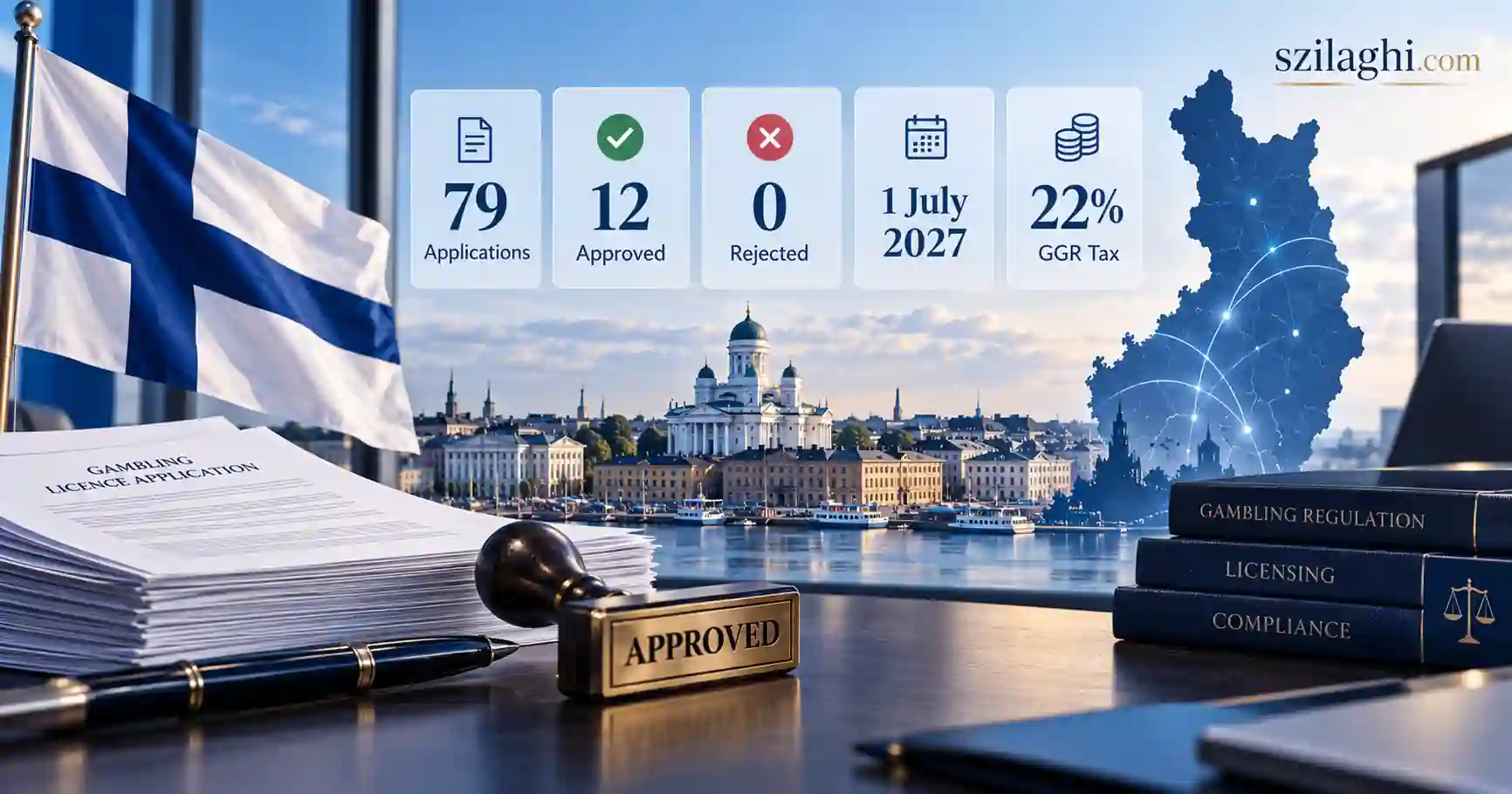
How many gambling licenses has Finland approved? Twelve, with none rejected. As of 26 October 2026, the Finnish National Police Board had received 79 applications, granted 12 licenses and refused none, according to figures it gave iGaming Business. It is the regulator’s first official count, after Wildz Group and Hippos ATG announced their own approvals earlier in October. The competitive market for online betting, casino, slots and bingo opens on 1 July 2027, and no license can take effect before then.
For operators the figures mark the start of a competitive phase, not a relaxed one. For the full licensing route, fees and conditions, see our Finland gambling license guide.
Finland’s licensing position at a glance
| Item | Position on 26 October 2026 |
|---|---|
| Applications received | 79 |
| Licenses granted | 12 |
| Applications rejected | 0 |
| Applications with no published decision | 67 |
| Applications open since | 1 March 2026 |
| Market opening | 1 July 2027 |
| Licensing authority | National Police Board (Poliisihallitus) until 30 June 2027; Finnish Supervisory Agency from 1 July 2027 |
| Application fee | €29,000 per application |
| License term | Up to 5 years |
| Tax from 1 July 2027 | 22% lottery tax on gambling margin |
Counts from the National Police Board’s reply to iGaming Business, published 26 October 2026; there is no public register until the Finnish Supervisory Agency starts one. The 67 is the arithmetic difference, not a published figure.
1. 79 applied, 12 approved, none rejected
Twelve approvals out of 79 is about 15% of applications so far, but that is a snapshot of a process still running, not an approval rate. Zero rejections means no negative decision had been recorded by the cutoff. It does not mean the other 67 files have passed: the Police Board is still reviewing ownership, financing, products, suppliers and compliance arrangements, and it can ask for more documents.
The number of applications has climbed steadily, from about 50 in June to 75 by 22 September and 79 by 26 October. The more useful signal for operators planning a July 2027 launch is that decisions have moved from review to formal approval.
2. The 12 licensees
| Licensed company | Note |
|---|---|
| Hippos ATG Oy | Joint venture of Sweden’s ATG and the Finnish racing association Suomen Hippos; announced its license on 19 October |
| Sunflower Gaming Limited | |
| Granturo Finland Ltd | Wildz Group; first to announce, on 15 October |
| Skill On Net Ltd | |
| SuomiVeto Oy | New Finnish challenger whose founders helped build Dutch sportsbook BetCity |
| Cloudberry Ent Limited | |
| SixthSpin Limited | |
| KuuFlip Limited | |
| RocketLily Ent Limited | |
| Nivei Ursi Limited | |
| YTBlue Limited | |
| Buccone Trading Limited |
The list names legal entities, not brands, and it does not mean any of them can launch now: a license granted during the transition takes effect on 1 July 2027 at the earliest. ComeOn Group has said it received three licenses, although Finnish trade press could not match any of the 12 entities to it, a reminder that brand announcements and the regulator’s entity list will not always line up.
Early approval gives these companies certainty to sign supplier contracts, certify platforms, set up payments and hire. It does not give early access to Finnish players. Each still has to show at launch that its live platform, products, player protection and marketing meet Finnish rules.
3. Veikkaus is not on the list yet
The state monopoly applied to compete through subsidiaries, Veikkaus Onnenpelit Oy for its exclusive licenses and Veikkaus Vedonlyönti ja Nettikasino Oy for a competitive gambling license, but neither appears among the first 12. With zero rejections recorded, that is not a refusal; its review simply had not concluded. Finnish trade press notes that the marketing ban imposed on Veikkaus in November 2024 may weigh on the assessment.
From 1 July 2027 Finland separates two worlds. Licensed private operators may offer online betting, casino, slots and bingo, while Veikkaus keeps exclusive rights to lotteries, scratch cards and land-based gaming. Veikkaus enters the transition with a national brand and an existing customer base, but it will meet the same compliance and marketing rules as new entrants in the competitive segment.
4. Approval is not permission to launch
The milestones are separate:
- 1 March 2026: B2C applications opened.
- October 2026: first licenses granted, effective no earlier than 1 July 2027.
- 1 July 2027: competitive market opens; the Finnish Supervisory Agency takes over; the 22% lottery tax applies; software suppliers can apply for their own license.
- 1 July 2028: licensees may use only software from Finnish-licensed suppliers.
The 22% tax applies to the gambling margin, broadly gross gaming revenue, not to deposits: €10 million of margin means €2.2 million of lottery tax before other costs. Operators also pay the €29,000 application fee and an annual supervision fee of €4,000–€434,000 by revenue. Game studios and platforms should note the 2027–2028 supplier timeline now; see the Finland guide for the supplier license.
5. Why zero rejections does not mean easy licensing
The Police Board targets six to eight months per application and assesses applicants on their documents: the company, its board and management, anyone holding 25% or more, financial standing, the games offered and the system suppliers. Applicants should prioritize:
- Eligibility and ownership: a structure and people that meet the fit-and-proper test.
- Financing: credible financial information and full disclosure of group relationships.
- Products and technology: each game type covered by the application, and the known software suppliers.
- Player protection: identity checks, deposit limits and self-exclusion built into the platform.
- Marketing: an acquisition plan that works without affiliates, influencers or sign-up bonuses, which the Finnish rules restrict.
- Regulatory change: the handover to the Finnish Supervisory Agency and the 2028 software deadline.
A complete, consistent file shortens the back-and-forth with the regulator; an incomplete one is the usual cause of delay.
6. What 79 applications mean for competition
There is no license cap and no closing date, so 79 applications are not 79 future brands. One group can file through several companies or for different permissions, and some applicants will change plans or fail the review. The count still shows strong interest in a market H2 Gambling Capital estimates at about €1.9 billion of gross gaming revenue in 2026, around 81% of it online.
The companies that win share will not necessarily be those with the earliest press releases. With tight limits on advertising and bonuses, the advantage goes to operators ready on day one with compliant technology, effective controls and a business that works under the 22% tax.
7. What to do next
| Your position | Next step |
|---|---|
| License granted | Finish platform, compliance, payments, tax and launch preparation for 1 July 2027 |
| Application under review | Be ready to answer requests for further documents quickly |
| Not yet applied | Allow 6–8 months; filing now still targets launch day |
| Software supplier | Prepare for the July 2027 application window and the July 2028 requirement |
| Licensed elsewhere | A Maltese, Swedish or Estonian license does not replace Finnish authorization |
Finland joins a wider European pattern of local licensing. For comparisons, see the Estonia gambling license, Latvia’s 2026 restrictions, where online gambling is legal and our jurisdictions register.
The real test comes on 1 July 2027
The Police Board’s first count shows Finland’s competitive market is becoming real: twelve licenses issued, none refused, dozens still in review. But zero rejections is not unrestricted access, and approval today is not permission to operate before July 2027. The first licensees have a head start in preparation; the question is who will be ready to use it.
Finland market-entry advice from Szilaghi Consulting
Founded by Alex Szilaghi, licensing gambling businesses since 2004, Szilaghi Consulting advises operators, investors and suppliers on licensing, structuring and compliance across Europe, with over 580 licenses obtained in multiple jurisdictions. If Finland is part of your 2027 plan, see the Finland gambling license guide, our licensing services, or book a free fit call for a market-entry assessment.
Information verified on 27 October 2026. License counts reflect the National Police Board’s figures at 26 October 2026, reported by iGaming Business, and will change as decisions are issued. General regulatory information, not a legal opinion for a particular business.