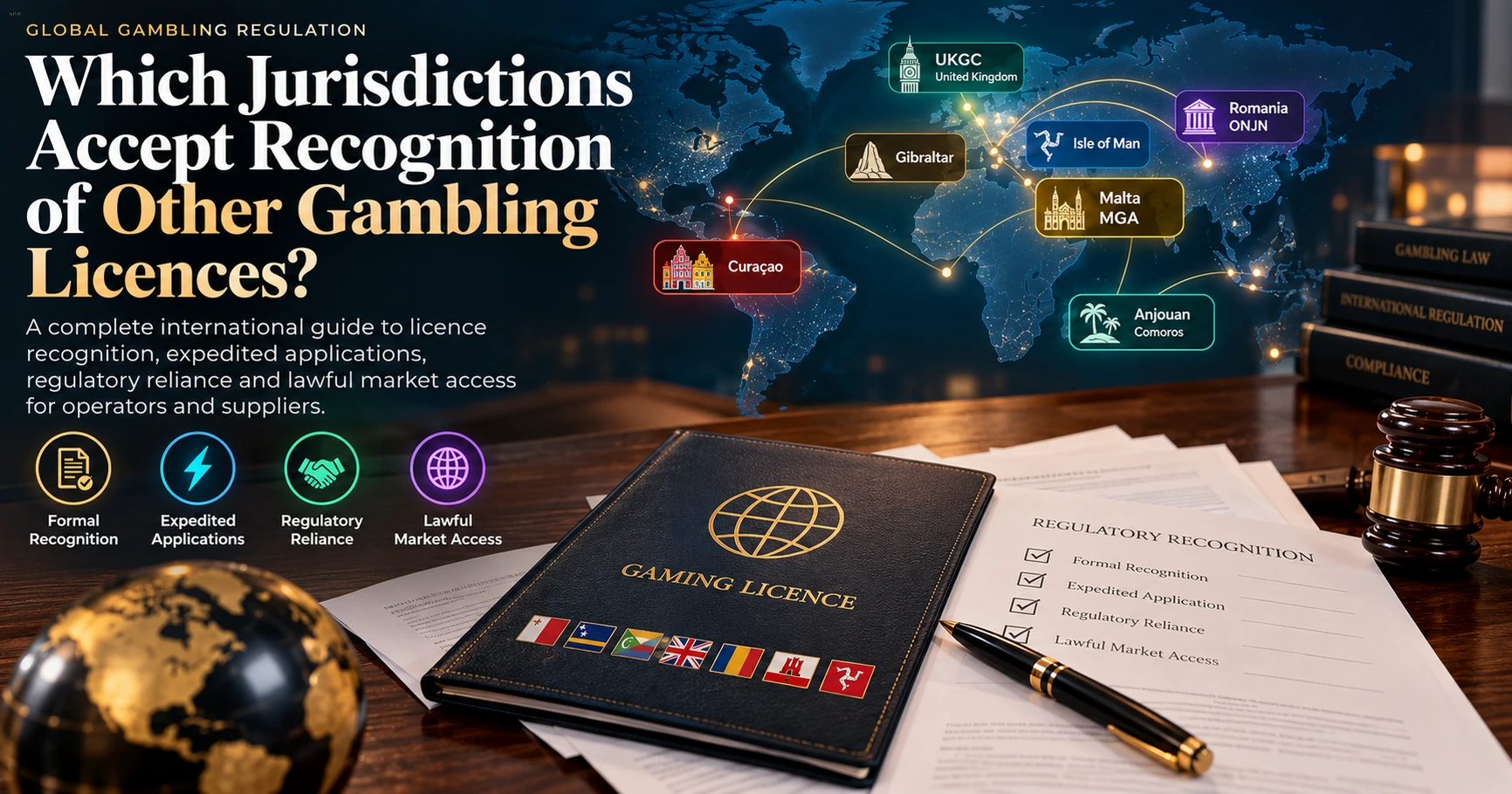
Quick answer: Malta and Anjouan are the two jurisdictions with identifiable mechanisms for recognizing certain foreign gambling authorizations. Malta operates a statutory Recognition Notice under its Gaming Authorisations Regulations; Anjouan issues a B2B Recognition Certificate to suppliers already licensed elsewhere. Other jurisdictions may rely on an existing license during an application, or exempt certain B2B activities, but that is not international license passporting.
For operators and software suppliers expanding internationally, the distinction saves unnecessary applications, prevents regulatory breaches and sharpens market-entry planning. But no gambling license provides worldwide market access, and a foreign license is not automatically valid wherever online gambling is offered — see where online gambling is legal in 2026.
This guide explains which jurisdictions recognize other gambling licenses, how recognition works, which original licenses may qualify, what it costs and what to verify before doing cross-border business.
What is foreign gambling license recognition?
Foreign license recognition is a regulatory mechanism through which one jurisdiction accepts a license issued by another gambling authority as satisfying specified local authorization requirements. It can matter to:
- B2C online casinos, sportsbooks and other operators;
- B2B game developers and platform providers;
- slot developers and live casino studios;
- game aggregators and technical infrastructure providers;
- other gambling service providers within a defined regulatory perimeter.
Four separate concepts are often confused:
| Mechanism | What it means | Does it replace a local license? |
|---|---|---|
| Formal recognition | The receiving regulator grants legal recognition to a foreign authorization | Potentially, within the approved scope |
| Regulatory reliance | The regulator takes foreign licensing history and compliance evidence into account | Usually no |
| Expedited licensing | A modified or simplified local licensing procedure | Usually no |
| B2B exemption | A specific supplier activity needs no separate local authorization | A license may not be needed for that activity |
Knowing which mechanism applies is the starting point for any international licensing strategy.
Which jurisdictions recognize foreign gambling licenses in 2026?
The clearest documented examples are Malta’s MGA Recognition Notice and Anjouan’s B2B Recognition Certificate.
| Jurisdiction | Relationship with foreign licenses | B2C / B2B | Key restriction |
|---|---|---|---|
| Malta | Formal Recognition Notice | Both | MGA eligibility and equivalence assessment |
| Anjouan | B2B Recognition Certificate | B2B | Scope of each certificate must be checked |
| Isle of Man | Unlicensed-supplier route via certified software | Mainly B2B | Not foreign-license passporting |
| Gibraltar | Prior approvals can support an application | Both | Gibraltar authorization still required |
| United Kingdom | Foreign regulatory record considered | Both | UKGC license required for regulated GB activity |
| Curaçao | No general foreign-license substitution | Both | Curaçao licensing rules still apply |
| Romania | No inbound license passport | Both | ONJN authorizations remain necessary |
| Kahnawake | Regulatory cooperation, not automatic passporting | Both | Local authorization requirements must be evaluated |
The table describes the nature of each jurisdiction’s relationship with foreign licenses. It does not imply that every B2B supplier needs a separate license everywhere. For costs, taxes and timelines side by side, compare gambling license jurisdictions.
1. Malta: formal recognition through the MGA
Malta has one of the clearest statutory recognition mechanisms in online gambling. Under the Gaming Authorisations Regulations (S.L. 583.05), the Malta Gaming Authority may recognize a gaming authorization issued by another EU or EEA member state, or by another state the MGA considers to offer safeguards largely equivalent to Maltese law. Recognition is granted as a Recognition Notice certificate.
What does an MGA Recognition Notice allow?
A Recognition Notice can give an existing foreign authorization the same regulatory effect as an MGA authorization for the approved gaming service or supply in or from Malta. It is relevant to both B2C operators and B2B suppliers. For example, a software provider already licensed in Romania may be able to seek a Recognition Notice instead of a full Malta license, provided its activities are eligible and the MGA accepts their comparability. This is a potential efficiency, not an automatic right. See Malta gambling license requirements for the full license route.
Malta Recognition Notice: costs and requirements
| Requirement | Details |
|---|---|
| Regulator | Malta Gaming Authority |
| Legal basis | Gaming Authorisations Regulations (S.L. 583.05) |
| Fee | €5,000, payable annually in advance |
| Validity | One year |
| Renewal | Annual maintenance review |
| Eligible licenses | EU/EEA, or another state accepted as offering equivalent safeguards |
| B2C / B2B | Both, within the approved scope (B2C applicants list the domains used) |
Applicants should be ready to supply the foreign license, a legal opinion on its scope (including whether it may be used outside the issuing state), details of the licensed activities, evidence of the originating regulator’s supervision and AML/CFT confirmations where applicable. The MGA may request more information or decline recognition.
Does a Recognition Notice allow gambling throughout Europe? No. It governs the effect of a foreign authorization under Maltese law only. It does not remove separate licensing obligations in Germany, Spain, the Netherlands, the United Kingdom or any other destination market.
In practice we have used this route alongside Romanian licensing — see the UK iGaming company and five-jurisdiction game studio case studies.
2. Anjouan: the B2B Recognition Certificate
Since July 2025, every B2B supplier working with an Anjouan-licensed operator must hold either a full Anjouan B2B license or a B2B Recognition Certificate (often called a recognition letter). The certificate lets a supplier already licensed and supervised elsewhere — platforms, game content, RNG and other services — supply Anjouan licensees without a full local license.
Suppliers licensed in Malta, the Isle of Man, Romania, Sweden, Gibraltar, the United Kingdom, Georgia and Kahnawake have obtained recognition. These are individual precedents: they show the route works, not that every license from those authorities qualifies automatically.
Why it matters to B2B suppliers: for game studios, aggregators and technology companies, the certificate is usually faster and cheaper than a second full license. Our Anjouan gambling license guide currently puts it at about €9,500 a year; confirm the fee against the regulator’s current offer before budgeting. Before relying on a certificate, confirm its legal effect, permitted activities, validity, reporting duties and how counterparties treat it. See the US iGaming company case study for a Romanian Class II license combined with Anjouan recognition.
Can Anjouan recognize a Curaçao license? Curaçao-licensed suppliers should confirm eligibility individually rather than assume a valid CGA license qualifies. Likewise, an Anjouan license does not authorize B2C gambling in Europe or other locally regulated markets.
3. Isle of Man: supplier routes, not recognition
The Isle of Man matters for cross-border compliance, but its software supply framework is not blanket recognition of foreign licenses. Under the Online Gambling Regulation Act regime, no license is required before supplying software to an Isle of Man operator; the operator must submit test-house certification to the Gambling Supervision Commission before deploying it.
A supplier can instead hold an optional Isle of Man software supplier license, with a £5,250 application fee and £36,750 a year. The distinction is commercially important: permission to supply certified software without a supplier license is not the same as recognizing an overseas gambling license, and for a game studio the cheapest compliant route may run through the operator’s certification rather than a new authorization. See our Isle of Man guide.
4. Gibraltar: reliance, not recognition
Gibraltar weighs applicants’ experience, governance and suitability, and its Gambling Act 2025 framework, in force since April 2026, revised how different gambling activities and services are licensed. An existing MGA, UKGC or Isle of Man license can be strong evidence of regulatory history and standards — but it does not replace an authorization Gibraltar law requires. Distinguish regulatory reliance on compliance records from a formal recognition process. See our Gibraltar guide.
5. United Kingdom: no recognition of foreign B2C licenses
Great Britain shows the difference between holding a reputable license and having lawful market access. Under the Gambling Act 2005, anyone providing remote gambling facilities to consumers in Great Britain generally needs a UK Gambling Commission license, even if the business is incorporated or licensed abroad. A Malta, Gibraltar, Curaçao, Isle of Man or Anjouan license cannot replace a UKGC operating license. Foreign licenses and regulatory history may help during the application, but there is no passport.
6. Curaçao: no general substitution
Curaçao remains a major licensing jurisdiction, but a foreign license does not substitute for the authorizations required under the National Ordinance on Games of Chance (LOK). Whether an entity needs a Curaçao authorization depends on its activities, establishment and license category. Establish first whether you need a B2C license, a B2B license or another authorization, and whether foreign regulatory history gives any procedural advantage — and assess the license separately from the law of each player market. See our Curaçao LOK guide.
7. Romania: can an ONJN license be recognized abroad?
Romania licenses operators under Class I and gaming-related service providers under Class II. There is no inbound passport: ONJN authorizations remain necessary for activity in Romania. Outbound, Romanian licenses are useful:
- Romania’s EU membership makes Romanian licensees candidates for Malta’s Recognition Notice, subject to activity comparability and MGA approval.
- Romanian-licensed suppliers have obtained Anjouan recognition.
A Romanian ONJN license does not authorize gambling services in the United Kingdom, the Netherlands, Germany or other regulated countries. For a supplier, a Romanian B2B gambling license — €45,500 in year one and €35,000 a year after — is often the most cost-effective EU-regulated base from which to pursue Malta and Anjouan recognition.
Can a Malta, Curaçao, Anjouan or UK license be used worldwide?
No. A license authorizes defined activities under the laws of its issuing regulator. International operations raise several distinct questions:
- Where is the operator incorporated and managed?
- Where are the players physically located?
- Which entity contracts with the players?
- Where are the servers and essential technical systems?
- Which products or services are supplied?
- Does the receiving market require a separate B2C, B2B or technical authorization?
- Are advertising, payment and consumer-protection requirements met?
A Malta-licensed casino holds a valid Maltese authorization, but that alone cannot permit it to accept British players without a UKGC license. Remote gambling must be tested market by market, not inferred from the existence of an offshore license.
Which existing licenses offer the best recognition opportunities?
| Existing license | Possible recognition opportunity | Key limitation |
|---|---|---|
| Malta MGA | Anjouan Recognition Certificate | No automatic market access elsewhere |
| Romania ONJN | Malta Recognition Notice; Anjouan certificate | Scope and category must be verified |
| UKGC | Anjouan certificate | MGA treatment of UK authorizations is discretionary |
| Gibraltar | Anjouan certificate | Separate local licensing elsewhere |
| Isle of Man | Anjouan certificate | Supplier rules differ by activity |
| Curaçao | Individual assessment | No general recognition entitlement |
| Anjouan | Individual assessment | No general foreign passport |
| Other EU/EEA licenses | Malta Recognition Notice | MGA equivalence and scope approval |
For B2B suppliers, the best solution depends on the activities and the receiving jurisdiction’s rules — not on which license is cheapest or fastest.
How much does recognition cost?
Recognition costs differ sharply from full license costs. An MGA Recognition Notice is €5,000 a year — not to be confused with the fees for a full MGA license. The Anjouan certificate is about €9,500 a year on our current figures, to be confirmed with the regulator. Jurisdictions without a recognition procedure have no recognition fee at all.
A reliable comparative budget should include:
- regulatory application and recurring fees;
- legal analysis of license equivalence;
- corporate and beneficial-owner due diligence;
- game or system testing and technical certification;
- local representation or substance requirements;
- compliance, reporting and audit obligations;
- banking and payment onboarding.
Recognition reduces duplicated licensing work; it does not remove other legal or operational obligations.
How to apply for foreign license recognition
Step 1 — Verify the original license. Confirm it is valid and covers the products and activities you intend to perform: licensee name, category, registration details, authorized domains and restrictions.
Step 2 — Identify the receiving jurisdiction’s mechanism. Formal recognition, an exemption, a new application, or no relevant route for that activity?
Step 3 — Assess regulatory equivalence. Compare ownership suitability, AML/CFT controls, responsible gambling, supervision, technical controls and reporting.
Step 4 — Prepare the file. License certificates, corporate documents, ownership records, regulatory history, technical specifications, product descriptions and compliance statements.
Step 5 — File and obtain written confirmation. Complete the formal process and obtain the notice, certificate or approval. Do not rely on an intermediary’s claim that recognition is available.
Step 6 — Maintain compliance. Track renewals, changes to the original license, reporting obligations and changes in the legal status of target markets. Recognition can be conditional, limited in scope, time-limited or withdrawn.
Common mistakes in international license recognition
- Assuming an EU license works across the EU. There is no EU-wide gambling passport.
- Treating an offshore license as permission to accept players everywhere. Local gambling laws still apply.
- Confusing B2B licensing with B2C market access. Supplier approval does not authorize consumer gambling.
- Assuming regulatory cooperation means mutual recognition. Information-sharing agreements do not remove licensing requirements.
- Relying on an outdated fee schedule or register. Fees, categories and authorized activities change.
- Ignoring banking and payments. Regulatory approval does not guarantee banking, acquiring or payment processing.
Cross-border licensing works best when licensing strategy, corporate structure, tax, technical compliance and payments are planned together.
Choosing the right cross-border license strategy
Recognition can create real efficiencies, especially for international B2B suppliers and operators widening their regulatory footprint. Malta offers a defined statutory procedure; Anjouan’s certificate gives licensed suppliers a practical route to its operators. Elsewhere, the efficient route may be regulatory reliance, a supplier exemption or a well-prepared domestic application.
The right strategy answers three questions: what activities are performed, where they are performed, and which jurisdictions regulate them.
Expert advice on international license recognition
Szilaghi Consulting advises operators, game studios, software suppliers and international gaming businesses on licensing, compliance and cross-border structures. We review existing licenses, identify recognition pathways, assess market-entry requirements and coordinate the applications. Explore our gambling licensing services and strategy and legal advisory, or contact Szilaghi Consulting to discuss your licensing strategy.
Regulatory note: general information based on public regulatory material reviewed on 17 October 2026. Eligibility, conditions, fees and market-access rules change; this is not a legal opinion for a specific operator, product or jurisdiction.